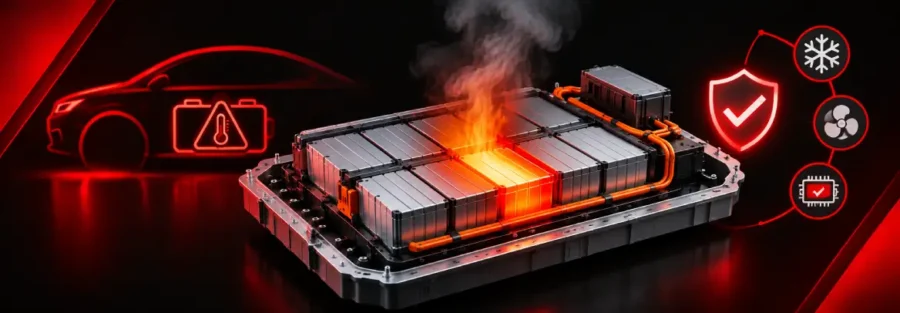
Thermal runaway is a condition in which a battery cell experiences an uncontrolled rise in temperature due to internal heat generation. In electric vehicle (EV) batteries, this process can trigger a chain reaction that causes neighbouring cells to overheat.
If not controlled, thermal runaway can lead to smoke, fire, gas release and damage to the entire battery pack. Understanding its causes and prevention methods is important when designing safe and reliable EV battery systems.
What Happens During Thermal Runaway?
Lithium-ion batteries generate heat during normal charging and discharging. Under abnormal conditions, such as internal short circuits or excessive temperatures, heat generation can exceed the battery’s ability to dissipate it.
As the temperature increases, internal chemical reactions can accelerate and generate additional heat. This creates a self-reinforcing process that may become difficult to stop.
Thermal runaway can involve several stages:
- Initial heating: A cell experiences abnormal heat generation due to an electrical, mechanical or thermal issue.
- Internal reactions: Elevated temperatures can trigger chemical reactions inside the cell, increasing heat generation.
- Gas generation and venting: Pressure builds inside the cell, potentially causing it to release hot gases.
- Cell failure: The cell may experience fire or other severe damage.
- Propagation: Heat from the affected cell can spread to neighbouring cells and potentially trigger further failures.
The exact sequence and temperatures depend on cell chemistry, design and operating conditions.
Common Causes of Thermal Runaway in EV Batteries
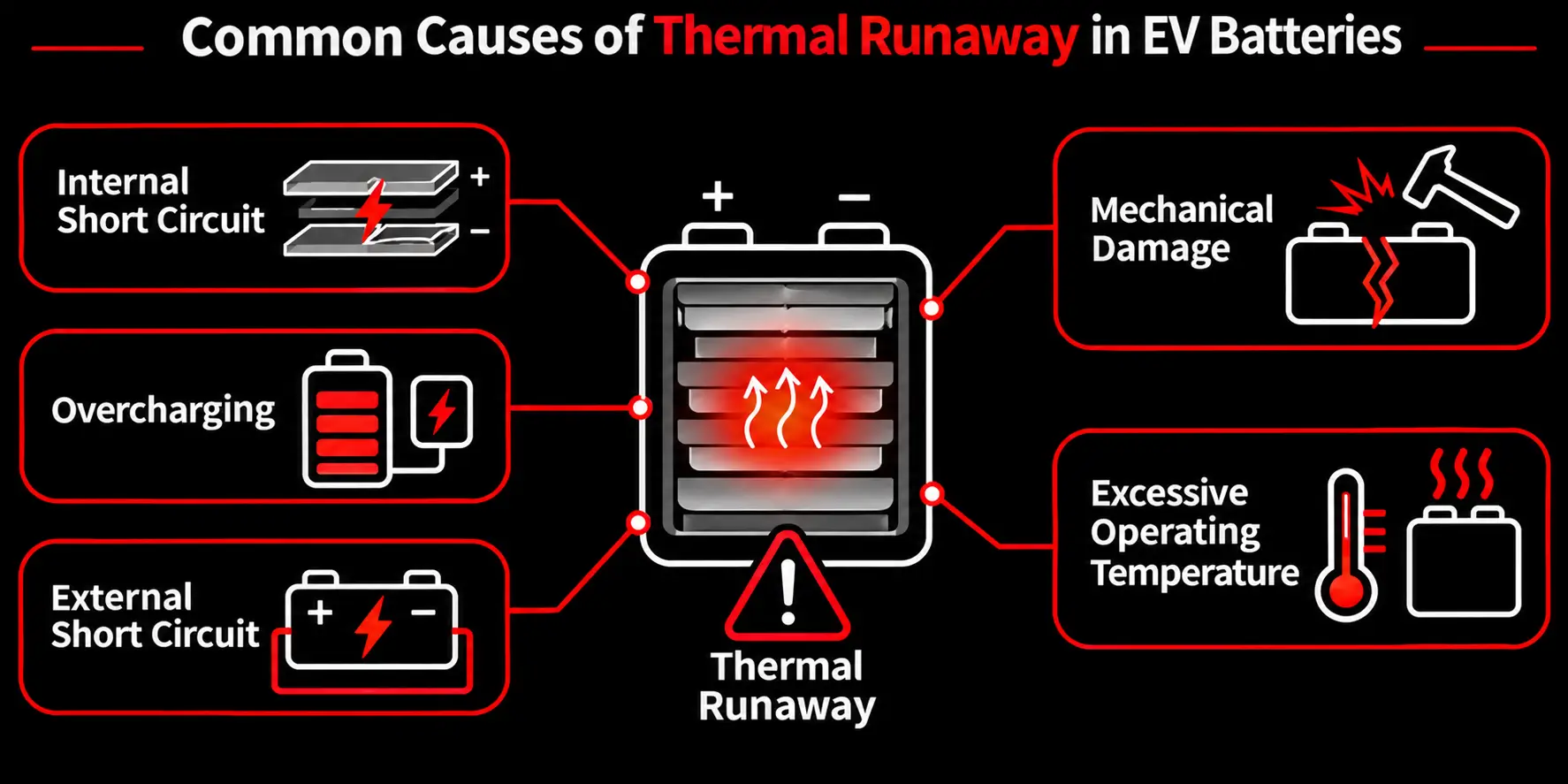
Thermal runaway can result from different electrical, mechanical and thermal problems.
1. Internal Short Circuit
An internal short circuit occurs when the positive and negative electrodes come into unintended electrical contact.
It can result from manufacturing defects, separator damage, contamination or mechanical damage. The resulting current can generate significant heat inside the cell.
2. Overcharging
Charging a battery beyond its specified voltage limits can cause unwanted chemical reactions and increase internal heat generation.
Overcharging may also contribute to lithium plating and internal cell damage, depending on the battery chemistry and operating conditions.
3. External Short Circuit
An external short circuit occurs when an unintended low-resistance path connects the battery terminals.
This can produce excessive current and rapid heating. Proper electrical protection is therefore essential at cell, module and pack levels.
4. Mechanical Damage
Vehicle collisions, underbody impacts, crushing or deformation can damage battery cells and their internal components.
A damaged separator or electrode structure may create an internal short circuit, increasing the risk of thermal runaway.
5. Excessive Operating Temperature
High ambient temperatures, inadequate cooling or heavy operating loads can increase battery temperature.
If the cooling system cannot remove sufficient heat, the battery may operate outside its intended temperature range, increasing the risk of degradation and thermal failure.
How Can Thermal Runaway Be Prevented?
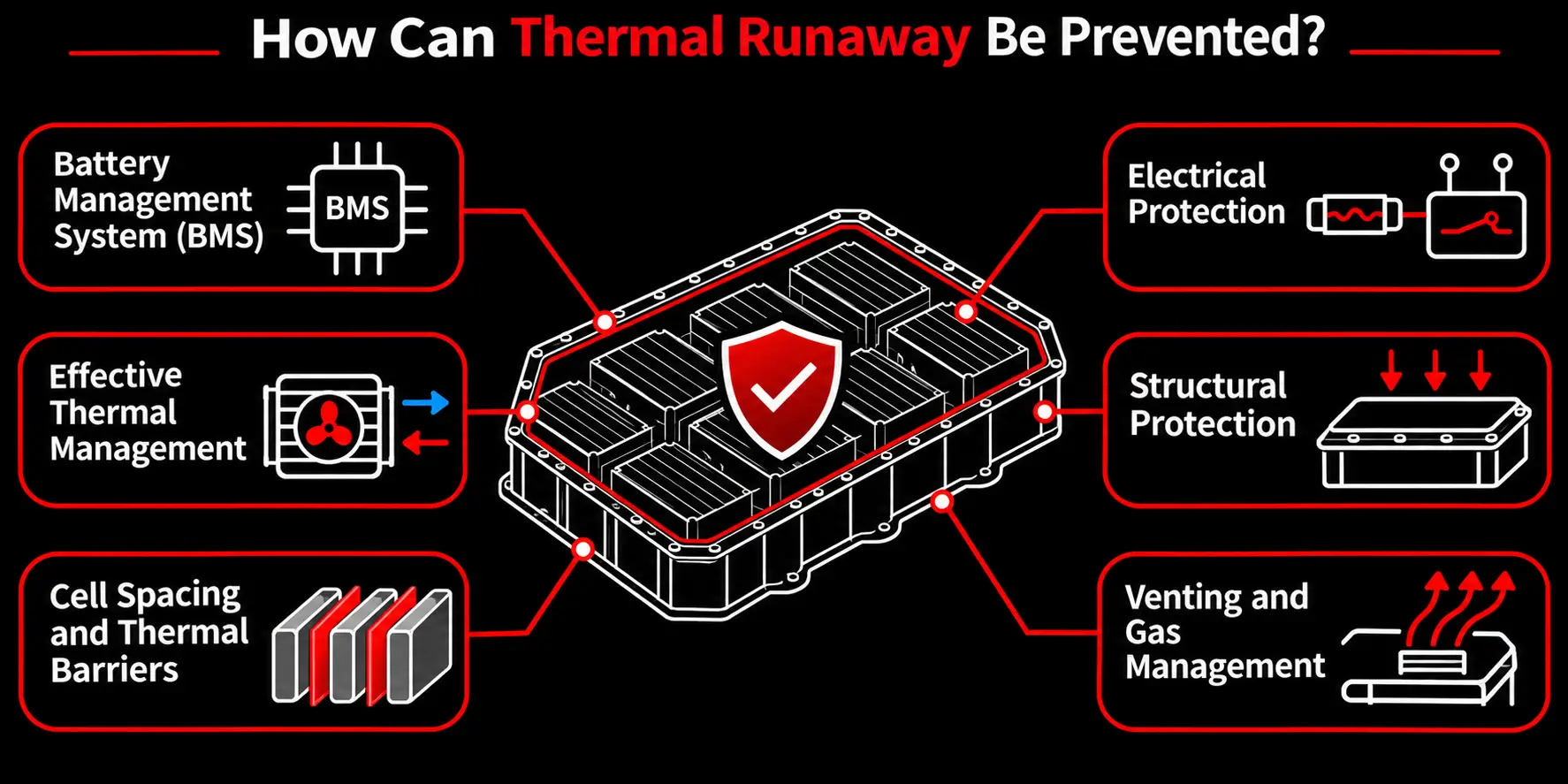
Thermal runaway prevention requires protection at multiple levels. Cell design, battery management, thermal management and pack structure must work together.
1. Battery Management System (BMS)
A Battery Management System monitors important battery parameters, including:
- Cell and pack voltage.
- Current during charging and discharging.
- Battery temperature.
- State of charge (SOC).
- Cell voltage differences.
When abnormal conditions are detected, the BMS can limit charging or discharging, issue warnings or disconnect the battery through the protection system.
A BMS helps prevent unsafe operating conditions, although it cannot detect or stop every internal cell failure.
2. Effective Thermal Management
The battery cooling system helps maintain cells within their specified operating temperature range.
Depending on the battery design, cooling may use air, liquid or other thermal management methods.
Engineers must consider coolant distribution, heat transfer, temperature uniformity and cooling performance under different operating conditions.
3. Cell Spacing and Thermal Barriers
Battery pack layout influences how heat travels between neighbouring cells.
Appropriate cell spacing, thermal insulation and fire-resistant barriers can help reduce heat transfer and delay thermal runaway propagation.
The effectiveness of these measures depends on the cell design, materials and pack configuration.
4. Electrical Protection
Fuses, contactors and other protection devices help isolate the battery during electrical faults.
The protection system must be designed around expected fault currents, voltage levels and operating conditions.
5. Structural Protection
The battery enclosure and mounting structure should protect cells from mechanical damage during vehicle operation and defined impact conditions.
Structural analysis helps engineers evaluate enclosure deformation, mounting loads and potential intrusion into the battery pack.
6. Venting and Gas Management
Battery cells may release hot gases during thermal failure. Battery pack design must consider how these gases are managed and directed.
Venting arrangements should reduce the risk of pressure build-up and prevent hot gases from creating additional hazards for nearby cells and vehicle occupants.
Role of Simulation in EV Battery Thermal Safety
Simulation helps engineers evaluate battery thermal behaviour and identify potential design weaknesses before physical testing.
Different engineering methods can be used depending on the analysis requirements.
- Thermal analysis: Evaluates temperature distribution across battery cells, modules and pack components.
- CFD simulation: Studies coolant flow, heat transfer and airflow within the battery system.
- Thermal runaway propagation analysis: Evaluates how heat from a failing cell may affect neighbouring cells
- Structural FEA: Assesses enclosure strength, deformation and mounting performance under defined mechanical loads.
- Thermal-structural analysis: Evaluates the effects of temperature changes and thermal expansion on structural components.
Simulation results can support cooling system development, pack layout decisions, thermal barrier selection and structural improvements. Physical testing is still necessary to validate battery safety and propagation performance.
How Caliber Technologies Supports EV Battery Engineering
Caliber Technologies provides engineering simulation support for EV battery systems and related components.
Our engineering capabilities can support projects involving:
- Battery thermal analysis.
- Cooling system and coolant flow evaluation.
- Battery enclosure structural analysis.
- Battery mounting bracket analysis.
- Thermal-structural evaluation.
- Design assessment based on defined operating and loading conditions.
The analysis scope depends on the battery architecture, available design data and project requirements.
Planning an EV battery thermal or structural analysis project?
Contact Caliber Technologies at operations@thecalibertech.com to discuss your requirements.