Robotics Engineering Services
Robotic hardware has to perform under real loads, repeated motion, changing positions and demanding operating conditions. The mechanical design therefore needs to be considered beyond the CAD model. Structural stiffness, weight, joints, actuators, load paths, vibration, fatigue and manufacturability can all influence the final performance of a robotic system.
Caliber Technologies provides robotics engineering services for companies developing robotic hardware, robotic arms, mechanisms and physical robotics products. Our engineering capabilities span mechanical design, CAD, CAE, FEA, simulation, design optimization and product development.
Whether you are developing a new robotic platform, refining an existing design, investigating a structural problem or preparing hardware for prototyping, we provide engineering support around the requirements of your project.
Robotics Engineering Services for Hardware Development
A robotics project rarely has a single engineering problem.
A robotic arm may need to carry a higher payload without increasing structural mass. A mechanism may need greater stiffness without changing its overall envelope. A bracket may need to withstand repeated loading. A new product may need to move from concept to detailed CAD and engineering validation.
These requirements are connected.
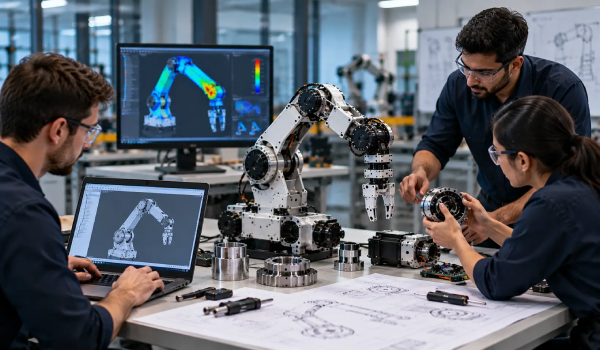
Our robotics engineering services bring mechanical design and engineering analysis together so that design decisions can be evaluated against actual operating requirements.
Our capabilities include:
- Robotics hardware design
- Robotics mechanical design
- Robotics CAD design
- Robotics CAE and FEA
- Robotics simulation
- Robotic arm design
- Robotics product development
- Structural analysis
- Design optimization
- Engineering validation
The scope can begin with a new concept or an existing CAD assembly and can be tailored to the stage of development your project has reached.
Our Robotics Engineering Capabilities
Robotics Hardware Design Services
Developing robotic hardware requires careful attention to the relationship between components, loads, interfaces and movement.
Our Robotics Hardware Design Services support the mechanical development of robotic structures and subsystems, including components that need to accommodate actuators, bearings, joints, tooling, sensors and other hardware.
We can support the development of:
- Robotic structural components
- Joint housings
- Actuator mounts
- Robot links
- Mechanical interfaces
- End-effector structures
- Mounting brackets
- Frames and support structures
- Custom robotic mechanisms
- Mechanical assemblies
The design can be developed around your existing requirements, concept, prototype or CAD data.
Robotics Mechanical Design Services
Mechanical design determines how a robotic system carries loads, transfers forces and maintains the required movement and stiffness.
Our Robotics Mechanical Design Services cover the development and refinement of mechanical components, assemblies and mechanisms used in robotic systems.
Engineering considerations can include:
- Component geometry
- Joint configuration
- Structural stiffness
- Load paths
- Material selection
- Actuator interfaces
- Bearing and shaft arrangements
- Mechanical packaging
- Assembly requirements
- Manufacturing considerations
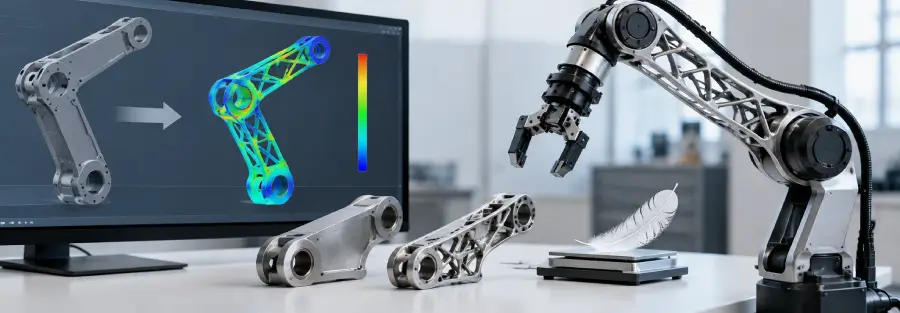
For an existing robotic design, we can also work on mechanical improvements where the objective is to reduce weight, improve stiffness, address stress concentrations or resolve other structural limitations.
Robotics CAD Design Services
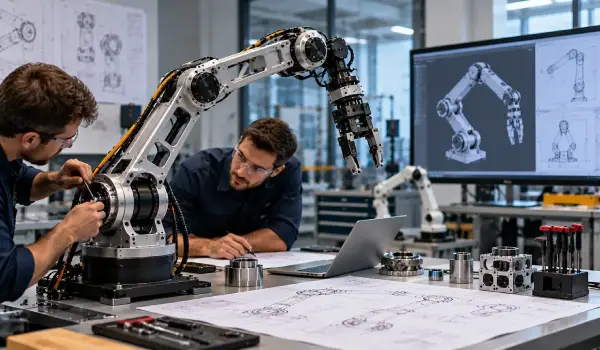
Detailed CAD is the foundation for developing, reviewing and manufacturing robotic hardware.
Our Robotics CAD Design Services support the creation and refinement of 3D components and assemblies for robotics applications. We can work from concepts, sketches, specifications, reference models or existing engineering designs.
Typical deliverables include:
- 3D part models
- Robotic assemblies
- Mechanism assemblies
- Detailed components
- Engineering drawings
- Assembly layouts
- Design modifications
- Manufacturing documentation
- CAD models prepared for analysis
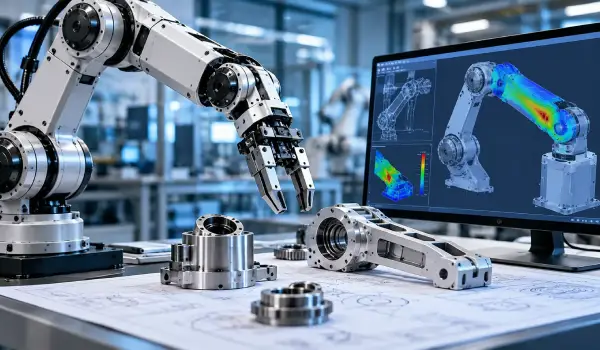
Where engineering analysis is required, CAD development can be connected directly with CAE and FEA so that simulation results can be incorporated into subsequent design revisions.
Robotics CAE & FEA Services
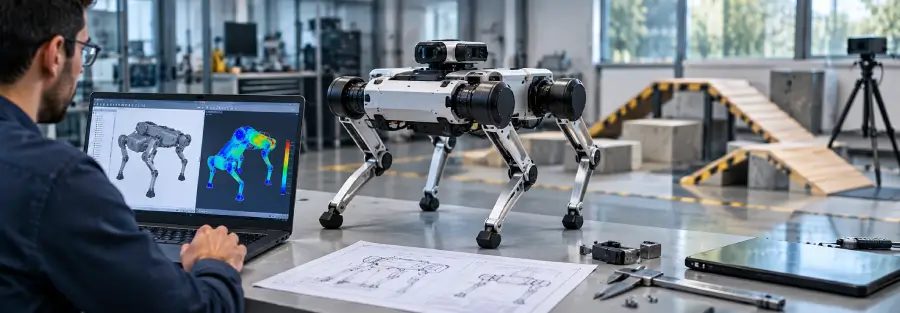
Structural performance becomes particularly important when robotic hardware is exposed to high payloads, repeated motion, acceleration or extended reach.
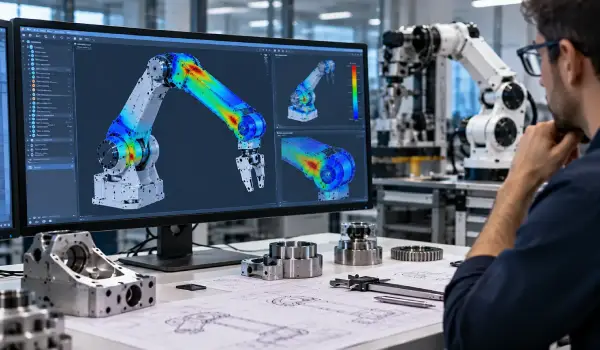
Our Robotics CAE & FEA Services help evaluate mechanical designs under defined operating conditions before expensive hardware iterations.
Analysis can include:
- Static structural analysis
- Stress analysis
- Deformation analysis
- Strain analysis
- Stiffness assessment
- Load-path evaluation
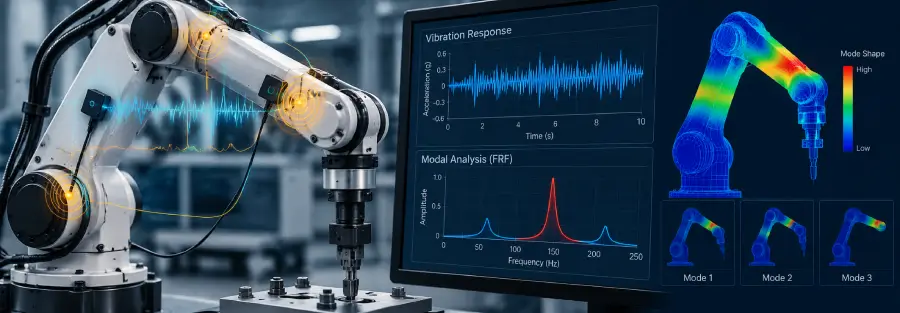
- Modal analysis
- Fatigue analysis
- Contact analysis
- Structural optimization
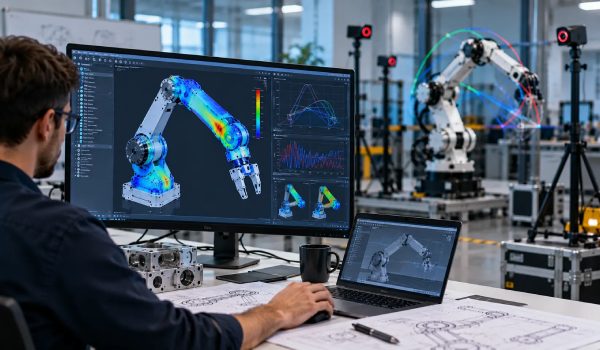
For robotic arms, analysis may consider payload, reach, gravity, tooling mass, acceleration, deceleration and other relevant loading conditions.
The purpose of FEA is not simply to produce simulation results. It is to understand how the design behaves and use that information to make engineering decisions.
Robotics Simulation Services
Simulation can help identify mechanical problems while the design is still being developed.
Our Robotics Simulation Services can be used to investigate structural and mechanical behavior under defined operating conditions and to compare alternative design concepts.
Depending on the application, simulation can help answer questions such as:
- Where are the critical stress regions?
- How much will the structure deform under load?
- Which components are contributing most to overall flexibility?
- Can structural mass be reduced?
- How will a design change affect stiffness?
- Are there potential modal or vibration concerns?
- Which design provides the required mechanical performance?
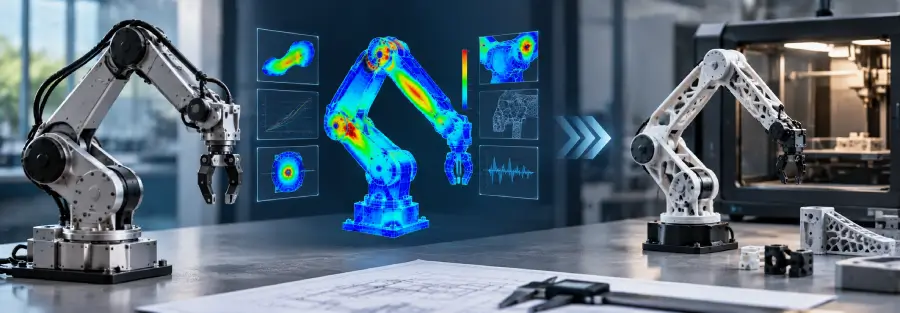
The results can then be used to guide CAD modifications and further engineering analysis.
Robotic Arm Design Services
Robotic arms combine several demanding mechanical requirements. The structure must carry payload while maintaining sufficient stiffness, controlling mass and withstanding repeated movement.
Our Robotic Arm Design Services support the mechanical development and analysis of robotic arms and their structural components.
Engineering activities may include:
- Arm architecture
- Link design
- Joint configuration
- Actuator interfaces
- Bearing arrangements
- Structural analysis
- Payload assessment
- Reach considerations
- Stiffness evaluation
- Deflection analysis
- Modal analysis
- Fatigue assessment
- Design optimization
A robotic arm is not evaluated only by whether it can carry a specified load. Structural mass, deformation, stiffness and dynamic behavior can also affect actuator requirements and overall system performance.
Caliber Technologies’ existing robotics engineering work includes robotic-arm FEA, deflection and fatigue analysis, dynamic loading and design optimization.
Robotics Product Development Services
A robotics product needs to progress from an engineering concept into hardware that can be manufactured, assembled and validated.
Our Robotics Product Development Services can support different stages of this process, depending on the maturity of your project.
We can contribute to:
- Concept development
- Mechanical architecture
- Detailed mechanical design
- CAD development
- Structural analysis
- FEA
- Simulation
- Design optimization
- Prototype preparation
- Design refinement
- Engineering documentation
- Design validation
This makes the service suitable for new robotic products as well as existing designs that require further engineering development.
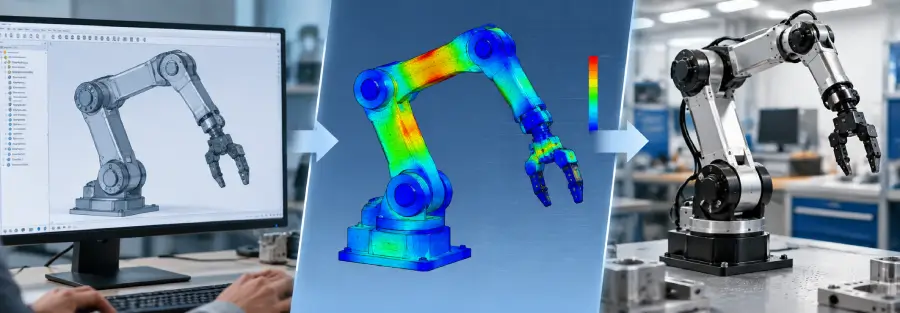
From Robotics Concept to Engineering Validation
Robotics engineering is most effective when design and analysis are treated as one continuous process.
01. Understand the Requirements
We first establish what the hardware needs to achieve.
Depending on the project, this may include payload, reach, speed, acceleration, duty cycle, operating environment, stiffness, allowable deformation, fatigue life and manufacturing requirements.
02. Develop the Mechanical Design
The mechanical architecture, components, mechanisms and interfaces are developed around those requirements.
03. Build the Engineering CAD
The design is translated into detailed components and assemblies suitable for engineering review, analysis and further development.
04. Analyze the Design
Relevant load cases and operating conditions are evaluated using engineering analysis, CAE, FEA and simulation.
05. Refine the Hardware
Analysis results can identify areas requiring changes to geometry, material, stiffness, weight, interfaces or structural configuration.
06. Validate the Design
The final design can be assessed against the defined engineering requirements before moving to the next stage of hardware development.
This process allows problems to be addressed while the design is still flexible rather than after the hardware has already been manufactured.
Engineering Problems We Help Solve
Robotics companies typically approach an engineering partner because they have a specific development requirement or a problem that needs to be investigated.
Our robotics engineering capabilities can support projects involving:
Excessive Structural Deflection
A robotic arm or mechanism may meet its strength requirement but still deform more than the application allows. Structural analysis can identify where stiffness needs to be improved.
High Structural Mass
Reducing the mass of robotic links and supporting structures can affect actuator loading and dynamic performance. FEA and optimization can help identify opportunities for more efficient designs.
Stress Concentrations
Corners, interfaces, mounting points and changes in geometry can create localized stress concentrations. Analysis can help identify critical areas requiring design changes.
Vibration and Modal Concerns
High-speed robotic systems may require evaluation of natural frequencies and mode shapes to understand potential vibration problems.
Fatigue Under Repeated Motion
Robotic components can experience repeated loading over a large number of operating cycles. Fatigue assessment can help identify areas requiring additional attention.
Existing Design Validation
An existing CAD design can be evaluated against specified loads and performance requirements before the company commits to another prototype or production iteration.
Engineering Support for Robotics Teams
You do not necessarily need to build a large internal engineering team to access specialist robotics design and analysis capabilities.
External robotics engineering support can be useful when your team needs:
- Additional mechanical design capacity
- Specialist FEA support
- Robotic-arm structural analysis
- CAD development
- Design optimization
- Independent engineering review
- Support before prototyping
- Engineering assistance during product development
- Analysis of an existing robotic design
- Support for a new robotic mechanism
The engagement can be structured around a specific component, subsystem or development stage rather than requiring the entire project to be outsourced.
Why Caliber Technologies for Robotics Engineering?
Robotics hardware sits at the intersection of mechanical design and engineering analysis.
A CAD model needs to represent the required geometry. The structure needs to carry the expected loads. The design needs sufficient stiffness. Components need to work together through their interfaces. And where the hardware will experience repeated motion, durability and dynamic behavior need to be considered.
Caliber Technologies brings these activities together across CAD, mechanical design, CAE, FEA, simulation, optimization and product development.
Our robotics engineering work includes CAD-to-FEA workflows, robotic-arm structural analysis, fatigue and deflection assessment, vibration-related analysis, design optimization and hardware validation.
This allows engineering analysis to remain connected to the design rather than becoming a separate activity performed after the hardware has already been finalized.
Robotics Engineering Deliverables
Depending on the project requirements, the engineering scope can produce deliverables such as:
- 3D CAD models
- Detailed robotic assemblies
- Engineering drawings
- Mechanical design revisions
- FEA models
- Structural analysis results
- Stress and deformation assessment
- Modal analysis
- Fatigue assessment
- Design optimization studies
- Engineering documentation
- Design validation results
The deliverables are defined around the engineering requirements and development stage of the project.
Have a Robotics Engineering Project?
Whether you are developing a robotic arm, designing custom robotic hardware, improving an existing mechanism or preparing a new robotics product for prototyping, the engineering decisions made during design can have a direct impact on structural performance, development cost and manufacturing.
Caliber Technologies can support the mechanical engineering work behind your robotics product, from CAD and mechanical design through CAE, FEA, simulation, optimization and validation.
Tell us what you are developing, what stage the project has reached and what engineering challenge you need to solve.
Frequently Asked Questions
What are robotics engineering services?
Robotics engineering services cover the mechanical design, development and analysis required to develop physical robotic systems and components. This can include hardware design, mechanical design, CAD, CAE, FEA, simulation, robotic arm design and robotics product development.
What types of robotic hardware can you design?
We can support mechanical development for robotic arms, links, joints, structural components, mechanisms, mounts, end-effector structures and other custom robotic hardware. The engineering scope depends on the requirements of the application.
Can you work with an existing robotics CAD model?
Yes. An existing CAD assembly can be reviewed and developed further, prepared for FEA, redesigned or optimized depending on the engineering requirement. This can be useful when a company already has a design but needs additional engineering analysis before prototyping.
What does FEA provide for a robotic design?
FEA can provide information about stress, deformation, strain, stiffness, load paths and, where appropriate, modal and fatigue behavior. The analysis should be based on realistic operating conditions and defined engineering requirements.
Can you help reduce the weight of a robotic arm?
Yes. Structural analysis and design optimization can be used to identify areas where material can potentially be removed or redistributed while maintaining required strength and stiffness. Weight reduction needs to be considered alongside actuator loads, deformation, dynamic behavior and manufacturing requirements.
Do you provide complete robotics product development?
We can support multiple stages of physical robotics product development, including mechanical architecture, CAD, structural analysis, simulation, optimization and design validation. The scope can be tailored around the development stage and capabilities of your internal team.
Can you support robotics startups and established engineering teams?
Yes. External engineering support can be structured for startups developing their first robotic product as well as established companies requiring additional CAD, mechanical engineering, CAE or FEA capacity for a specific project.
What information do you need to start a robotics engineering project?
Useful starting information includes the current CAD or concept, project requirements, payload, operating loads, dimensions, materials, expected motion, mounting conditions and manufacturing requirements. If some information is not available, the engineering requirements can be established as part of the initial project discussion.
How We Provide Services
Project Scope Based Services
Time Based Projects
On-site Resource Assignment
Strategic Consulting Services
We are very glad to get client review.
Have a question? Send us a message, and we’ll respond shortly.
Tackle your toughest technical challenges in automotive engineering and reach your product development goals by leveraging the expertise of our trusted engineers.