
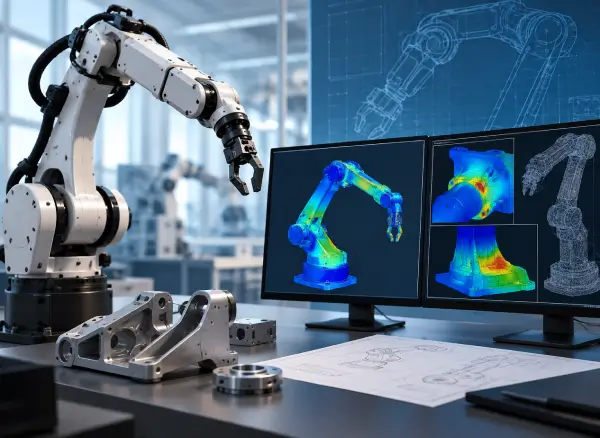
Robotics CAE & FEA Services
Robotic structures are subjected to changing loads as they move, accelerate, stop and carry different payloads. A design that appears adequate in CAD may still experience excessive stress, deformation, vibration or fatigue under its actual operating conditions.
Caliber Technologies provides robotics CAE and FEA services to evaluate the structural behavior of robotic hardware before physical testing or manufacturing. We analyze components, mechanisms and robotic arms against defined load cases and use the results to identify design changes where required.
FEA for Robotics Starts With the Right Engineering Question
Finite element analysis is only useful when the model represents the engineering problem that needs to be solved.
For a robotic arm, that may mean understanding deformation at maximum reach and payload. For a joint housing, it may mean checking stress around a bearing interface. For a structural bracket, the concern may be fatigue under repeated loading rather than a single static load.
Our FEA for robotics work is therefore built around the design and its operating conditions.
Depending on the project, we can investigate:
- Stress and strain
- Structural deformation
- Stiffness
- Load paths
- Safety margins
- Modal behavior
- Fatigue
- Contact behavior
- Critical interfaces
- Structural weight reduction
The analysis is then used to answer the engineering question and guide the next design decision.
Robotics FEA Services for Mechanical Hardware
Robotic hardware can experience loads that vary significantly depending on its position and operating condition.
A component may see relatively low loading near one position and substantially higher bending or torsional loading at another. Payload, tooling mass, gravity, acceleration and external forces can all contribute to the final load case.
Our robotics FEA services can be applied to:
- Robot links
- Joint housings
- Actuator mounts
- Structural brackets
- Frames
- End-effector structures
- Shafts and supports
- Mechanical housings
- Robotic mechanisms
- Custom structural components
The analysis can be performed on a new design or an existing CAD model that needs engineering validation.
Robotic Arm FEA
Robotic arms are particularly sensitive to the relationship between payload, reach, mass and stiffness.
As the arm extends, the moment generated by the payload can increase significantly. Structural deformation at the end effector can then affect positioning and overall system behavior.
Our robotic arm FEA work can examine components and assemblies under representative loading conditions, including:
Static Structural Analysis
Evaluate stress and deformation under defined payload, gravity and external loading conditions.
Deflection Analysis
Determine how much a link, joint or arm structure moves under load and whether the deformation remains within the required limit.
Stiffness Evaluation
Identify areas where the structure may be too flexible and determine which components contribute most to the overall deformation.
Modal Analysis
Study natural frequencies and mode shapes where vibration or dynamic behavior is an engineering concern.
Fatigue Analysis
Evaluate the effect of repeated loading where components are expected to operate through a significant number of cycles.
Design Comparison
Compare an existing design with a revised geometry or alternative material to understand the effect of the change.
The analysis scope depends on the operating requirements of the robotic arm.
Robot Structural Analysis
Robot structural analysis is not limited to finding the highest stress in a component.
For robotics applications, it can be equally important to understand where the load is going, how much the structure moves and which component is controlling the system’s stiffness.
For example, a robotic arm may show acceptable stress levels but excessive end-effector displacement. Increasing material everywhere may solve the deflection problem, but it may also add unnecessary mass.
A more useful analysis may identify:
- The section contributing most to deformation
- The critical load path
- Areas with low structural efficiency
- Interfaces creating local stress concentrations
- Components that can be reinforced selectively
- Areas where material can potentially be removed
This type of analysis provides a stronger basis for mechanical design changes.
Structural Analysis of Robotic Joints
Robotic joints transfer forces between connected components while accommodating movement.
Their structural behavior can be affected by bearing supports, shafts, actuator interfaces, fasteners and the surrounding housing.
FEA can be used to investigate areas such as:
- Joint housing stress
- Bearing support deformation
- Shaft loading
- Actuator mounting loads
- Fastener regions
- Local stress concentrations
- Housing stiffness
- Joint deflection
This can be particularly useful when a joint has to carry significant loads within a limited physical envelope.
Where the analysis identifies a problem, the results can be taken back into the mechanical CAD model and used to develop a revised design.
Stress and Deformation Analysis
Stress results alone do not tell the complete story for robotic hardware.
A structure can remain below the material’s allowable stress and still deform enough to affect the robot’s performance.
For this reason, we evaluate stress alongside deformation and structural stiffness where those factors are relevant to the application.
The analysis can help determine:
- Where peak stress occurs
- How the load travels through the structure
- Which regions experience significant deformation
- Whether an interface is contributing to flexibility
- Whether geometry changes could improve stiffness
- Whether material is being used efficiently
This is particularly important for robotic arms, positioning mechanisms and tooling where mechanical accuracy can be affected by structural movement.
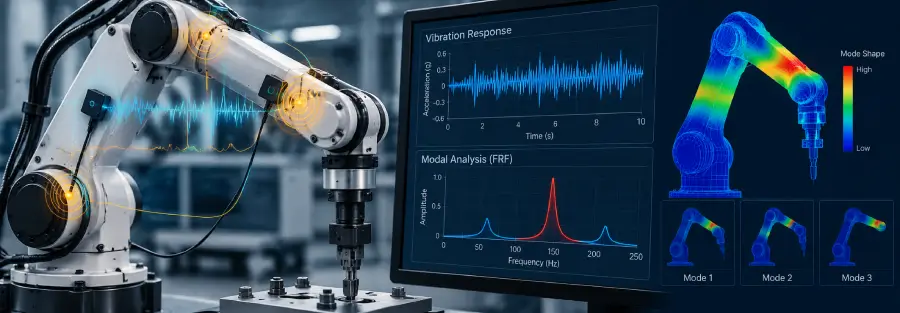
Modal and Vibration Analysis
High-speed robotic equipment can encounter vibration-related problems that are not apparent from a static structural analysis.
Modal analysis can be used to identify natural frequencies and associated mode shapes of a structure.
This can help engineering teams investigate whether:
- A structural mode is within a relevant operating range
- A component is insufficiently stiff
- A design change has shifted the natural frequency
- A lightweighting change has altered dynamic behavior
- Additional structural stiffness may be required
Modal analysis is therefore useful when the robotic system operates at higher speeds or when vibration has been observed during testing.
Fatigue Analysis for Repeated Robot Loading
Robotic hardware often performs the same movement thousands or millions of times.
A component that survives a single static load may still require attention when that load is repeated throughout the operating life of the machine.
Our FEA work can be extended to fatigue assessment where the required loading history and material information are available.
Fatigue analysis can help identify:
- Areas exposed to repeated stress
- Potential fatigue-critical regions
- Effects of stress concentration
- Design areas requiring additional attention
- Differences between alternative designs
The appropriate fatigue approach depends on the material, loading pattern, number of cycles and available engineering data.
CAE for Robotics Design Development
CAE becomes more useful when it is connected to the design process rather than performed only at the end.
A typical development cycle may look like:
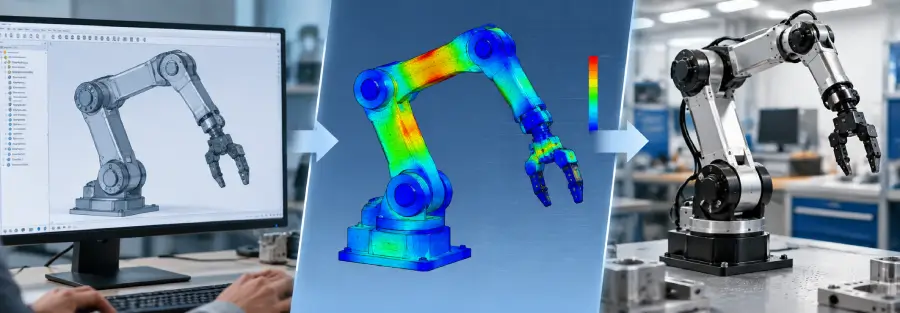
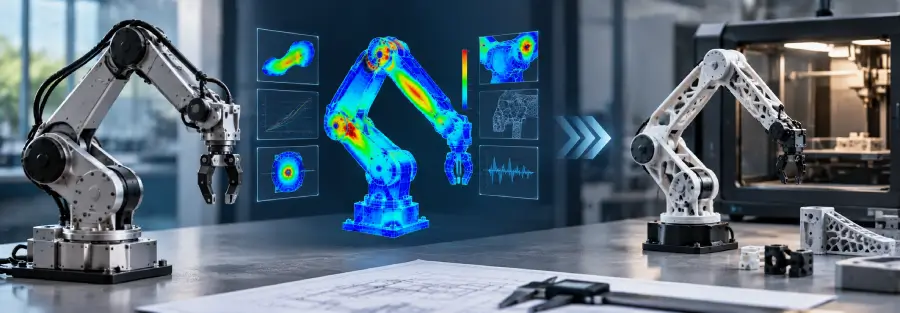
CAD model → load definition → FEA → engineering review → design change → FEA
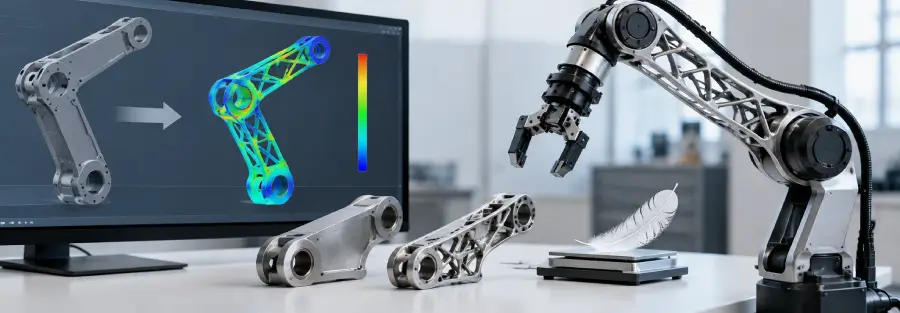
For example, an initial robotic arm link may show excessive deformation under the required payload. The design can then be modified by changing the section geometry or material distribution and analyzed again.
The second analysis provides evidence of whether the change actually improved the structure.
This connection between robotics CAE services and mechanical design allows simulation to become part of the development process rather than a final documentation exercise.
FEA for Robotics Design Optimization
FEA can also be used when the objective is not to find a failure, but to improve the existing design.
Robotic hardware often has a difficult balance to maintain:
Lower mass + sufficient stiffness + acceptable stress + manufacturable geometry
Removing material can reduce actuator loading, but excessive material removal may increase deformation. Adding reinforcement may improve stiffness but increase mass.
Our CAE and FEA work can help compare these trade-offs.
Potential optimization objectives include:
- Weight reduction
- Improved stiffness
- Lower deformation
- Better stress distribution
- More efficient material placement
- Improved structural configuration
For robotic arms, these changes can also influence the loads experienced by upstream joints and actuators.
Load Cases for Robotic Systems
The accuracy of an FEA result depends heavily on how the model is loaded and constrained.
Robotic systems can require multiple load cases rather than one simple static condition.
Depending on the application, these may include:
- Maximum payload
- Maximum reach
- Gravity loading
- Tooling mass
- Acceleration
- Deceleration
- External process loads
- Different arm positions
- Repeated loading conditions
- Mounting constraints
The relevant cases depend on how the robot operates.
For a robotic arm, for example, maximum structural loading may occur at a particular combination of reach and payload rather than simply at the largest payload value.
Working With Existing CAD Models
You do not need to start a robotics FEA project with a newly created model.
We can work with existing CAD where the design needs structural validation, redesign or optimization.
The analysis preparation may involve:
- Reviewing the geometry
- Simplifying unnecessary features
- Defining materials
- Establishing contacts
- Defining mounting conditions
- Applying relevant loads
- Creating an appropriate mesh
- Setting up the required analysis
The purpose of model preparation is to create an analysis that represents the engineering problem without introducing unnecessary computational complexity.
Where analysis identifies a design issue, the CAD model can then be revised and re-evaluated.
From FEA Results to Design Changes
A useful FEA engagement should answer the question: What should we do with the result?
If a robotic link shows excessive deformation, the next step may be a geometry change.
If stress is concentrated around a mounting interface, the connection may need to be redesigned.
If a lightweight structure has moved into an undesirable modal range, additional stiffness may be required.
If a component shows a fatigue concern, the geometry, material or load condition may need to be reconsidered.
This is why our robotics CAE services are connected with mechanical design and CAD development. Analysis can be followed by design revision rather than ending with a report.
What We Analyze
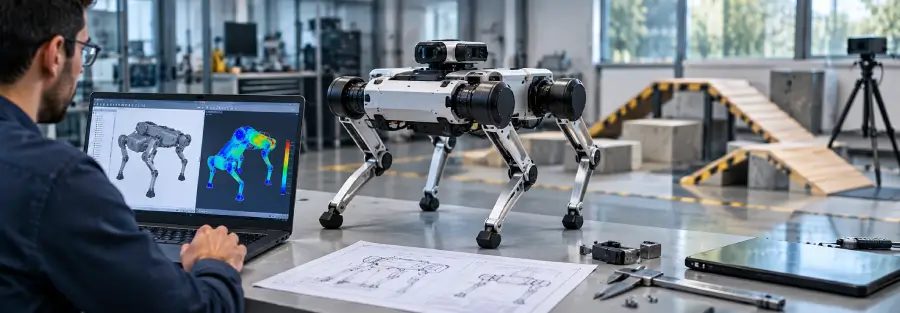
Our robotics CAE and FEA capabilities can be applied to a range of robotic hardware, including:
Robotic Arms
Links, joints, housings, structural members and end-effector interfaces.
Robotic Mechanisms
Linkages, actuator-driven mechanisms and custom mechanical assemblies.
Structural Components
Frames, brackets, supports, mounts and load-bearing components.
End Effectors
Mechanical structures and tooling interfaces subjected to operational loads.
Automation Hardware
Mechanical structures used in automated equipment and robotic work cells.
Custom Robotic Products
Components and assemblies developed for specialized robotic systems.
Why Caliber Technologies for Robotics FEA?
The value of FEA depends on more than the solver.
The model needs to represent the geometry correctly. The loads and constraints need to reflect the actual application. Material properties need to be appropriate. The results need to be interpreted in the context of the mechanical design.
Caliber Technologies brings mechanical design, CAD, CAE, FEA and structural optimization together within its engineering work.
This allows analysis to remain connected to the hardware being developed. A simulation result can lead directly to a geometry change, design comparison or optimization study rather than being treated as an isolated technical document.
Caliber’s robotics work already applies CAD-to-FEA methods to robotic arms and mechanical structures, including evaluation of stress, deformation, fatigue, vibration and design optimization.
FEA Deliverables
Depending on the analysis scope, deliverables may include:
- Prepared FEA models
- Defined load cases
- Mesh information
- Stress results
- Deformation results
- Strain results
- Factor-of-safety assessment
- Modal results
- Fatigue results
- Design comparisons
- Optimization findings
- Engineering analysis documentation
The analysis scope and reporting format are established according to the engineering requirements of the project.
Need FEA for a Robotic System?
If you have an existing robotic design that needs structural validation, a robotic arm showing excessive deflection, or a component that needs to be optimized before prototyping, Caliber Technologies can support the analysis and the engineering work that follows it.
Send us your CAD model, loading conditions or project requirements and tell us what you need the analysis to determine.
Frequently Asked Questions
What are robotics FEA services?
Robotics FEA services use finite element analysis to evaluate the structural behavior of robotic components and assemblies under defined operating conditions. Depending on the project, this can include stress, deformation, stiffness, modal and fatigue analysis.
What types of robotic components can you analyze?
FEA can be applied to robotic arms, links, joint housings, brackets, actuator mounts, frames, end-effector structures, mechanisms and other load-bearing robotic hardware.
Can you perform FEA on our existing CAD model?
Yes. Existing CAD can be reviewed and prepared for analysis. Depending on the model, some geometry may need to be simplified and the relevant materials, contacts, loads and constraints defined before the analysis.
What load cases should be considered for a robotic arm?
The appropriate load cases depend on the robot and its application. They can include payload, reach, gravity, tooling mass, acceleration, deceleration, external process loads and different arm positions. Multiple load cases may be required to identify the critical condition.
Can FEA determine how much a robotic arm will deflect?
Yes. Structural FEA can calculate deformation under defined loading conditions. This can help determine whether the arm or individual components have sufficient stiffness for the required application.
Can FEA be used to reduce the weight of a robot?
Yes. FEA can identify areas where material is carrying significant structural load and areas where material may potentially be reduced. Weight reduction needs to be evaluated alongside stress, stiffness, deformation, dynamic behavior and manufacturing constraints.
Do you provide modal and fatigue analysis for robotics?
Yes. Modal analysis can be used to investigate natural frequencies and mode shapes, while fatigue analysis can be used where components experience repeated loading and suitable material and load-cycle information is available.
What happens if the FEA shows a problem?
The result can be used to identify the likely cause and guide a design change. The geometry can then be modified and re-analyzed to determine whether the revised design addresses the original issue.
How We Provide Services
Project Scope Based Services
Time Based Projects
On-site Resource Assignment
Strategic Consulting Services
We are very glad to get client review.
Have a question? Send us a message, and we’ll respond shortly.
Tackle your toughest technical challenges in automotive engineering and reach your product development goals by leveraging the expertise of our trusted engineers.