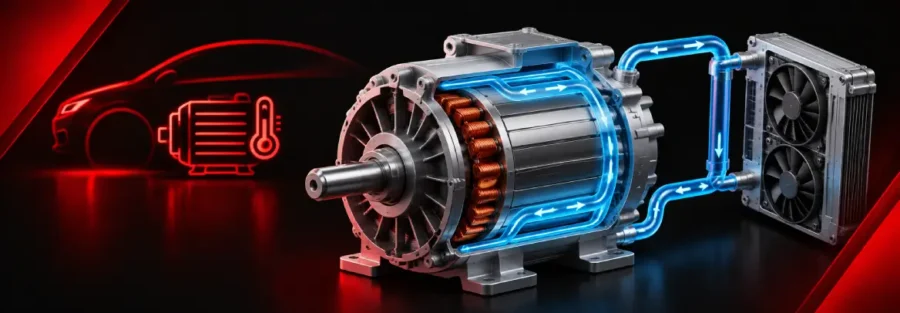
Electric motors generate heat during operation due to electrical losses, magnetic losses and mechanical friction. In electric vehicles, effective motor cooling is essential to maintain performance, prevent overheating and protect components from thermal damage.
The cooling system must remove heat from critical motor components while keeping temperatures within their operating limits. Its design directly affects motor efficiency, power density, reliability and service life.
Why Is Electric Motor Cooling Important?
Heat generation increases as an electric motor operates under higher loads and speeds. If this heat is not managed properly, it can affect several motor components.
- Winding insulation: Excessive temperature can accelerate insulation ageing and reduce winding reliability.
- Permanent magnets: High temperatures can reduce magnetic performance and, in some conditions, cause irreversible demagnetisation.
- Bearings: Elevated temperatures can affect lubricant properties and bearing life.
- Rotor and stator: Uneven temperature distribution can cause thermal expansion and affect component clearances.
- Overall performance: Thermal limitations can restrict continuous torque and power output.
An effective cooling system helps maintain stable operating temperatures under different driving conditions.
Common Electric Motor Cooling Methods
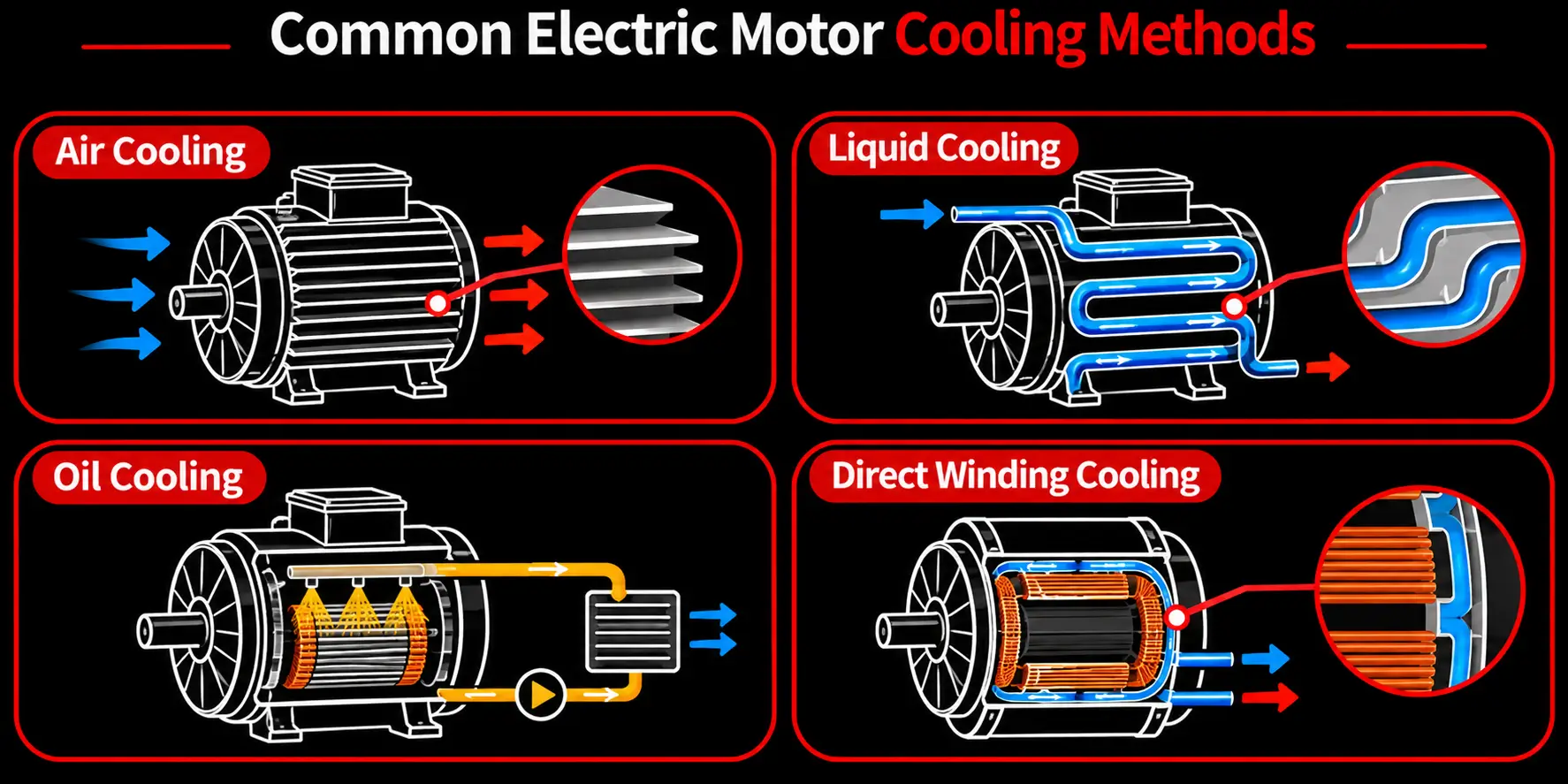
The choice of cooling method depends on motor design, power rating, operating speed, packaging space and thermal requirements.
1. Air Cooling
Air cooling uses natural or forced airflow to remove heat from the motor.
In forced-air systems, a fan moves air through or around the motor housing. Cooling fins may also be used to increase the surface area available for heat transfer.
Key characteristics:
- Simple system design.
- Lower system complexity.
- Suitable for motors with relatively modest heat loads.
- Limited heat removal compared with many liquid-cooled designs.
2. Liquid Cooling
Liquid cooling uses a coolant, such as a water-glycol mixture, to transfer heat away from motor components.
Coolant may circulate through channels in the motor housing or around the stator. A pump moves the coolant through the cooling circuit, while a heat exchanger or radiator removes the absorbed heat.
Key characteristics:
- Higher heat removal capability than conventional air cooling
- Suitable for high-power-density applications.
- Requires pumps, coolant passages and heat exchangers.
- Cooling channel design affects thermal performance and pressure drop.
3. Oil Cooling
Oil cooling uses dielectric or electrically suitable oil, depending on the system design, to remove heat from motor components.
In some designs, oil is sprayed directly onto the end windings or rotor. Other systems use oil circulation through dedicated passages.
Key characteristics:
- Can provide direct cooling to specific motor components.
- Useful for managing high local heat loads.
- Requires careful fluid distribution and sealing.
- Oil compatibility and electrical insulation properties must be considered.
4. Direct Winding Cooling
Direct winding cooling focuses on removing heat from the stator windings, which can be a major source of motor heat.
Coolant may flow through channels close to the windings or through specially designed conductors and passages, depending on the motor architecture.
This approach can reduce the thermal resistance between the heat source and the coolant. However, manufacturing complexity, sealing and electrical insulation requirements must be addressed.
Key Design Considerations for Electric Motor Cooling
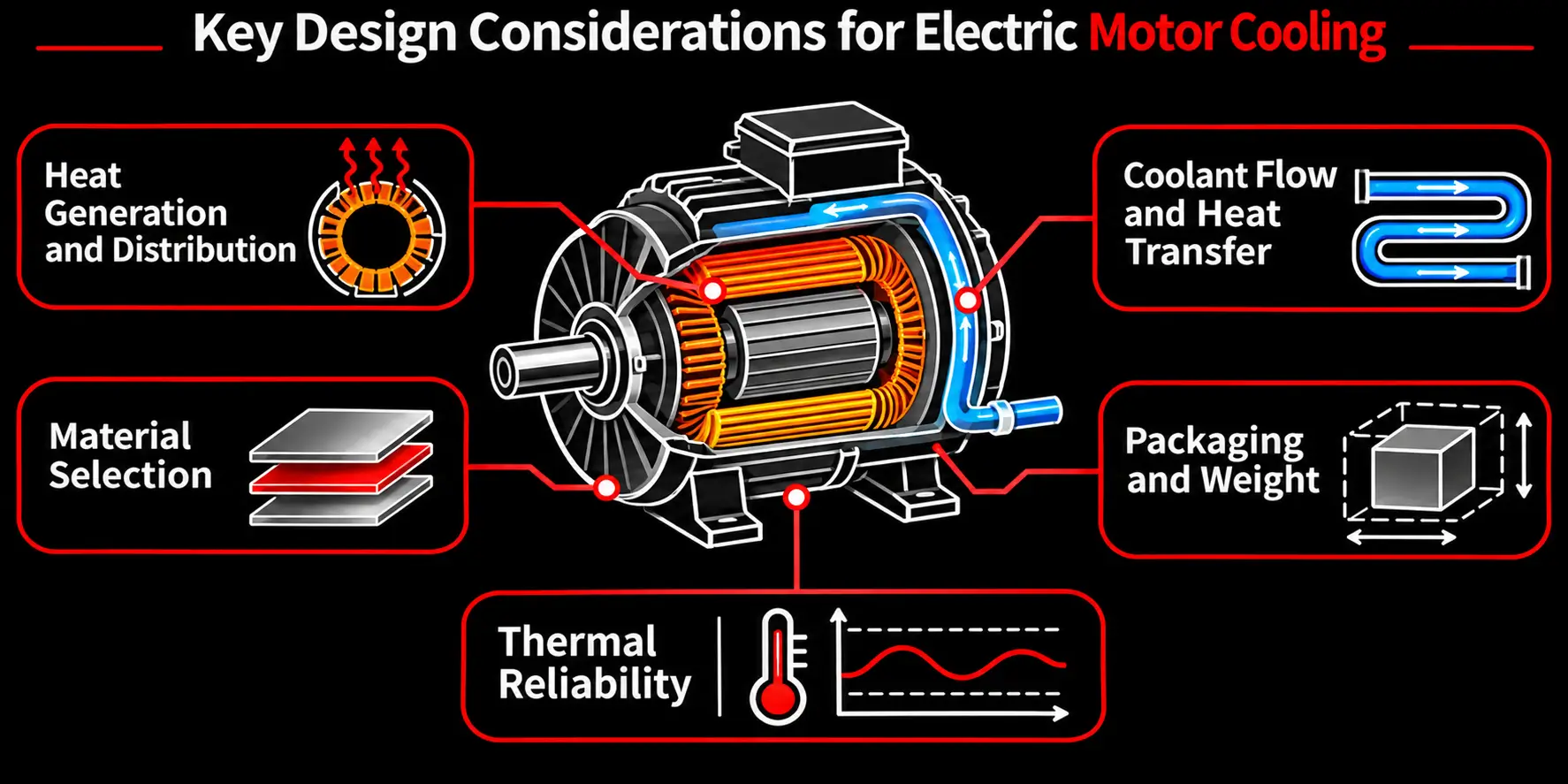
Designing an effective cooling system requires more than selecting a cooling method. Engineers must evaluate the motor’s operating conditions and thermal behaviour.
1. Heat Generation and Distribution
Heat is generated in different parts of the motor, including stator windings, rotor, iron core and bearings.
Engineers need to understand where heat is generated and how it moves through the motor structure. This helps identify components that require additional cooling.
2. Coolant Flow and Heat Transfer
For liquid and oil-cooled motors, coolant flow rate, inlet temperature, channel geometry and pressure drop influence cooling performance.
Poor flow distribution can create localised hot spots, even when the overall coolant flow appears sufficient.
3. Material Selection
Motor materials have different thermal conductivity and expansion characteristics.
Material selection affects heat transfer, thermal expansion and the mechanical behaviour of motor components under changing temperatures.
4. Packaging and Weight
The cooling system must fit within the available motor and vehicle space. Pumps, pipes, cooling channels and heat exchangers also add weight and complexity.
Engineers must balance cooling performance with packaging, manufacturing and vehicle integration requirements.
5. Thermal Reliability
Motor components must remain within their specified temperature limits across different operating conditions.
Thermal cycling, repeated acceleration and sustained high-load operation can affect component durability. Cooling system design should account for these operating conditions.
Role of Thermal Simulation in Electric Motor Cooling
Thermal simulation helps engineers understand temperature distribution and heat transfer within an electric motor before physical testing.
Depending on the motor design and project requirements, simulation can help evaluate:
- Temperature distribution across stator windings and rotor components.
- Heat transfer through motor materials and interfaces.
- Coolant flow and temperature variation.
- Hot spots under different operating conditions.
- Cooling channel performance and pressure drop.
- Thermal behaviour during continuous and transient operation.
CFD analysis can be used to study coolant flow and heat transfer, while thermal and coupled thermal-structural analysis can help evaluate temperature-related effects on motor components.
These results help engineers identify cooling limitations and assess design modifications.
Electric Motor Cooling Analysis with Caliber Technologies
Caliber Technologies supports engineering teams with thermal and CFD simulation for electric motor and EV powertrain components.
Our engineering support can include:
- Motor thermal analysis.
- Coolant flow and heat transfer evaluation.
- Cooling channel performance assessment.
- Temperature distribution and hot spot identification.
- Thermal-structural evaluation.
- Design comparison and optimisation based on simulation results.
The analysis is defined according to the motor architecture, operating conditions and project requirements.
Need engineering support for electric motor cooling or thermal simulation?
Contact Caliber Technologies at operations@thecalibertech.com to discuss your project.