Engine displacement is one of the basic specifications used to describe an internal combustion engine. It refers to the total volume swept by all pistons as they move from top dead centre (TDC) to bottom dead centre (BDC).
It is usually measured in cubic centimetres (cc) or litres (L). For example, a 2.0-litre engine has approximately 2,000 cc of displacement.
Engine displacement helps engineers understand engine size and compare different engine designs. However, displacement alone does not determine how much power an engine produces. Other factors, including compression ratio, fuel delivery, turbocharging and combustion efficiency, also influence performance.
How Is Engine Displacement Calculated?
Engine displacement depends on three main parameters: cylinder bore, stroke length and the number of cylinders.
- Cylinder Bore: The internal diameter of the engine cylinder.
- Stroke Length: The distance travelled by the piston between TDC and BDC.
- Number of Cylinders: The total number of cylinders in the engine.
The formula for calculating engine displacement is: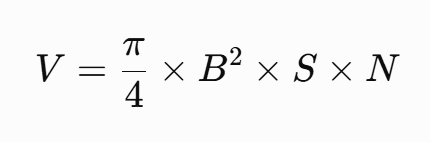
Where:
- V = Total engine displacement
- B = Cylinder bore
- S = Stroke length
- N = Number of cylinders
Example:
Consider a four-cylinder engine with an 86 mm bore and an 86 mm stroke.
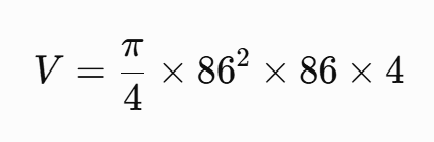
The total displacement is approximately 1,996 cc, or 2.0 litres.
This calculation gives the total swept volume of all four cylinders.
How Do Bore and Stroke Affect Engine Design?
Bore and stroke dimensions influence engine geometry, piston movement and overall packaging.
A larger bore provides more space for a larger piston diameter and can accommodate larger valves, depending on the cylinder head design.
A longer stroke increases the distance travelled by the piston during each cycle. It also affects mean piston speed, crankshaft geometry and the loads acting on engine components.
Engineers consider the relationship between bore and stroke when developing an engine.
Common configurations include:
- Oversquare Engine: Bore is larger than stroke.
- Undersquare Engine: Stroke is longer than bore.
- Square Engine: Bore and stroke are approximately equal.
Each configuration involves different design considerations related to engine dimensions, operating speed, combustion chamber geometry and component loading.
Does Higher Engine Displacement Mean More Power?
Not necessarily. A larger engine can generally move more air and fuel per cycle, but its actual power output depends on several design factors.
For example, a naturally aspirated 2.0-litre engine and a turbocharged 1.5-litre engine can have very different power outputs.
Engine performance also depends on:
- Compression ratio.
- Air intake and exhaust design.
- Fuel injection system.
- Combustion efficiency.
- Engine operating speed.
- Turbocharging or supercharging.
This is why engine displacement should be considered alongside the complete engine design rather than as an independent measure of performance.
What Should Engineers Consider When Designing an Engine?
Selecting bore and stroke dimensions is only one part of engine development. Engineers must also evaluate how these dimensions affect other components.
Important considerations include:
- Piston dimensions, weight and clearance.
- Connecting rod length and geometry.
- Crankshaft dimensions and loading.
- Cylinder pressure and combustion conditions.
- Piston speed and mechanical stresses.
- Thermal expansion and component temperatures.
- Engine block strength and packaging constraints.
Changes to bore or stroke can affect multiple components. Therefore, engineers need to assess the complete assembly before finalising the design.
How Engineering Simulation Supports Engine Development
Engineering simulation helps evaluate how engine components behave under different operating conditions.
For example, structural analysis can be used to assess stress and deformation in pistons, connecting rods and crankshafts. Thermal analysis helps evaluate temperature distribution and thermal loading in engine components.
These studies help engineers identify potential design issues, compare component configurations and assess structural performance before physical testing.
Caliber Technologies: Engine Design and Simulation Support
Caliber Technologies provides engineering design and simulation support for internal combustion engine development.
Our capabilities include engine component design, CAD modelling, structural analysis and thermal simulation. We support engineering teams working on pistons, connecting rods, crankshafts and other engine components based on project requirements.
To discuss your engine design or simulation requirements, contact our engineering team.