
A crankshaft is one of the most important components of an internal combustion engine. It converts the up-and-down movement of the pistons into rotational motion, which is then used to drive the vehicle.
The crankshaft works alongside pistons, connecting rods and other engine components to maintain continuous engine operation. Its design must withstand repeated forces, rotational loads and vibrations during engine operation.
Understanding crankshaft parts, functions and working principles is important when designing an engine for reliable performance and durability.
What Are the Main Parts of a Crankshaft?
A crankshaft consists of several sections that work together to convert piston movement into rotational motion.
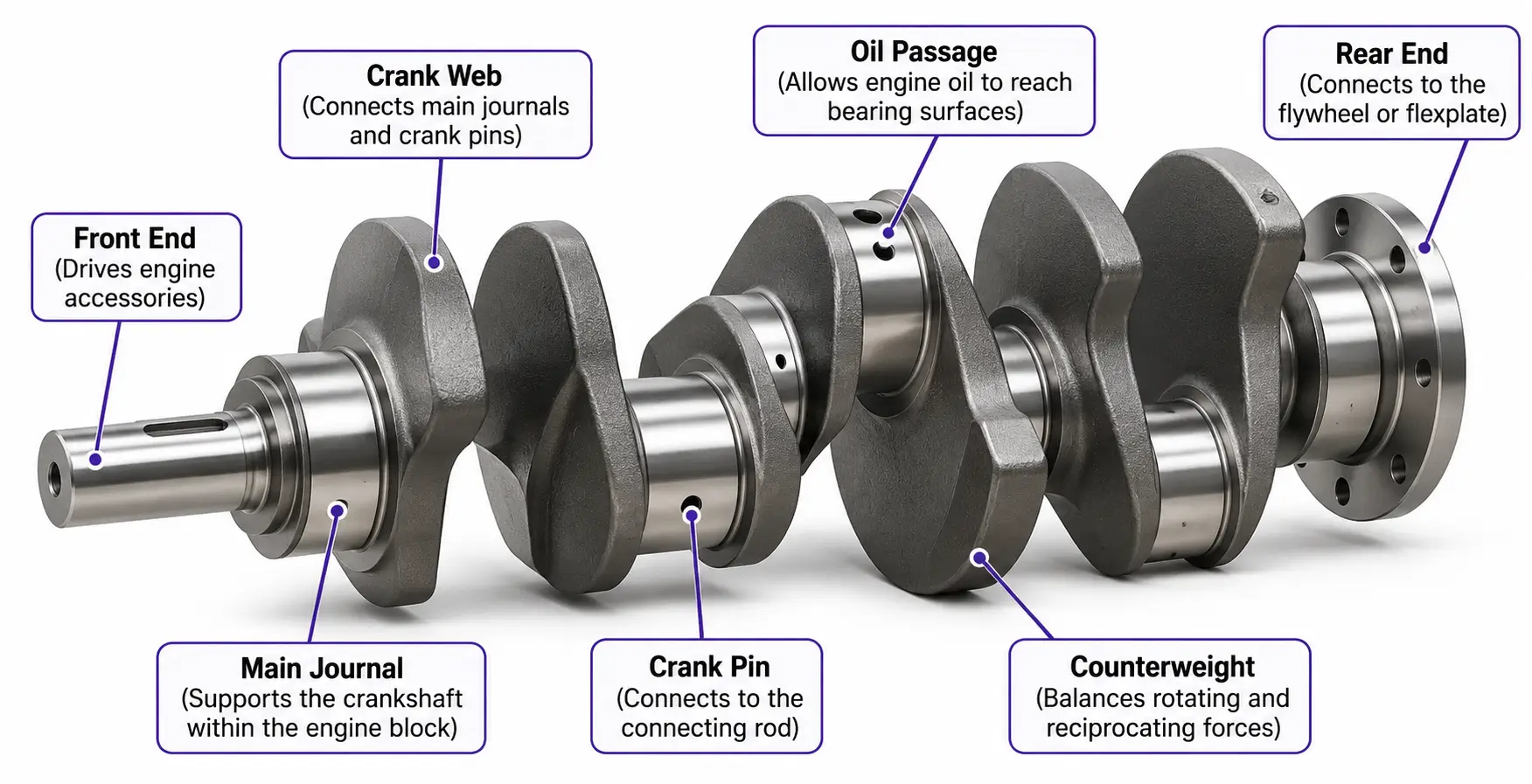
- Main Journals: Support the crankshaft within the engine block and rotate inside the main bearings.
- Crank Pins: Connect the crankshaft to the connecting rods and provide the offset required to convert piston movement into rotation.
- Crank Webs: Connect the main journals and crank pins, forming the crankshaft structure.
- Counterweights: Balance rotating and reciprocating forces to reduce vibration and bearing loads.
- Oil Passages: Allow engine oil to reach important bearing surfaces for lubrication.
- Front and Rear Ends: The front end drives engine accessories, while the rear end connects to the flywheel or flexplate.
How Does a Crankshaft Work?
The crankshaft works through its connection with the piston and connecting rod.
During the combustion process, expanding gases push the piston downward inside the cylinder. The connecting rod transfers this force to the crank pin, causing the crankshaft to rotate.
As the crankshaft continues rotating, its offset crank pins move the connecting rods and pistons through their upward and downward strokes.
This process repeats throughout engine operation, converting reciprocating motion into continuous rotational motion.
The rotational output is transferred through the flywheel and transmission to drive the vehicle.
What Are the Different Types of Crankshafts?
Crankshafts are designed differently depending on engine configuration, cylinder arrangement, operating speed and application.
Common types include:
- Single-Cylinder Crankshaft: Used in small engines such as motorcycles and certain utility engines.
- Inline Engine Crankshaft: Designed to accommodate cylinders arranged in a single row.
- V-Engine Crankshaft: Used in engines with cylinders arranged in two banks, requiring specific crank pin and journal arrangements.
- Flat-Plane Crankshaft: Commonly used in certain high-performance V8 engines, with crank pins arranged in a single plane.
- Cross-Plane Crankshaft: Commonly used in V8 engines, with crank pins arranged at different angular positions to manage engine balance and firing characteristics.
What Materials Are Used in Crankshaft Manufacturing?
Crankshafts must withstand bending, torsional loads, fatigue and repeated engine cycles. Material selection plays an important role in their strength and service life.
Common materials include:
- Forged Steel: Offers high strength and fatigue resistance, making it suitable for demanding engine applications.
- Cast Iron: Commonly used in production engines where manufacturing cost and required mechanical properties must be balanced.
- Nodular Cast Iron: Provides improved strength and toughness compared with conventional grey cast iron.
Manufacturing processes such as forging, casting, machining, heat treatment and surface hardening are selected according to the engine’s requirements.
What Causes Crankshaft Failure?
Crankshaft failure can affect engine operation and may result in significant repair costs. Some common causes include:
- Fatigue Cracks: Repeated bending and torsional loading can initiate cracks around crank webs and fillets.
- Bearing Failure: Poor lubrication or excessive bearing loads can damage journal surfaces.
- Excessive Vibration: Unbalanced forces can increase dynamic loads on the crankshaft and bearings.
- Overloading: Operating conditions beyond the component’s design limits can increase stress.
- Improper Lubrication: Insufficient oil supply can cause excessive friction, heat and journal damage.
Proper crankshaft design, material selection, lubrication and maintenance help reduce these risks.
How Is Crankshaft Strength Evaluated?
Crankshafts experience complex loading during engine operation. They are subjected to bending forces from piston loads, torsional forces from combustion and rotational forces from the moving assembly.
Engineers use structural analysis and simulation to evaluate these conditions.
Finite Element Analysis (FEA) can help identify stress concentrations around crank pins, main journals and crankshaft fillets. Fatigue analysis can estimate the component’s response to repeated loading, while modal analysis can help identify natural frequencies and vibration characteristics.
These studies support crankshaft design validation and help engineers identify areas that may require design improvements.
Crankshaft Design and Analysis Support from Caliber Technologies
Caliber Technologies provides engineering design and simulation support for internal combustion engine components.
Our capabilities include CAD modelling, structural FEA, fatigue assessment and engineering analysis to evaluate component strength and performance under defined operating conditions.
If you are developing or evaluating crankshafts or other engine components, contact our engineering team to discuss your requirements.