Why EV Battery Enclosure Structural Analysis Matters
An electric vehicle battery enclosure does more than house battery modules. It provides structural support, protects internal components, and transfers loads through its mounting points into the vehicle structure.
During operation, the enclosure may experience road-induced vibration, vertical acceleration, braking forces, cornering loads, and stresses caused by vehicle body movement. These loads can affect the enclosure floor, sidewalls, crossmembers, joints, and mounting brackets.
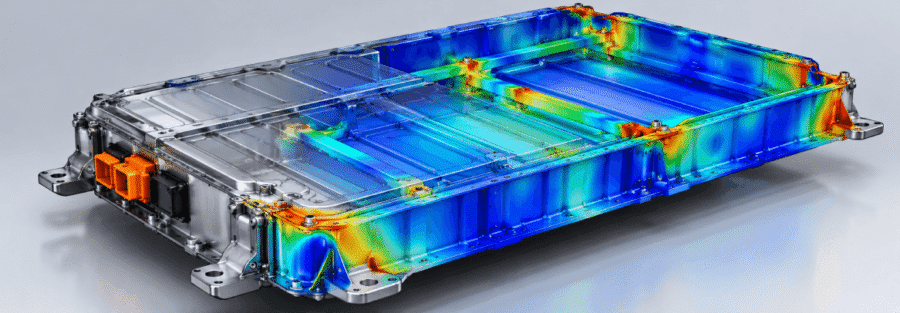
EV battery enclosure FEA helps engineers identify high-stress areas, evaluate deformation, and assess design changes before physical prototypes are built.
The objective is to establish whether the proposed design meets its defined structural requirements without unnecessary mass or excessive deformation.
Common Structural Challenges in EV Battery Enclosures
1. High Stress Around Mounting Points
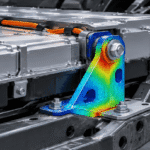
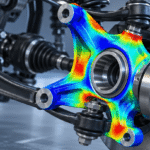
Battery enclosures transfer loads through brackets, bolts, and attachment points. Local stresses can develop around bolt holes, bracket interfaces, and changes in section thickness.
FEA helps engineers examine these regions and evaluate changes to bracket geometry, reinforcement, and load distribution.
2. Floor Panel Deflection
Large enclosure floor panels may deform under distributed loads, module support loads, or vehicle-level loading conditions. Excessive movement can affect component clearances and the support provided to internal battery modules.
Structural simulation helps assess panel stiffness and determine whether ribs, crossmembers, or changes in panel thickness are needed.
3. Crossmember and Joint Strength
Crossmembers support the enclosure structure and help distribute loads. Welded joints, bolted connections, and intersections between structural members can become critical regions under combined loading.
The analysis should represent these connections appropriately for the level of detail and engineering question being investigated.
4. Vibration and Fatigue
Repeated road inputs can create cyclic stresses in enclosure panels, mounting brackets, and joints. Areas that remain below yield strength during a single load case may still require fatigue assessment over the intended service life.
Fatigue evaluation should use suitable load histories, material data, and connection details rather than relying on a static stress plot alone.
How EV Battery Enclosure FEA Is Performed
- CAD and material review: Prepare the enclosure geometry and confirm material properties, panel thicknesses, and connection details.
- Finite element meshing: Refine the mesh around mounting holes, brackets, joints, and other areas with high stress gradients.
- Load case definition: Apply relevant vehicle acceleration, braking, cornering, module support, and vibration-related loads based on project requirements.
- Structural simulation: Evaluate stress, deformation, stiffness, and load transfer through the enclosure.
- Design assessment: Compare results with defined acceptance criteria and review possible changes to ribs, panels, brackets, and crossmembers.
- Validation: Check mesh sensitivity, boundary conditions, reaction forces, and correlation with physical test data where available.
What Engineers Evaluate
| FEA output | Purpose |
|---|---|
| Stress distribution | Identify critical regions and assess material limits |
| Panel deformation | Check stiffness and internal clearances |
| Mounting-point loads | Assess attachment and load transfer |
| Joint behaviour | Review critical welded or bolted connections |
| Fatigue assessment | Evaluate repeated-load durability |
| Mass comparison | Compare structural alternatives against weight targets |
The enclosure’s structural requirements depend on its architecture, mounting arrangement, vehicle application, and applicable safety requirements. Structural FEA alone does not establish thermal-runaway protection, sealing performance, or crashworthiness; these need appropriate separate analyses and validation.
Improving Battery Enclosure Design Through FEA
Simulation allows engineers to compare design alternatives before committing to tooling or extensive physical testing. Potential changes include:
- Adjusting panel thickness and reinforcement layout.
- Improving load distribution around mounting brackets.
- Modifying crossmember geometry.
- Reviewing joint design and local stress concentrations.
- Reducing unnecessary material while maintaining required stiffness and strength.
Each proposed change should be evaluated against the same relevant load cases and acceptance criteria. Weight reduction should not compromise structural integrity, durability, manufacturability, or other enclosure requirements.
When Should EV Manufacturers Use Battery Enclosure FEA?
EV battery enclosure FEA is useful when developing a new enclosure, changing its mounting arrangement, reducing structural mass, investigating deformation, or evaluating durability under repeated vehicle loads.
It can also support design reviews before prototype testing by identifying critical areas and helping engineers prioritise physical validation.
EV Battery Enclosure Analysis by Caliber Technologies
Caliber Technologies supports engineering teams with finite element analysis and structural simulation for component development and design evaluation.
For EV battery enclosure projects, analysis can be scoped around enclosure geometry, mounting conditions, material data, design loads, and the structural performance criteria that need to be assessed.
To discuss your requirements, contact operations@thecalibertech.com.