Why Battery Pack Mounting Bracket Analysis Matters
Battery pack mounting brackets connect the battery assembly to the vehicle structure. Although they may appear to be small components, they must transfer loads from a heavy battery pack while maintaining secure attachment under different driving conditions.
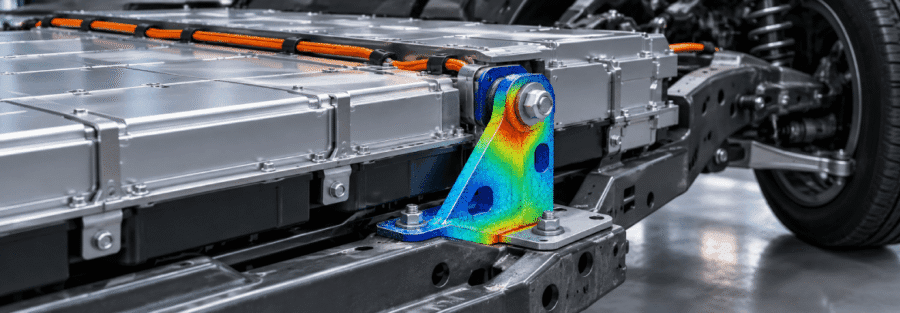
Braking, cornering, road vibration, and vertical acceleration can produce forces and moments at bracket connections. These loads may create local stress around bolt holes, bends, welds, and changes in bracket thickness.
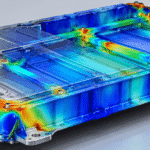
Battery pack mounting bracket analysis helps engineers identify critical regions, assess deformation, and evaluate whether the bracket design meets its structural requirements before physical testing.
The aim is to achieve the required strength and durability without adding unnecessary weight or making the bracket difficult to manufacture.
Common Engineering Challenges
1. Stress Concentration Around Bolt Holes
Bolt holes can experience high local stresses as loads pass between the bracket and its mating structure. Hole position, edge distance, bracket thickness, and load direction all influence the stress distribution.
FEA helps engineers assess these regions and compare alternative hole layouts or reinforcement features.
2. Bracket Bending and Deformation
Cantilevered brackets and offset mounting designs can develop bending moments under battery loads. Excessive deformation may affect alignment, joint behaviour, or the clearance between nearby components.
Structural simulation helps determine whether changes to bracket geometry, thickness, or support location are needed.
3. Bolt Loads and Joint Behaviour
Bracket performance depends on both the bracket itself and its bolted connections. Engineers need to consider bolt loads, clamping conditions, contact between mating surfaces, and the possibility of local bearing stress or joint separation.
Where necessary, the model should include suitable contact and connection representations rather than treating every interface as perfectly fixed.
4. Fatigue Under Repeated Loads
Road vibration and repeated vehicle acceleration can produce cyclic stresses in brackets and welded joints. A bracket that remains below its yield limit under a single load case may still require fatigue assessment.
Fatigue analysis should use appropriate load histories and material data to evaluate durability over the intended service life.
How FEA Is Used for Battery Mounting Brackets
- Geometry and material review: Check bracket dimensions, bends, thickness, material properties, and connection details.
- Load case definition: Establish relevant vertical, longitudinal, and lateral loads using vehicle requirements and mounting conditions.
- Mesh generation: Refine the mesh around holes, bends, welds, and other critical features.
- Structural analysis: Evaluate stress, deformation, bolt loads, and load transfer through the mounting assembly.
- Fatigue assessment: Where required, evaluate repeated loading using suitable fatigue data.
- Design comparison: Compare bracket thickness, reinforcement, hole positions, and alternative geometries against the same acceptance criteria.
What Engineers Should Check in the Results
| Analysis output | Purpose |
|---|---|
| Stress distribution | Identify critical regions and assess material limits |
| Bracket deformation | Check stiffness and mounting alignment |
| Bolt and contact forces | Assess joint load transfer |
| Weld stresses | Review critical welded connections |
| Fatigue life or damage | Evaluate durability under cyclic loading |
| Component mass | Compare strength and weight trade-offs |
Peak stress values should be interpreted carefully, particularly near idealised constraints, sharp corners, and connection interfaces. Mesh convergence and realistic boundary conditions are important before using results to make design decisions.
Optimising Battery Pack Mounting Brackets
FEA can help engineers evaluate practical design changes, including:
- Adding or repositioning reinforcement ribs.
- Adjusting bracket thickness or bend geometry.
- Improving bolt-hole layout and edge distances.
- Reducing stress concentrations around attachment features.
- Comparing alternative materials and manufacturing methods.
The goal is to meet strength, stiffness, fatigue, and packaging requirements without adding unnecessary material.
Battery Pack Mounting Bracket Analysis by Caliber Technologies
Caliber Technologies supports engineering teams with structural simulation and finite element analysis for component development and design evaluation.
For battery pack mounting brackets, the analysis can focus on load transfer, critical stresses, connection behaviour, deformation, and fatigue requirements based on the project scope.
To discuss your requirements, contact operations@thecalibertech.com.