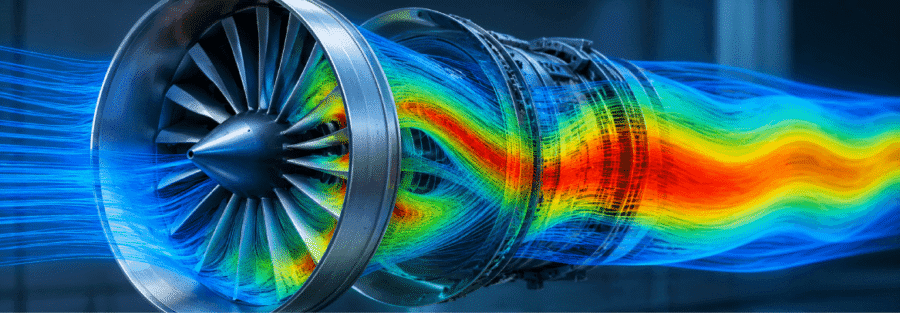
Computational Fluid Dynamics (CFD) helps engineers study airflow, fluid movement, pressure distribution, heat transfer, and turbulence before committing to physical prototypes or design changes.
The cost of CFD simulation depends on what needs to be modelled. A basic airflow study around a simple component requires a different level of effort from an automotive external aerodynamics project, an engine cooling study, or a coupled fluid and thermal simulation.
There is no single price that applies to every CFD project. The estimate depends on the engineering question, the complexity of the model, the required accuracy, and the deliverables.
For manufacturers, understanding these factors makes it easier to define the project scope and compare simulation proposals.
Typical CFD Simulation Cost
Publicly listed prices show how much costs can vary between providers and project scopes.
| CFD project type | Published price reference |
|---|---|
| Focused flow study | From US$1,500 |
| Standard consulting project | US$2,490–$6,990 package pricing |
| Typical single-physics, single-geometry project | US$5,000–$30,000 |
| Advanced multiphysics or large optimisation study | Requires a project-specific quote |
These are examples of published prices, not a universal industry rate. A quote should specify the number of cases, engineering work, verification requirements, and final deliverables.
What Factors Affect CFD Simulation Cost?
1. Geometry Complexity
A simple duct or nozzle generally requires less geometry preparation than a complete vehicle, complex HVAC system, or industrial flow assembly. Detailed CAD cleanup and fluid-domain preparation can add significant engineering time.
2. Type of Flow Physics
The cost depends on the physical behaviour being modelled.
- Internal flow: Pressure drop, velocity distribution, and flow uniformity.
- External aerodynamics: Drag, lift, and airflow around vehicles or equipment.
- Thermal CFD: Heat transfer, temperature distribution, and cooling performance.
- HVAC simulation: Air distribution, ventilation, and thermal comfort.
- Multiphase flow: Interaction between liquids, gases, or particles.
- Combustion simulation: Fuel-air mixing, chemical reactions, and heat release.
Complex physics generally require more setup, computational effort, and result interpretation.
3. Mesh Requirements and Accuracy
The mesh must resolve the important flow features for the engineering question. Boundary layers, small passages, separation regions, and complex geometry may require additional refinement.
Mesh sensitivity and other verification checks can also add time, but they help establish whether the numerical results are sufficiently reliable for their intended use.
4. Number of Operating Conditions
A simulation at one flow rate may be relatively straightforward. Comparing multiple speeds, temperatures, pressure conditions, or design variations requires additional cases and result comparisons.
5. Transient Versus Steady-State Analysis
Steady-state CFD evaluates flow that is treated as no longer changing with time. Transient CFD captures time-dependent behaviour and may require many more time steps and additional computational resources.
The appropriate method depends on the actual engineering problem, not simply on which method is more detailed.
6. Reporting and Validation
A complete engineering deliverable may include mesh-quality checks, convergence assessment, quantitative plots, comparison with test data, recommendations, and a technical report. Confirm which of these are included before comparing prices.
How to Reduce CFD Simulation Costs
Engineering teams can manage costs by:
- Defining the engineering question and required outputs before requesting a quote.
- Providing usable CAD geometry and reliable operating conditions.
- Starting with the most important operating case.
- Comparing design alternatives only where the results will inform a decision.
- Agreeing on the number of revisions and report requirements in advance.
A phased approach can be useful when the problem is uncertain. An initial study can identify the main flow issues before more detailed analysis is commissioned.
Is Outsourcing CFD More Cost-Effective Than In-House Simulation?
In-house CFD may suit organisations with frequent, ongoing simulation requirements and dedicated engineering staff. Outsourcing can be more practical for occasional projects or when specialist expertise is needed.
The comparison should include software, hardware, engineering time, training, project deadlines, and the cost of obtaining reliable results. Published cost guidance also identifies engineering personnel as a major component of CFD expenditure.
Get a CFD Simulation Cost Estimate from Caliber Technologies
Caliber Technologies supports engineering teams with CFD and engineering simulation for applications such as automotive aerodynamics, HVAC airflow, and thermal performance.
To request a project estimate, share:
- CAD geometry or drawings.
- The fluid or thermal problem to be investigated.
- Operating conditions and available test data.
- The number of designs or conditions to compare.
- Required results, reporting, and delivery timeline.
Contact operations@thecalibertech.com to discuss your requirements and obtain a scope-specific quotation.