
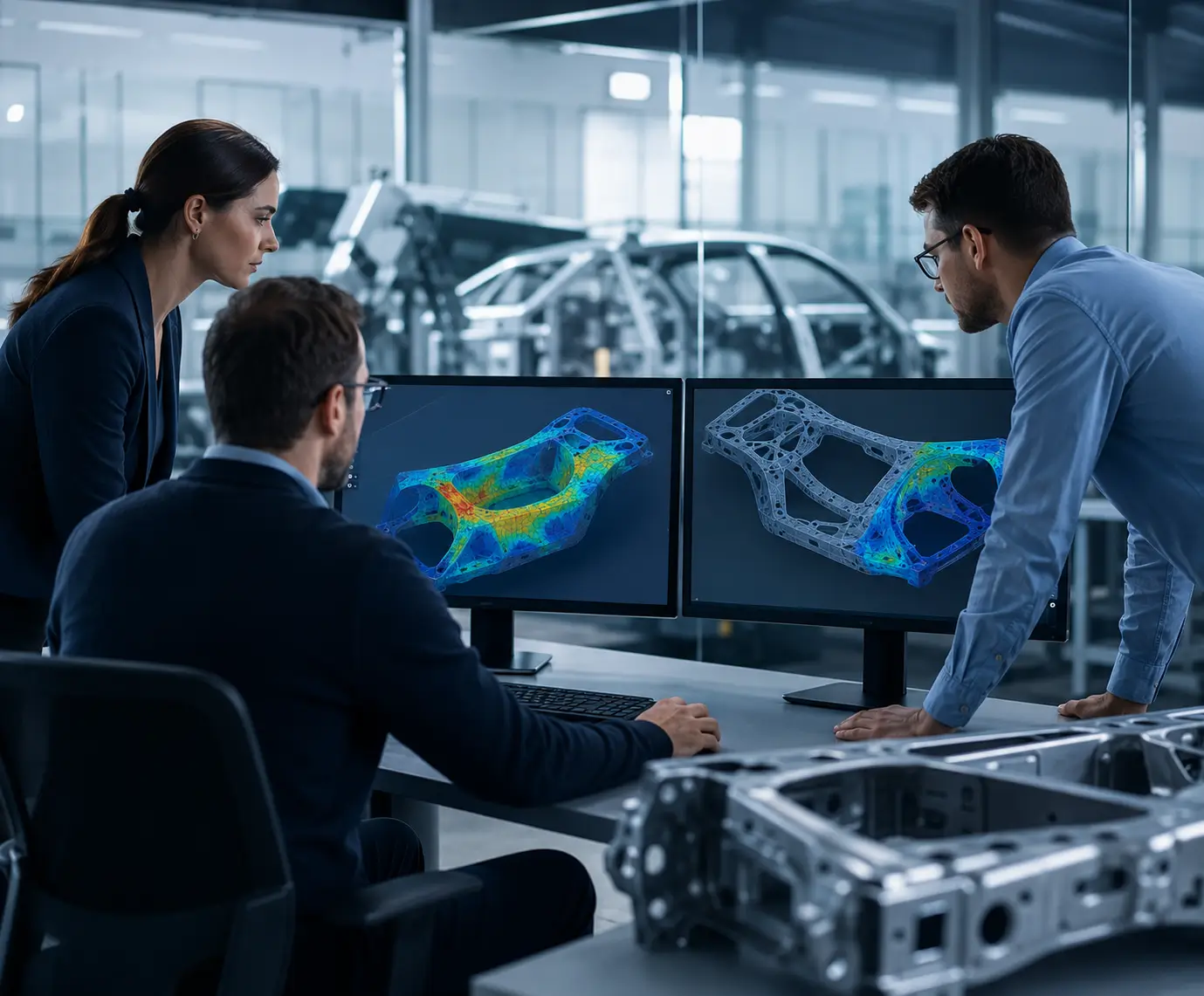
Structural Simulation Services in Michigan
When a product has to withstand real-world forces, engineers need more than assumptions to understand how it will perform. Caliber Technologies delivers Structural Simulation Services in Michigan that help engineering teams evaluate product behavior virtually, identify structural concerns, compare design alternatives, and make informed development decisions before moving further into physical validation.
Our engineering team supports structural simulation for components, assemblies, and complete systems across industries. From early-stage product development to troubleshooting an existing design, simulation can provide the technical insight needed to improve strength, stiffness, reliability, weight, and overall structural performance.
Where Structural Simulation Adds Value
Structural simulation can play a role at several points in an engineering program.
You may be deciding between two concepts, trying to understand why a component is deforming, assessing a new material, investigating a failed part, or looking for opportunities to reduce weight without compromising performance.
In each situation, the simulation needs to answer a specific engineering question.
Our structural engineering simulation work can help organizations with:
- New product and component development
- Design verification
- Structural performance assessment
- Stress and strain evaluation
- Deformation prediction
- Stiffness studies
- Load-path investigation
- Design modification assessment
- Weight and material optimization
- Durability-related structural evaluation
- Engineering troubleshooting
- Simulation-to-test comparison
Rather than treating simulation as an isolated technical exercise, we focus on producing information that can be used by designers, engineers, product teams, and decision-makers.
Virtual Evaluation Before Physical Prototyping
Physical prototypes can be expensive and time-consuming to produce, particularly when multiple design iterations are required.
Simulation gives engineering teams an opportunity to evaluate a design virtually before every change requires another physical prototype.
A virtual structural assessment can help answer questions about a proposed design while there is still flexibility to modify the geometry.
For example, engineers may want to compare different wall thicknesses, reinforcement strategies, materials, mounting arrangements, or component geometries.
Simulation can provide comparative engineering data that helps narrow the options before progressing to manufacturing and physical validation.
This does not eliminate the need for testing. Instead, it can make the overall development process more informed by allowing engineering teams to identify important areas for testing and investigation earlier.
Finite Element Structural Modeling
For many structural engineering problems, Finite Element Analysis (FEA) provides the foundation for virtual evaluation.
Our FEA services in Michigan can be used to model the response of engineered components and systems under defined loading and operating conditions.
Depending on the application, a model may be used to investigate:
- Structural stresses
- Strains
- Displacement
- Deflection
- Stiffness
- Load distribution
- Structural integrity
- Contact behavior
- Component interaction
- Critical regions
The level of modeling depends on the question being asked.
A component-level model may be appropriate when the objective is to understand a particular part. A larger assembly model may be more suitable when interfaces, connections, or load transfer between components are important.
Our engineers can help determine an appropriate level of simulation based on the intended use of the results.
Understanding Loads, Constraints, and Structural Behavior
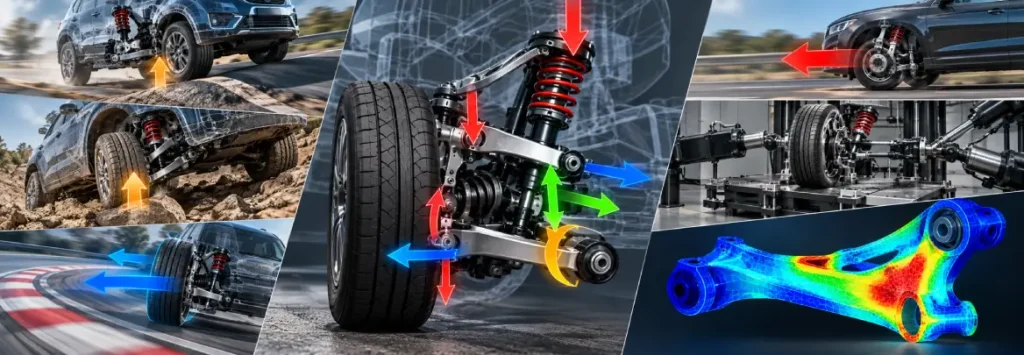
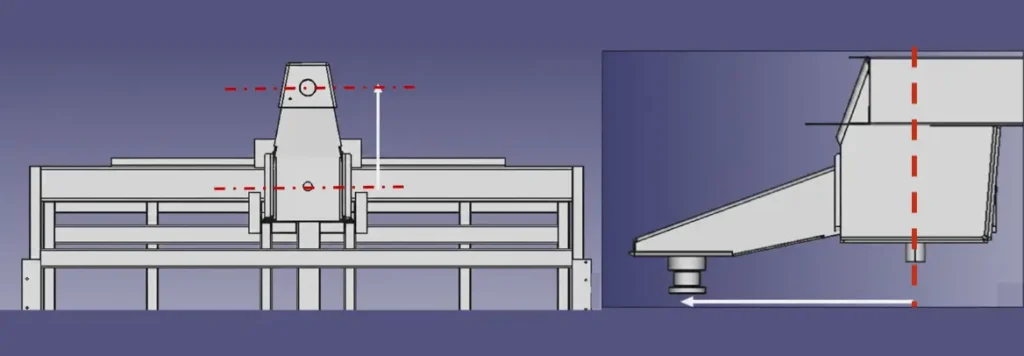
A structural model is only useful when the conditions represented in the model are relevant to the real engineering problem.
Loads and constraints can have a significant influence on simulation results. Incorrect assumptions can lead to results that appear technically precise but do not represent actual product behavior.
Our structural simulation process therefore considers the relationship between:
Product → Operating Conditions → Loads → Constraints → Material Behavior → Structural Response
Understanding this relationship helps engineers interpret why a structure behaves the way it does.
This can be especially important when investigating an unexpected structural issue or comparing simulation results with physical observations.
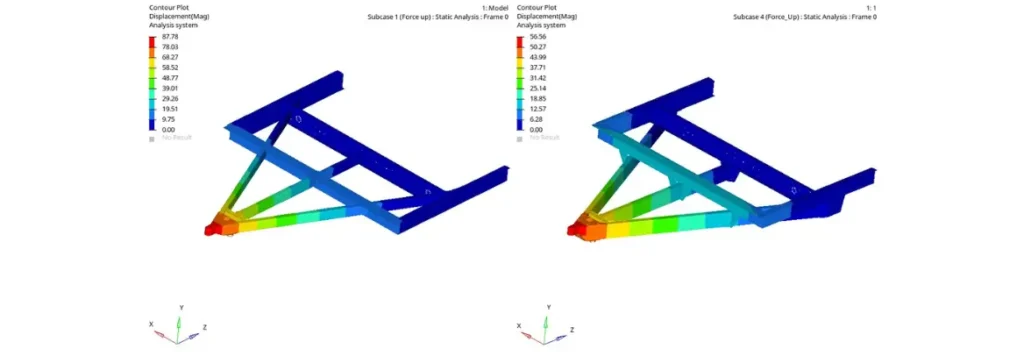
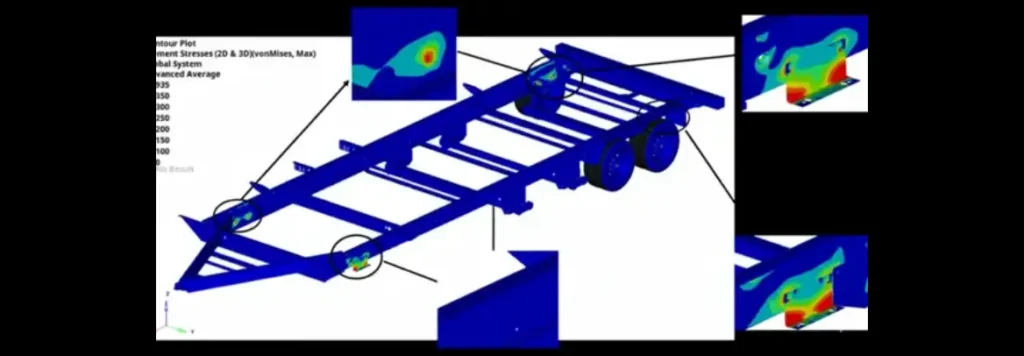
Stress Concentration and Critical Areas
Structural problems frequently begin in localized areas rather than across an entire component.
Changes in geometry, holes, corners, mounting points, joints, thickness transitions, and other features can affect how loads move through a structure.
Structural simulation can help identify areas that deserve closer engineering attention.
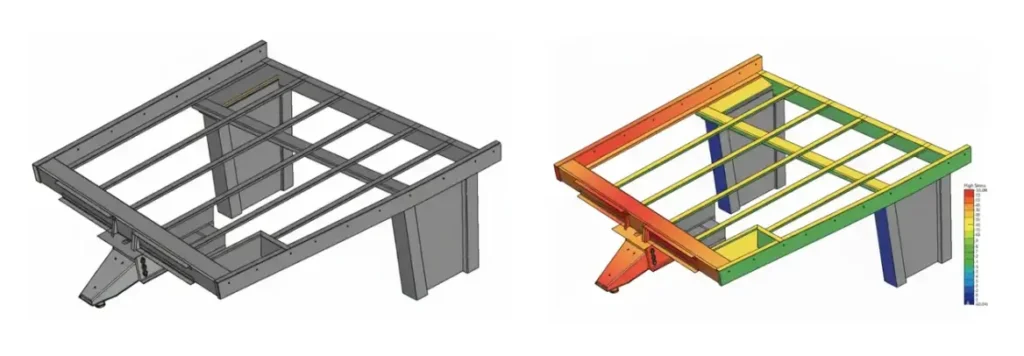
Our stress analysis services in Michigan can help evaluate:
- High-stress regions
- Load concentrations
- Structural discontinuities
- Local deformation
- Critical interfaces
- Design-sensitive areas
Once a critical region has been identified, engineers can investigate potential design changes and evaluate their effect through additional simulation.
This provides a more systematic way to improve a design than relying entirely on physical trial and error.
Deformation, Deflection, and Stiffness Evaluation
A product does not necessarily need to experience a structural failure to have a performance problem.
Excessive movement or flexibility can affect the way a product operates.
For example, deformation may influence alignment, fit, sealing, movement, clearances, vibration, or interaction between components.
Our structural deformation and stiffness analysis services help engineers evaluate these behaviors under specified loading conditions.
Simulation can be used to compare different:
- Geometries
- Materials
- Structural reinforcements
- Thicknesses
- Mounting configurations
- Support conditions
This can help determine whether a design provides the required balance between structural rigidity and other product objectives.
Design Improvement Without Guesswork
Engineering design often involves competing requirements.
Increasing material may improve strength but add weight. Increasing thickness may improve stiffness but affect manufacturing or cost. Adding reinforcement may improve performance but create packaging or assembly challenges.
Structural simulation can help engineers understand these trade-offs before committing to a design change.
Our engineering team can support simulation-driven design improvement by evaluating alternatives and examining how modifications affect structural behavior.
This may involve comparing several design iterations rather than analyzing only one final configuration.
The resulting information can help engineering teams make design decisions based on measurable structural performance.
Lightweight Structural Design
Weight reduction is an important objective in many engineering applications.
Reducing unnecessary material can improve efficiency, transportation costs, handling, performance, or system-level energy consumption. However, lightweighting needs to be balanced against strength, stiffness, durability, and other requirements.
Structural simulation provides a way to investigate where material can potentially be reduced and where structural reinforcement may be necessary.
Our engineers can evaluate design alternatives to help organizations explore a balance between:
- Structural strength
- Stiffness
- Weight
- Material usage
- Durability
- Product requirements
The objective is not simply to make a component lighter. It is to understand how much structural performance can be achieved with an appropriate use of material.
Structural Analysis for Assemblies and Connected Components
Many real-world products depend on multiple components working together.
The behavior of one component can influence another through fasteners, joints, mounts, interfaces, brackets, supports, or other connections.
In these situations, analyzing a single part may not provide the complete engineering picture.
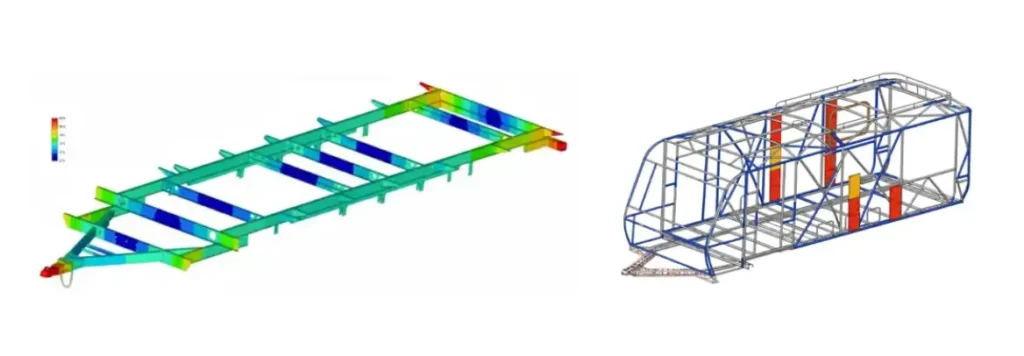
Our structural simulation services can be applied to assemblies where understanding load transfer and component interaction is important.
Assembly-level simulation can help engineers investigate:
- How loads move through the system
- Which components carry the greatest loads
- How interfaces affect structural response
- Where deformation occurs
- How design changes affect neighboring components
This can provide a broader perspective when structural performance depends on the interaction of several parts.
Investigating Existing Product Problems
Structural simulation is also valuable after a product has already been developed.
An unexpected crack, deformation, failure, excessive movement, or premature durability issue can require engineers to determine what caused the problem.
Simulation can be used as part of an engineering investigation to recreate relevant operating conditions and evaluate potential causes.
Our structural analysis support can help teams investigate:
- Unexpected structural failures
- Excessive deformation
- High-stress locations
- Design weaknesses
- Load-related problems
- Structural performance differences
- Potential corrective designs
The purpose is to provide additional engineering evidence that can help narrow down the cause and evaluate possible solutions.
Structural Durability Considerations
Many products operate under changing and repeated loads rather than a single static condition.
When structural performance must be maintained over an extended operating life, durability becomes an important consideration.
Our structural simulation capabilities can support engineering evaluations involving repeated or variable loading conditions.
This can help teams examine the relationship between operating loads and structural response and identify areas that may require additional durability attention.
Applications can include components and systems subjected to:
- Repeated mechanical loads
- Variable operating conditions
- Cyclic loading
- Dynamic loading
- Long-term service conditions
Where required, structural analysis can be considered alongside broader load and durability engineering activities.
Structural Simulation for Different Engineering Industries
There is no single industry that owns structural simulation.
The same fundamental engineering questions appear across different sectors: Will the product carry the expected load? Will it deform too much? Is the design sufficiently stiff? Where are the critical areas? Can the design be made lighter without compromising performance?
Our structural simulation services in Michigan can support organizations developing:
Industrial and Manufacturing Products
Evaluate machinery, equipment, fabricated components, assemblies, tooling, and other manufactured products.
Mechanical Systems
Investigate the structural response of mechanical components and systems during development and improvement programs.
Transportation Products
Assess structural performance of components and systems exposed to operational loading.
Energy and Power Equipment
Evaluate engineered components exposed to mechanical and operational loads.
Aerospace Applications
Support structural engineering studies where strength, stiffness, weight, and reliability are important considerations.
Medical and Technical Products
Analyze engineered products where structural behavior and mechanical reliability are important to performance.
Consumer and Commercial Products
Evaluate products subjected to handling, operating, impact, or other physical loads.
Heavy-Duty Equipment
Support structural assessment of components and systems operating under demanding mechanical conditions.
The appropriate simulation methodology depends on the product and engineering objective.
Simulation Correlation With Physical Results
Simulation is most useful when engineers understand how closely the virtual model represents the physical product.
Where physical test data is available, simulation results can be compared with measured behavior to investigate the level of agreement.
Our structural simulation correlation services can support this process.
Correlation may help identify whether differences between simulation and test results are associated with:
- Loading assumptions
- Boundary conditions
- Material properties
- Geometry
- Connections
- Model simplifications
- Other modeling factors
This information can then be used to improve the model where appropriate.
The purpose of correlation is not necessarily to make every simulation result identical to a test result. It is to understand the model’s behavior and establish an appropriate level of confidence for its intended engineering use.
From Engineering Data to Actionable Results
A structural simulation can generate a substantial amount of technical information.
Engineering teams, however, typically need answers.
Which area should be redesigned? Which concept performs better? Is the deformation acceptable? Does the component have sufficient stiffness? Where should additional testing focus?
Our engineers interpret structural simulation results within the context of the product and its requirements.
This allows the output of a simulation study to become part of the design process rather than remaining as a standalone analysis report.
Support for Michigan Engineering Teams
Michigan has a long-established engineering and manufacturing ecosystem, with activity spanning mobility, manufacturing, industrial products, advanced technologies, and other engineering-intensive sectors.
Companies operating in this environment may have their own engineering and design teams but still require additional simulation capacity or specialized structural expertise.
Caliber Technologies can work alongside internal engineering groups when additional support is needed.
This may be useful when:
- Internal engineers are managing multiple development programs
- A project requires additional FEA resources
- Specialized structural analysis experience is needed
- A new product requires virtual engineering support
- An existing design needs investigation
- Physical testing has identified an unexpected result
- Engineering schedules require additional simulation capacity
External simulation support can give your organization access to additional engineering capability without requiring every structural analysis requirement to be handled internally.
A Structural Simulation Partner for Product Development
Choosing a simulation provider is about more than selecting someone who can create an FEA model.
The engineering team needs to understand the product, the operating environment, the question being investigated, and the implications of the results.
Caliber Technologies approaches structural simulation from that engineering perspective.
We can become involved at the point where your team needs:
A second engineering perspective
Use simulation to investigate a structural concern or evaluate an important design decision.
Additional simulation capacity
Extend your existing engineering team’s ability to handle demanding development schedules.
Specialized structural expertise
Bring in additional engineering experience for a project that requires simulation beyond your current capabilities.
Development support
Use structural simulation throughout a product development program as designs evolve.
A Focused Process for Structural Simulation
Our approach can be adapted to the complexity of your project, but the work generally begins with understanding the engineering objective.
Engineering Requirement
We establish what needs to be evaluated and what information your team needs from the analysis.
Product and Operating Conditions
We review the product, geometry, materials, interfaces, and conditions under which it is expected to operate.
Simulation Definition
The appropriate modeling strategy, loads, constraints, and analysis requirements are established.
Virtual Analysis
The structural simulation is performed and the relevant results are evaluated.
Engineering Review
Critical findings are examined in relation to the product requirements and intended use.
Design Direction
The results can then support design modifications, further simulation, physical testing, or other engineering decisions.
This keeps the analysis connected to the reason it was commissioned in the first place.
Why Companies Choose Caliber Technologies
Engineering-Focused Thinking
We approach simulation as an engineering problem-solving activity rather than simply a software exercise.
Experience Across Product Development
Structural simulation can be required during concept development, detailed design, troubleshooting, optimization, and validation. Our services can support different stages of the product lifecycle.
Multi-Industry Application
Our structural simulation expertise can be applied across different industries and product types rather than being restricted to one market.
Flexible Engagement
You can engage our engineering team for a defined project, additional capacity, or continuing development support.
Practical Interpretation
Simulation results are most useful when they help answer a real engineering question. We focus on interpreting results in the context of the product and its requirements.
Structural Simulation Services Throughout Michigan
Caliber Technologies supports engineering organizations throughout Michigan, including Detroit, Grand Rapids, Warren, Sterling Heights, Ann Arbor, Lansing, Flint, Dearborn, Livonia, Troy, and surrounding areas.
Our structural simulation services can support companies involved in manufacturing, industrial engineering, product development, transportation, energy, technology, and other engineering-driven industries.
Whether you are evaluating a new component, improving an existing product, investigating a structural issue, or looking for additional engineering simulation capacity, our team can work with you to define the appropriate approach.
Have a Structural Engineering Challenge?
A structural problem can become expensive when it is discovered late in development.
Simulation gives your engineering team an opportunity to investigate product behavior earlier, compare potential solutions, and make more informed decisions before committing to the next stage of development.
If you need structural FEA, stress analysis, deformation analysis, stiffness evaluation, structural durability simulation, design optimization, or engineering support for a structural problem, Caliber Technologies can help.
Talk to our engineering team about your project and find out how structural simulation can support your product development goals in Michigan.
How We Provide Services
Project Scope Based Services
Time Based Projects
On-site Resource Assignment
Strategic Consulting Services
We are very glad to get client review.

Have a question? Send us a message, and we’ll respond shortly.
Tackle your toughest technical challenges in automotive engineering and reach your product development goals by leveraging the expertise of our trusted engineers.