Why RV Slide-Out Assemblies Develop Alignment Problems
RV slide-outs extend the usable interior space of a recreational vehicle, but their operation depends on the structural stability of the slide-out room, supporting floor, opening, and extension mechanism.
When these structures deflect under load, the slide-out may no longer remain properly aligned with its opening or support system. This can contribute to uneven gaps, increased friction, seal problems, or binding during extension and retraction.
For RV manufacturers, the challenge is to determine whether the problem comes from structural deformation, support conditions, mechanism alignment, or a combination of factors.
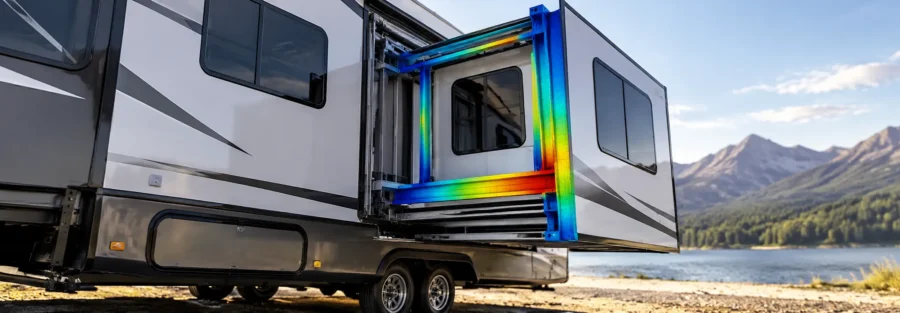
Structural finite element analysis (FEA) helps engineers evaluate how the slide-out assembly and surrounding body structure deform under representative loading conditions.
What Causes Excessive Deflection in RV Slide-Outs?
1. Floor and Support Structure Flexibility
The slide-out floor must support its own weight, furniture, appliances, and other expected loads. Depending on the design, these loads may produce bending in the floor structure and supporting members.
If the floor deflects excessively, the slide-out may change position relative to its guides, rollers, or extension mechanism. The resulting misalignment can affect smooth operation and load distribution.
FEA can help identify which floor members, support points, or structural connections contribute most to the deformation.
2. Distortion Around the Slide-Out Opening
Creating a slide-out opening interrupts the surrounding wall and body structure. The header, side posts, floor connections, and adjacent frame members must transfer loads around this opening.
If the surrounding structure lacks sufficient stiffness, the opening may distort under body loads or slide-out weight. Even relatively small changes in geometry can matter when the mechanism depends on controlled clearances and alignment.
Engineers can use structural analysis to evaluate deformation around the opening and assess whether changes to member dimensions, connections, or reinforcement improve stiffness.
3. Uneven Loading Across the Slide-Out Room
The location of furniture, appliances, storage, and other components affects how loads are distributed across the slide-out floor.
A concentrated load or an uneven distribution may produce more local deformation than a uniform loading assumption predicts. This can influence roller reactions, guide loads, floor bending, and the alignment of the moving room.
Analysis should therefore represent realistic load locations and the support conditions of the actual design.
4. Body Flex and Connection Movement
An RV body experiences loads from road inputs, chassis movement, and uneven support conditions. Depending on the construction, some of this movement may be transferred to the slide-out opening and its mechanism.
If the slide-out structure and surrounding body respond differently, the relative movement can affect clearances and operating loads.
Evaluating the slide-out in isolation may miss this interaction. The model should include enough of the surrounding body structure to represent the load path and deformation that influence slide-out alignment.
How FEA Helps Evaluate Slide-Out Deflection
Measure Total and Local Deformation
FEA predicts how the structure moves under defined loads and constraints. Engineers can examine total displacement, floor bending, opening distortion, and relative movement between the slide-out room and its supporting structure.
The most useful result is not necessarily the maximum displacement anywhere in the model. It is the deformation that affects functional requirements, such as guide alignment, seal contact, and clearance between moving and fixed components.
Identify Structural Weak Points
Displacement and stress results help engineers identify members or connections that contribute disproportionately to the overall deformation.
Potential areas for investigation include floor beams, opening headers, side posts, support brackets, and joints between the slide-out and the main body structure.
This helps distinguish a local stiffness problem from a broader structural issue and supports more targeted design changes.
Evaluate Design Alternatives
Engineers can compare alternative member sections, reinforcement layouts, floor structures, and connection designs before manufacturing revised prototypes.
Each option should be assessed for both stiffness and strength. Increasing stiffness in one area may shift loads into another member or connection, so the complete load path should be reviewed after significant changes.
The goal is to control functional deformation without adding unnecessary material or creating new stress concentrations.
How to Investigate Slide-Out Binding Through Structural Analysis
When a slide-out binds, structural deflection is one possible cause, but it should not be assumed to be the only one. Mechanical wear, adjustment, guide condition, actuator synchronization, and installation tolerances can also affect operation.
A useful engineering investigation follows a clear sequence:
- Define the symptom: Identify where binding occurs, whether it happens during extension or retraction, and whether it changes with loading or vehicle support conditions.
- Measure the geometry: Record relevant gaps, alignment, floor position, and opening dimensions where practical.
- Establish realistic load cases: Include the slide-out’s self-weight, expected contents, and relevant body or chassis loading conditions.
- Run structural analysis: Evaluate deflection at critical interfaces and identify potential sources of misalignment.
- Compare findings with physical measurements: Use inspection or testing to determine whether the predicted deformation explains the observed problem.
This approach helps avoid unnecessary reinforcement when the actual cause lies in the mechanism or assembly tolerances.
Structural FEA for RV Slide-Out Assemblies
Caliber Technologies supports structural simulation and engineering analysis for vehicle structures and assemblies. For RV slide-out projects, FEA can help evaluate floor deformation, opening stiffness, support loads, and alignment-sensitive interfaces.
The analysis scope should reflect the slide-out mechanism, body construction, loading conditions, functional clearances, and available test data.
Investigating slide-out binding, excessive floor deflection, or opening distortion? Contact Caliber Technologies at operations@thecalibertech.com to discuss your structural analysis requirements.