
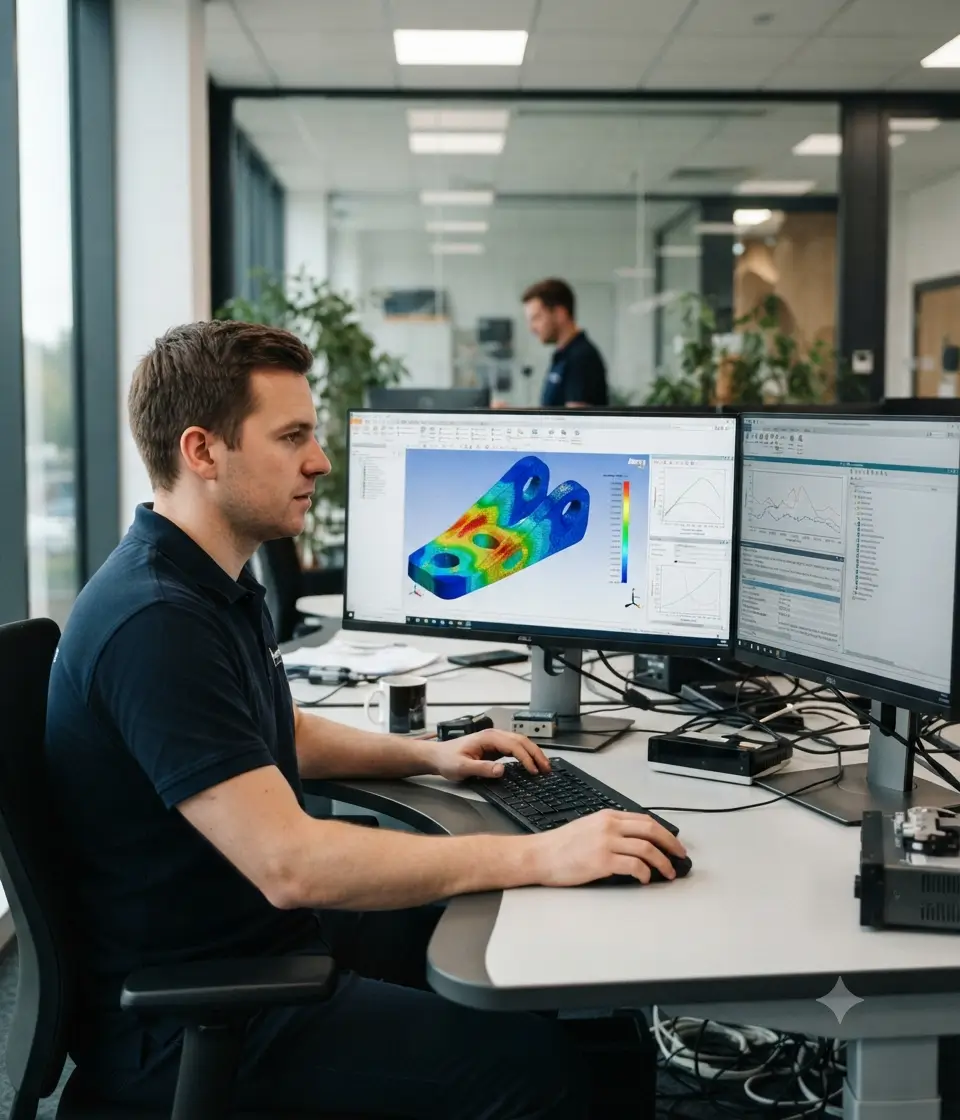
CAE Consulting Services in Michigan
Caliber Technologies provides CAE consulting services in Michigan for companies that need additional engineering simulation expertise for product development, design evaluation, testing, and technical problem-solving. We work with businesses across industries and support engineering teams with the analysis and simulation capabilities they need to move projects forward.
Our services include engineering simulation, FEA, structural analysis, CFD, thermal analysis, durability and load analysis, NVH, dynamic simulation, control validation, CAE tool development, simulation correlation, and enterprise CAE consulting.
Whether you need support for a defined engineering project, help investigating a product issue, or additional CAE resources for an active development program, our team can work with you based on your requirements.
Talk to Caliber Technologies about your CAE consulting needs in Michigan.
Additional CAE Expertise for Engineering and Product Development Teams
Engineering teams do not always need outside support because they lack engineering knowledge.
Often, they need support because a project has become more complex, development timelines are tight, or internal specialists are already committed to other priorities.
A product development program may suddenly require additional structural analysis.
A prototype may produce results that need further investigation.
A design change may affect durability, vibration, temperature, or system performance.
Or a company may have strong internal engineering capabilities but need access to a specific area of CAE expertise for a limited period.
This is where external CAE consulting can become a practical extension of the engineering team.
Caliber Technologies works with clients that need experienced simulation support without requiring them to build every CAE capability internally.
We can become involved in a specific analysis or provide broader engineering support as a project develops.
Supporting Product Validation and Engineering Decisions
Before a product reaches production, engineering teams often need to answer a series of questions.
Does the design meet the required performance criteria?
How will the product behave under expected operating conditions?
What happens when loads change?
Will repeated use create durability concerns?
Does the design need to be modified before additional testing?
Physical testing remains an important part of engineering validation.
However, testing alone may not always explain why something happened.
A prototype can show that a component failed without immediately revealing the combination of conditions that caused the failure.
CAE can provide another layer of engineering insight.
Simulation can help teams study the forces, temperatures, movement, vibration, fluid behavior, and other conditions affecting a product.
The goal is not to replace engineering judgment or physical validation.
The goal is to give engineering teams more information before making the next decision.
CAE Consulting Services for Michigan Businesses
Structural Simulation and Finite Element Analysis
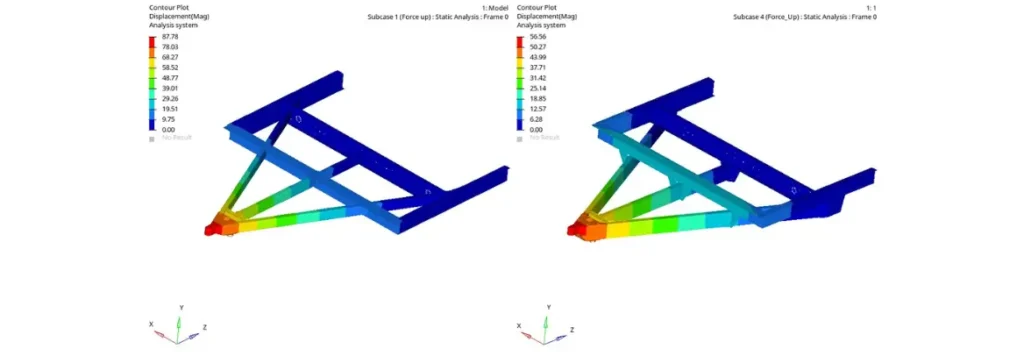
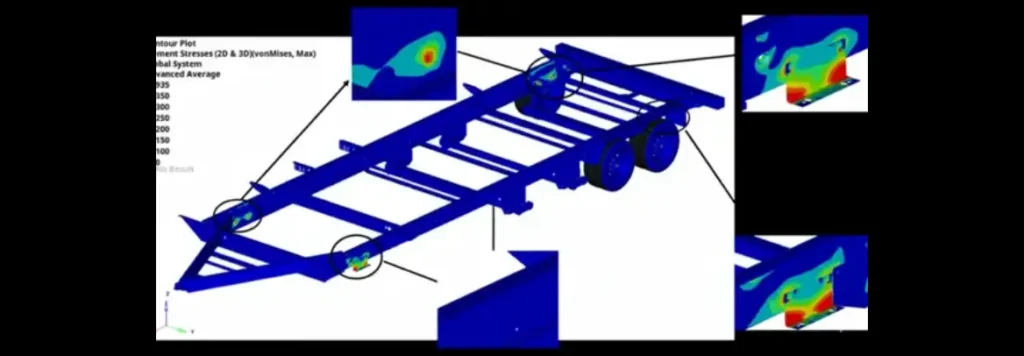
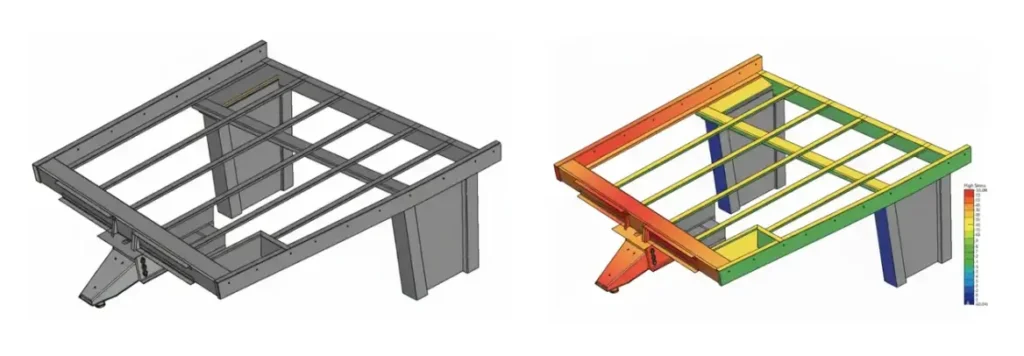
Structural analysis is often required when engineers need to understand how a component, assembly, or larger system responds to applied forces.
A design may need to meet requirements related to strength, stiffness, deformation, weight, or long-term reliability.
Our FEA consulting services in Michigan can support:
- Structural strength analysis
- Stress and strain evaluation
- Displacement analysis
- Deformation studies
- Stiffness assessment
- Component simulation
- Assembly analysis
- Material behavior
- Linear analysis
- Nonlinear analysis
- Structural optimization
- Failure investigation
A useful FEA project starts with the actual engineering conditions.
The same geometry can produce very different results depending on the applied loads, constraints, material properties, contacts, and operating assumptions.
That is why engineering context matters.
Our team works with the available design and operating information to help develop a model that addresses the engineering question.
The result can help teams decide where a design may need improvement and which options deserve further investigation.
Load Generation and Durability Analysis
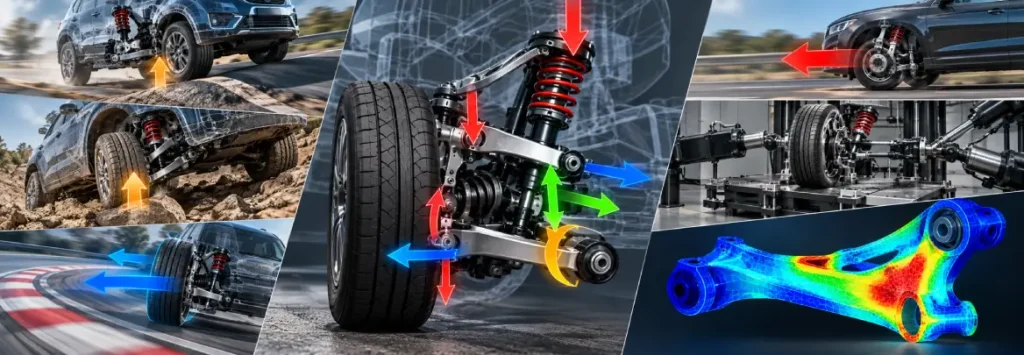
Products that operate repeatedly are exposed to changing loads over time.
Understanding these loads is important when evaluating durability.
A component may experience different conditions during startup, normal operation, transportation, acceleration, deceleration, or other operating events.
Our CAE consulting support includes load generation and durability analysis for engineering teams that need to better understand these conditions.
We can help with:
- Engineering load development
- Repeated loading studies
- Durability analysis
- Fatigue investigations
- Structural life evaluation
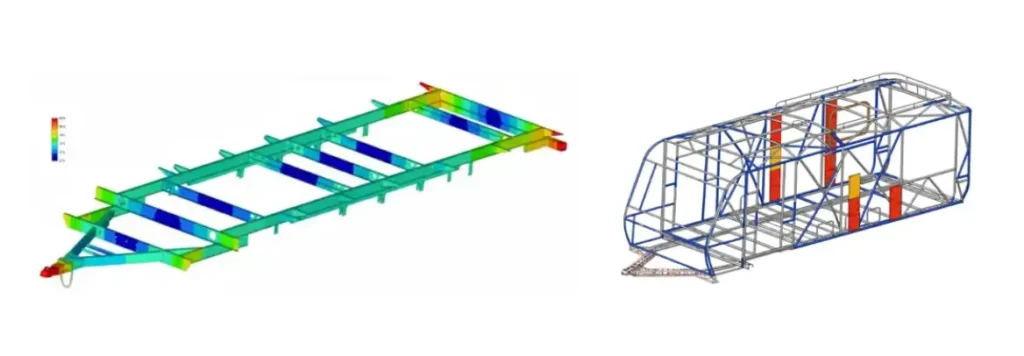
- Identification of highly stressed areas
- Design comparison
- Reliability-focused engineering studies
For product development teams, durability simulation can provide useful insight before committing to additional prototypes or design changes.
The goal is to understand the conditions that matter most and use that information to guide engineering decisions.
CFD Consulting for Engineering Systems
Fluid behavior can influence many aspects of product performance.
Air may not move where it is needed.
A fluid path may create unnecessary pressure losses.
Cooling may be uneven.
Heat transfer may affect reliability.
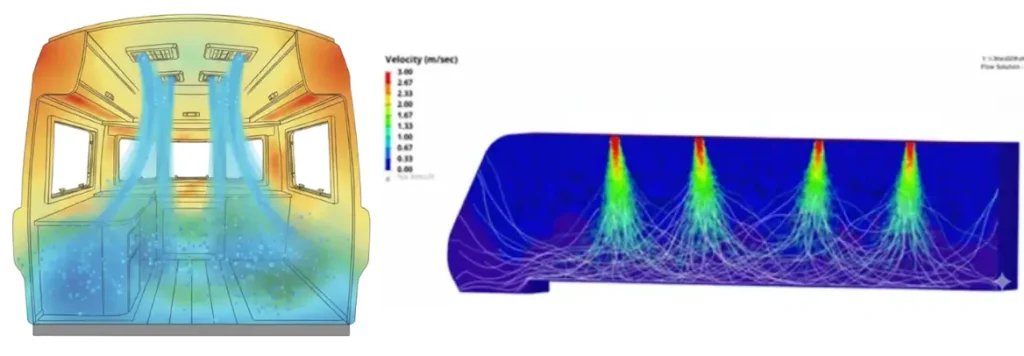
Computational Fluid Dynamics helps engineering teams investigate these issues.
Our CFD consulting services in Michigan can support:
- Airflow studies
- Fluid flow analysis
- Internal flow
- External flow
- Pressure distribution
- Pressure drop
- Cooling evaluation
- Heat transfer
- Thermal-fluid behavior
- Flow optimization
CFD can help engineers investigate what is difficult to see during physical testing.
For example, measurements may indicate that one part of a system is experiencing higher temperatures. CFD can help investigate how airflow, fluid movement, geometry, and heat transfer may be contributing to the problem.
This information can support a more focused engineering response.
Thermal Analysis
Temperature can affect how materials, components, and systems perform.
In some cases, thermal concerns are obvious.
A product overheats.
A component reaches an unacceptable temperature.
A cooling system does not perform as expected.
In other cases, thermal effects may gradually influence performance and reliability.
Our thermal simulation support can help engineering teams investigate:
- Temperature distribution
- Heat generation
- Heat transfer
- Cooling performance
- Thermal loading
- Operating conditions
- Thermal design changes
Thermal analysis can help teams compare options before building or modifying physical prototypes.
It can also provide additional information when a physical test identifies a problem but the underlying cause is not clear.
NVH and Dynamic Analysis
Dynamic problems can be difficult to diagnose.
A system may behave normally at one operating condition and produce excessive vibration at another.
A component may respond strongly at a particular frequency.
Noise may be linked to structural or mechanical behavior that is not immediately visible.
Our CAE consulting capabilities include support for:
- Modal analysis
- Natural frequency analysis
- Mode shapes
- Dynamic response
- Structural vibration
- NVH investigations
- Simulation and test correlation
Dynamic analysis helps engineering teams understand how structures and systems respond when conditions change.
This can be valuable when investigating product performance, vibration issues, or long-term reliability concerns.
System-Level and Multiphysics Simulation
Some engineering challenges involve more than one component or physical behavior.
A product may experience mechanical loading while temperature changes the material response.
Fluid flow may influence cooling.
Mechanical systems may interact with electrical components and controls.
System-level and multiphysics simulation can help investigate these relationships.
Depending on the project, the analysis may involve:
- Structural behavior
- Thermal conditions
- Fluid dynamics
- Mechanical systems
- Electromechanical systems
- Controls
The purpose is to understand the engineering interactions that matter to the product.
Not every project requires a highly complex model.
We focus on selecting an approach that is appropriate for the question being investigated.
Simulation Support When Testing Reveals a Problem
Physical testing can answer an important question:
Did the product meet the requirement?
But when the answer is no, engineering teams still need to understand why.
This is where CAE consulting can be particularly valuable.
Simulation can help investigate:
- Unexpected failures
- Excessive deformation
- Thermal issues
- Vibration problems
- Durability concerns
- Unexpected system behavior
- Differences between design expectations and test results
For example, if a component fails during testing, engineers may use structural analysis to investigate stress concentrations and loading conditions.
If a system overheats, thermal and fluid analysis may help identify the factors affecting cooling.
If vibration occurs under a particular operating condition, dynamic analysis can help investigate the system response.
Simulation gives engineering teams a structured way to investigate the problem and compare possible solutions.
Simulation Correlation and Engineering Validation
Simulation models are only useful when engineering teams understand their assumptions and limitations.
A CAE model may use estimated loads, material properties, boundary conditions, or operating conditions.
Testing can provide valuable information about whether those assumptions are appropriate.
Caliber Technologies provides simulation correlation and validation support to help engineering teams connect virtual analysis with physical results.
This can involve:
- Comparing simulation with test data
- Reviewing model assumptions
- Investigating differences
- Improving engineering inputs
- Supporting model validation
- Developing confidence in future simulations
Correlation is not simply about making two sets of numbers match.
The differences can provide valuable information.
They may indicate that the physical product is behaving differently than expected or that an important modeling assumption needs to be reconsidered.
A better understanding of these differences can improve future engineering work.
Control System Development and Validation
Many products and systems depend on software and controls.
Testing every control scenario only with physical hardware can require significant time and resources.
Caliber Technologies supports control system development and validation through simulation and virtual testing.
Our capabilities include:
- Model-in-the-Loop (MIL)
- Software-in-the-Loop (SIL)
- Hardware-in-the-Loop (HIL)
- Control algorithm development
- Virtual validation
- Virtual calibration
These methods allow engineering teams to evaluate system and control behavior under a range of conditions.
Virtual testing can provide additional opportunities to investigate edge cases and changing operating conditions before relying entirely on physical hardware.
CAE Tool Development and Engineering Process Support
Engineering organizations often have established calculation methods and analysis processes.
Some are managed through spreadsheets.
Others depend on specialized internal tools.
Over time, these tools may become increasingly important to the engineering workflow.
Caliber Technologies provides CAE tool development and engineering process support to help companies improve and maintain these capabilities.
Our services can support:
- Physics-based engineering tools
- Internal engineering applications
- CAE automation
- Analysis workflow development
- Existing tool improvement
- Engineering software support
- Tool modernization
- Process automation
The goal is to make engineering knowledge easier to apply while reducing unnecessary manual work.
A better engineering workflow can also improve consistency across projects and teams.
When an Engineering Team Should Bring in a CAE Consultant
External CAE consulting can be useful in many situations.
When Internal Resources Are Fully Committed
An engineering team may have simulation capability but lack capacity for an additional project.
Outside support can help prevent important analysis work from becoming a bottleneck.
When a Specialized Analysis Is Needed
Some simulation disciplines require experience that is not needed on every project.
A consulting partner can provide specialized expertise when required.
When Testing Produces Unexpected Results
CAE can help investigate why a product is behaving differently from expectations.
When Product Development Needs to Move Faster
Simulation can help teams evaluate design alternatives before building every physical version.
When the Company Is Expanding Its CAE Capability
Outside consulting can support organizations that are developing new processes, tools, and simulation workflows.
Industries We Support
Caliber Technologies provides CAE consulting services for all industries.
We do not limit our engineering simulation capabilities to automotive or any single sector.
Our work is based on the engineering challenge and the physical behavior of the product or system.
We can support organizations involved in:
- Manufacturing
- Industrial machinery
- Heavy equipment
- Energy systems
- Power generation
- Renewable energy
- Aerospace
- Electronics
- Electromechanical systems
- Robotics
- Automation
- Medical equipment
- HVAC and thermal systems
- Consumer products
- Commercial products
- Transportation
- Construction equipment
- Mechanical product development
- Advanced technology
And other industries where engineering simulation can provide useful product information.
Why Work With Caliber Technologies?
Engineering teams need more than simulation output.
They need to understand what the results mean and how those results can support the next decision.
Caliber Technologies works with clients by focusing on the engineering objective first.
Before beginning an analysis, we look at questions such as:
- What is the product expected to do?
- What operating conditions matter?
- What problem needs to be investigated?
- What information is already available?
- What decision does the team need to make?
This helps keep the analysis connected to the engineering work.
Engineering Experience
Our work is supported by more than 25 years of engineering experience across products and technologies.
Flexible Support
We can support focused projects, ongoing development programs, and organizations that need additional engineering resources.
Industry-Neutral Engineering Expertise
Our services are based on engineering principles and simulation capabilities that can support products across industries.
A Collaborative Working Model
We work alongside client engineering teams and provide support based on the requirements of the project.
Enterprise CAE Assessment for Growing Engineering Organizations
Some companies have access to simulation tools but are unsure whether their overall CAE capability is meeting the organization’s needs.
The issue may involve processes, skills, validation practices, tool usage, or how simulation is integrated into product development.
Caliber Technologies provides enterprise CAE assessment and consulting to help organizations evaluate their current capabilities.
An assessment can examine:
- CAE processes
- Engineering workflows
- Simulation maturity
- Team skills
- Tool usage
- Process gaps
- Validation approaches
- Opportunities for improvement
The purpose is to help organizations identify practical next steps.
Rather than recommending a generic process, the assessment should reflect the company’s engineering goals and current situation.
Flexible Ways to Work With Our CAE Consultants
Project-Based Support
A defined project may require a specific analysis with clear objectives and deliverables.
Examples include:
- Structural analysis
- CFD
- Thermal simulation
- Durability studies
- Dynamic analysis
- Simulation correlation
Time-Based Engineering Support
Some development programs evolve continuously.
Time-based support provides flexibility when future engineering requirements cannot be fully defined at the beginning.
Extended Engineering Support
Longer programs may require additional technical resources over an extended period.
Caliber Technologies can provide support based on the requirements of the engineering program.
CAE Consulting Support for Companies Across Michigan
Caliber Technologies provides CAE consulting support for engineering and product development teams throughout Michigan.
We can work with businesses in locations including:
- Detroit
- Grand Rapids
- Warren
- Sterling Heights
- Ann Arbor
- Lansing
- Dearborn
- Troy
- Livonia
- Novi
- Kalamazoo
- Other locations throughout Michigan
Whether your organization is developing a new product, investigating a technical issue, validating a design, or looking for additional simulation expertise, we can discuss your requirements and determine how our CAE consulting services may support your team.
Discuss Your Engineering Challenge With Our CAE Consultants
You may already know what type of simulation you need.
“We need an FEA study.”
“We need help with CFD and thermal analysis.”
“We need to investigate a durability issue.”
“We need additional CAE resources.”
Or you may simply know that something is not working as expected.
“The prototype failed.”
“Our test results are different from the model.”
“We have a vibration problem.”
“We need another engineering perspective.”
That is enough to start a conversation.
Looking for CAE Consulting Services in Michigan?
Caliber Technologies provides engineering simulation and CAE consulting support for companies across industries.
Our capabilities include FEA, structural analysis, CFD, thermal analysis, durability and fatigue analysis, NVH, dynamic simulation, control validation, CAE tool development, simulation correlation, and enterprise CAE assessment.
Contact Caliber Technologies today to discuss your Michigan engineering project and learn how our CAE consultants can support your product development and engineering goals.
How We Provide Services
Project Scope Based Services
Time Based Projects
On-site Resource Assignment
Strategic Consulting Services
We are very glad to get client review.
Have a question? Send us a message, and we’ll respond shortly.
Tackle your toughest technical challenges in automotive engineering and reach your product development goals by leveraging the expertise of our trusted engineers.