
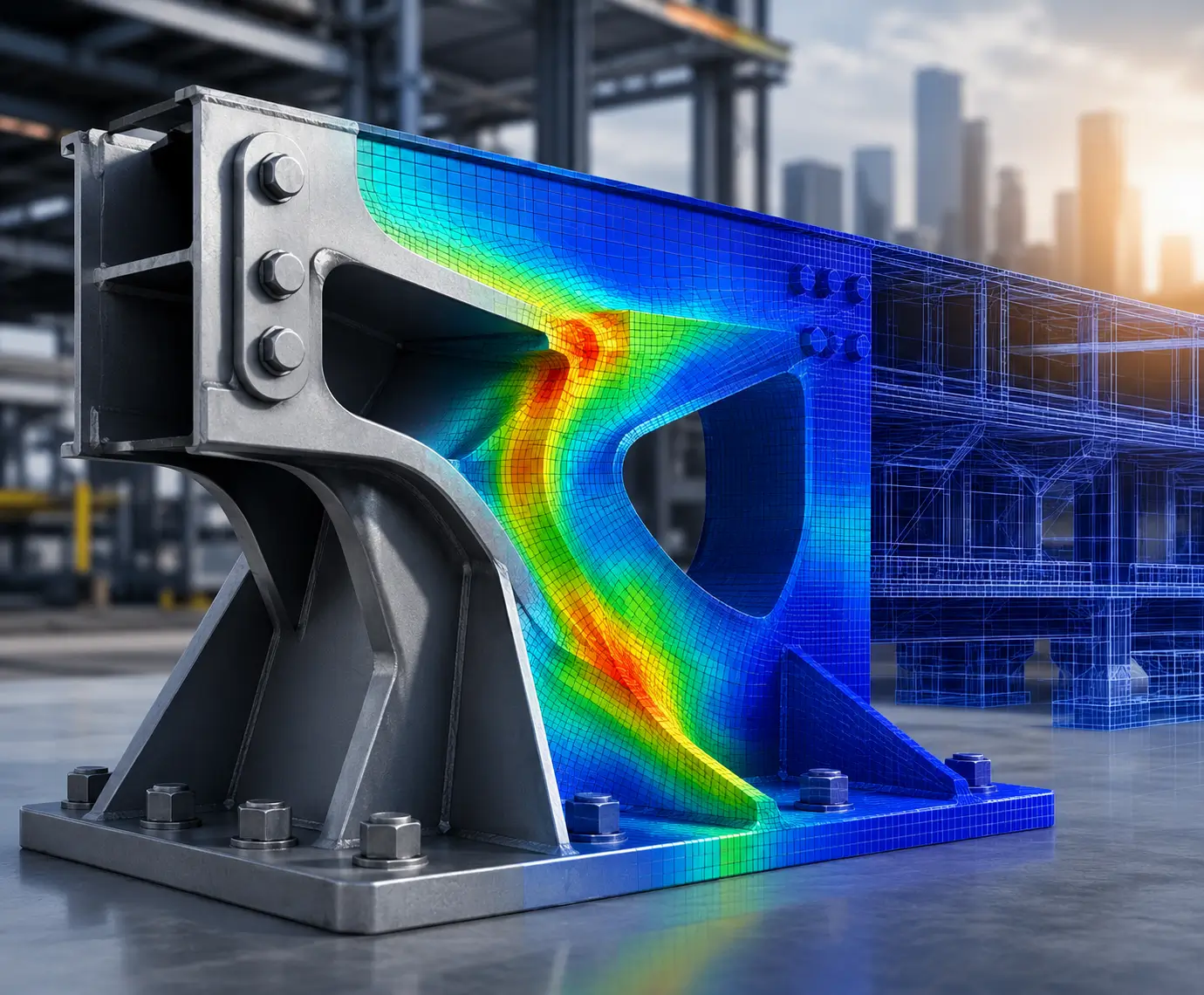
Structural Simulation Services in Texas
When Structural Simulation Becomes the Right Engineering Tool
There are many reasons an engineering team may need structural simulation.
Sometimes the objective is straightforward. A new component needs to be evaluated before a prototype is built.
In other cases, the problem may be more difficult to define. A product is deforming unexpectedly, a design needs to become lighter, a physical test has produced an unexpected result, or a manufacturing change may affect structural performance.
Our structural simulation services in Texas can support all of these situations.
Common requirements include:
- Assessing a new product design
- Evaluating an existing component
- Investigating structural performance
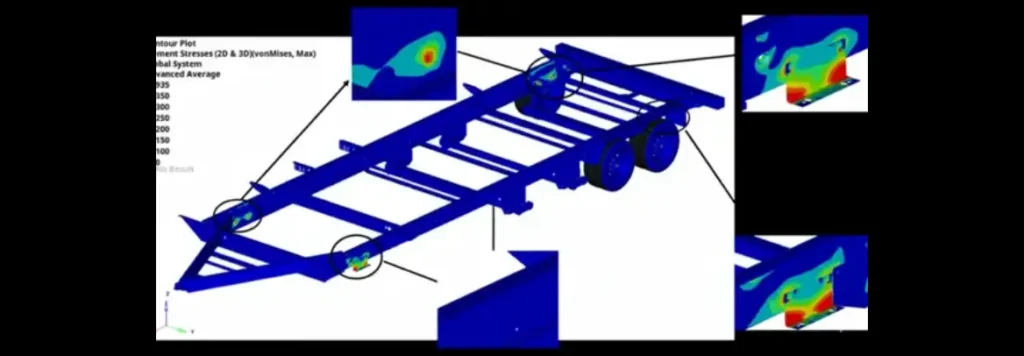
- Understanding stress concentrations
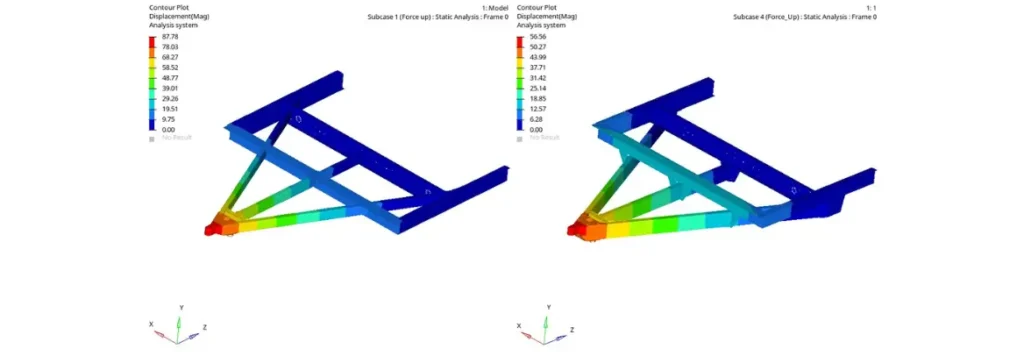
- Predicting deformation
- Measuring structural stiffness
- Evaluating load transfer
- Comparing design alternatives
- Supporting lightweighting
- Investigating structural failures
- Evaluating durability-related concerns
- Supporting physical validation
The starting point is the engineering requirement. The simulation approach follows from that requirement.
From CAD Geometry to Engineering Understanding
A CAD model describes what a product looks like.
Structural simulation helps engineers investigate what that product may do when it is exposed to loads.
That difference is important.
Two products can have similar geometry but behave differently because of material selection, thickness, connections, loading, constraints, or operating conditions.
Our engineers consider these factors when developing a structural simulation approach.
The objective is to establish a useful relationship between:
Design Geometry + Materials + Loads + Constraints = Structural Response
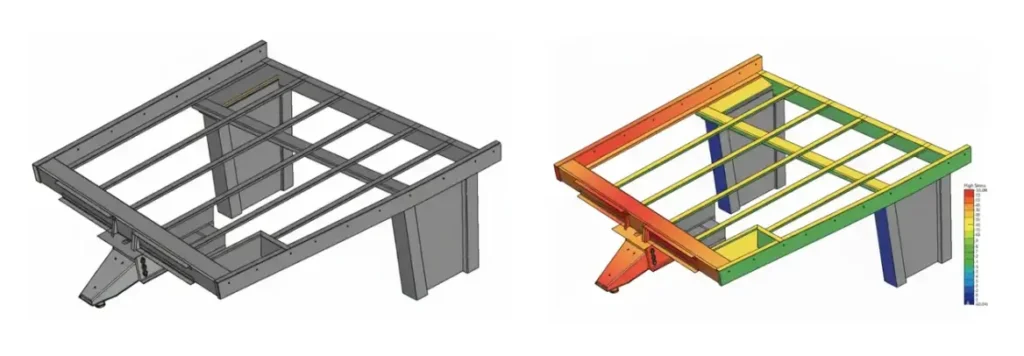
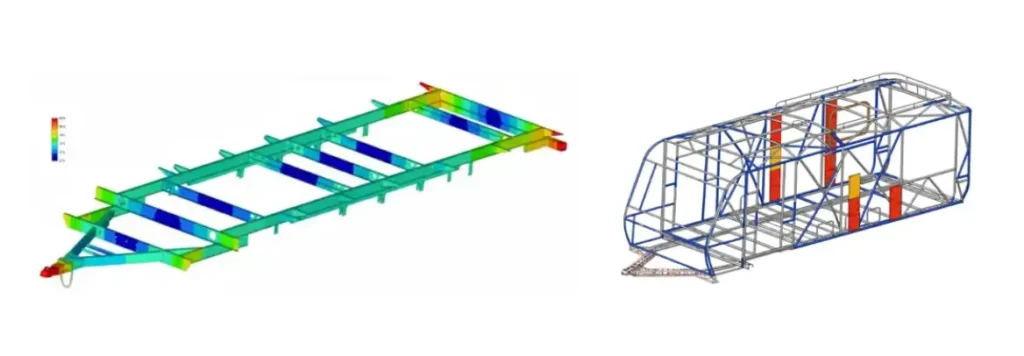
The resulting analysis can provide information about stress, strain, displacement, deformation, stiffness, and other structural characteristics relevant to the application.
Structural FEA for Components and Products
Our structural FEA services in Texas provide engineering teams with a virtual method for investigating product behavior.
Finite Element Analysis can be applied at different stages of development and at different levels of product complexity.
Individual Parts
Analyze components where the primary concern is the structural performance of a specific part.
Subassemblies
Consider multiple interacting components where connections and load transfer influence the response.
Larger Systems
Evaluate broader structural behavior where multiple components contribute to the engineering outcome.
The appropriate model depends on what your engineering team needs to determine.
A focused model can be more effective than an unnecessarily complex model when the engineering question is specific. Conversely, an assembly-level model may be necessary when component interaction is central to the problem.
What Structural Simulation Can Reveal
A structural simulation can provide engineers with a detailed picture of how a design responds to specified conditions.
Depending on the analysis, results can provide insight into:
Stress
Identify areas where structural loading produces significant stress.
Strain
Understand how the material responds to applied loading.
Displacement
Measure movement of components or structural regions.
Deformation
Evaluate changes in shape under operating conditions.
Stiffness
Understand how much a structure resists deformation.
Load Transfer
Investigate how forces move through components and assemblies.
Structural Response
Compare the behavior of different design configurations.
The importance of each result depends on the product and engineering objective.
Improve a Design Before Manufacturing
Design changes become more difficult and expensive once tooling, production processes, and supply chains are established.
Simulation can provide an opportunity to investigate potential changes earlier.
Suppose an engineering team is considering:
- Increasing or reducing material thickness
- Changing a structural feature
- Adding reinforcement
- Removing unnecessary material
- Changing a material
- Modifying a mounting arrangement
- Altering a component interface
Instead of immediately producing a new physical prototype, the team can use simulation to investigate how the proposed change may influence structural behavior.
This can help narrow down promising options before moving into physical development.
Structural Optimization for Weight and Performance
Many products need to achieve more than basic structural strength.
They may need to be lighter, more efficient, easier to manufacture, or more cost-effective while maintaining required performance.
Our structural optimization support can help engineers evaluate these competing requirements.
Simulation can be used to investigate how changes to geometry and material affect:
- Strength
- Stiffness
- Weight
- Structural efficiency
- Load distribution
- Product performance
The goal is to help engineering teams understand the trade-offs involved in design changes.
A lighter component is not necessarily a better component if it sacrifices required stiffness or durability. Simulation helps make these relationships more visible during the development process.
Structural Behavior Under Different Loading Conditions
A product may encounter different types of loads during its operating life.
Depending on the application, these may include:
- Static forces
- Dynamic forces
- Pressure
- Weight
- Acceleration
- Operational loads
- Repeated loads
- Combined loading conditions
Our structural engineering team can help determine how the relevant loading conditions should be represented in the simulation.
This is important because the same structure can respond very differently depending on how and where a load is applied.
Understanding the loading environment also helps engineers interpret simulation results in the context of actual product use.
Engineering Support for Structural Stiffness
Some applications place greater emphasis on deformation and rigidity than on ultimate strength.
A product may need to maintain its geometry under load or prevent excessive movement between components.
Our stiffness analysis services in Texas can help engineering teams evaluate these requirements.
Stiffness studies can support development of:
- Mechanical components
- Industrial equipment
- Structural assemblies
- Precision products
- Transportation systems
- Machinery
- Lightweight structures
Engineers can compare different design configurations and investigate how geometry, thickness, material, reinforcement, and support conditions influence stiffness.
Stress Concentrations and Structural Weak Points
A structure’s overall performance does not always reveal where the actual engineering concern lies.
A small region can experience substantially different loading from the rest of the component.
Structural simulation can help identify areas that deserve additional attention.
These may include:
- Sharp geometry transitions
- Mounting locations
- Holes and openings
- Joints
- Interfaces
- Brackets
- Thickness changes
- Other structural discontinuities
Once identified, these areas can be investigated through design modifications or additional analysis.
This can help engineering teams focus their effort where it is most relevant.
Use Structural Simulation to Investigate Failures
Existing products can generate some of the most challenging structural engineering questions.
When a component cracks, bends, breaks, or fails to maintain its intended performance, replacing the part may not address the underlying problem.
Simulation can help investigate possible causes.
Our structural failure analysis support can examine potential relationships between the product design, loading conditions, constraints, material characteristics, and observed behavior.
Depending on the available engineering information, simulation can be used to compare potential scenarios and evaluate proposed corrective designs.
This can provide useful technical evidence during a broader engineering investigation.
Structural Durability and Repeated Loading
Some products are expected to operate for long periods under repeated mechanical loads.
In these applications, structural performance needs to be considered over the expected operating life rather than only under one loading event.
Our structural simulation capabilities can support durability-related studies where repeated or variable loading is relevant.
These evaluations can help engineering teams investigate:
- Cyclic loading
- Variable operating conditions
- Repeated mechanical loads
- Critical structural locations
- Load histories
- Potential fatigue-related concerns
- Design alternatives
Structural simulation can be used alongside broader durability and load analysis when the engineering problem requires it.
Structural Simulation Throughout Product Development
The value of simulation is not limited to the final design.
Different questions arise at different development stages.
Concept Development
Determine whether a proposed structural concept is technically viable.
Design Development
Investigate detailed geometry, material, stress, deformation, and stiffness.
Design Optimization
Compare alternatives intended to improve performance or reduce weight.
Prototype Development
Use simulation to identify areas that may require particular attention during physical testing.
Validation
Compare virtual predictions with physical test observations where appropriate.
Product Improvement
Evaluate proposed changes to existing products before implementing them.
Using simulation at multiple stages can help engineering teams maintain a stronger connection between design decisions and expected product behavior.
Structural Simulation for Texas Industries
Texas has a broad engineering and industrial economy, which creates structural simulation opportunities across many different product categories.
Our structural simulation services can support companies working in:
Energy and Power
Evaluate structural components and equipment exposed to mechanical and operational loads.
Industrial Manufacturing
Analyze machinery, equipment, fabricated components, tooling, and assemblies.
Aerospace
Support structural evaluations where strength, stiffness, weight, and reliability are important engineering considerations.
Transportation
Investigate structural behavior of transportation components and engineered systems.
Construction and Infrastructure
Evaluate engineered structural components and systems where simulation is appropriate.
Medical Technology
Support mechanical performance evaluation of engineered medical products and equipment.
Consumer Products
Analyze products exposed to handling, impact, operational loads, or repeated use.
Heavy Equipment
Evaluate structures and components subjected to demanding operating environments.
Automotive and Mobility
Support structural evaluation of vehicle components, mobility systems, and related products.
The service is not tied to a particular industry. The methodology is adapted to the product and the engineering question.
Structural Simulation for Manufacturing Changes
A design can perform differently when manufacturing processes change.
Changes to thickness, material, joining methods, geometry, tolerances, or component interfaces can affect structural behavior.
Simulation can help engineering teams investigate these potential effects before implementing a production change.
For example, when evaluating a proposed manufacturing change, engineers may want to understand whether it could influence:
- Stiffness
- Stress distribution
- Deformation
- Load transfer
- Structural durability
This can provide another layer of engineering assessment before a change is introduced into production.
Connect Simulation With Physical Testing
Simulation provides predictions. Testing provides measurements.
Bringing these two sources of information together can strengthen the engineering development process.
Our team can support structural simulation correlation when appropriate test data is available.
The comparison can help investigate differences related to:
- Loads
- Boundary conditions
- Materials
- Geometry
- Interfaces
- Model assumptions
Understanding these differences can help determine whether the simulation model is sufficiently representative for its intended purpose or whether refinement is needed.
Additional Structural Engineering Capacity
Your organization may already have experienced structural engineers.
The challenge may simply be workload.
A major development program, multiple concurrent projects, unexpected testing issues, or a short-term increase in analysis requirements can put pressure on internal resources.
Caliber Technologies can provide additional structural simulation capacity when your team needs it.
Support can be useful for:
- Backlog reduction
- Specific FEA projects
- Design investigations
- Product development
- Structural troubleshooting
- Simulation correlation
- Engineering optimization
This allows your internal team to maintain ownership of its products while accessing additional engineering resources when required.
Structural Simulation Without Unnecessary Complexity
More simulation is not always better simulation.
A model should contain enough detail to answer the engineering question effectively.
Our engineers consider the intended use of the results when determining the appropriate simulation approach.
This helps keep attention on:
- The product requirement
- Relevant loading
- Important structural behavior
- Appropriate model detail
- Useful outputs
- Engineering decisions
The objective is to avoid analysis becoming unnecessarily complicated while still representing the engineering problem appropriately.
What Makes an Effective Structural Simulation Study?
A successful simulation study typically depends on several elements working together.
Clear Objective
The engineering team should know what it needs the simulation to determine.
Appropriate Representation
The model should represent the product and relevant physical behavior at a suitable level.
Relevant Loading
The analysis should consider loading conditions appropriate to the intended application.
Engineering Judgment
Results need to be interpreted rather than simply reported.
Validation Where Appropriate
Physical data can provide valuable evidence about the relationship between simulation and real-world behavior.
Actionable Output
The final result should help the engineering team decide what to do next.
These principles keep structural simulation connected to product development.
Why Caliber Technologies?
Engineering Rather Than Software-Only Analysis
Structural simulation is ultimately about understanding physical product behavior. Our engineers focus on the engineering problem behind the model.
Support Across Product Types
We work with engineered products and systems across industries rather than limiting structural simulation to one market.
Practical Development Support
Simulation can be used for concept evaluation, detailed development, troubleshooting, optimization, and validation.
Flexible Resource Model
You can engage structural simulation expertise for a defined project or use additional support as part of a broader development program.
Engineering Interpretation
The value of simulation comes from understanding what the results mean for the product. Our focus remains on turning analysis into useful engineering insight.
Serving Engineering Teams Across Texas
Caliber Technologies provides Structural Simulation Services throughout Texas, supporting engineering and product-development organizations in Houston, Dallas, Austin, San Antonio, Fort Worth, Arlington, Plano, Irving, El Paso, and surrounding areas.
Our services can support companies involved in manufacturing, energy, aerospace, transportation, technology, industrial products, medical technology, consumer products, and other engineering-intensive fields.
Whether you have a new product to evaluate, an existing design that needs improvement, or a structural problem that requires investigation, our engineering team can help determine how simulation can contribute to the solution.
Let’s Discuss Your Structural Simulation Requirement
You may already have a defined FEA requirement. Or you may simply have a structural engineering problem and need help determining how to investigate it.
Caliber Technologies can support both situations.
From stress and deformation analysis to stiffness evaluation, structural FEA, load analysis, durability-related simulation, design optimization, and simulation correlation, our engineers can provide structural simulation support based on your product and engineering objectives.
Contact Caliber Technologies to discuss Structural Simulation Services in Texas and find out how simulation can support your next engineering decision.
How We Provide Services
Project Scope Based Services
Time Based Projects
On-site Resource Assignment
Strategic Consulting Services
We are very glad to get client review.

Have a question? Send us a message, and we’ll respond shortly.
Tackle your toughest technical challenges in automotive engineering and reach your product development goals by leveraging the expertise of our trusted engineers.