
Structural Simulation Services in Ohio
Make Structural Decisions With Better Engineering Data
Product development frequently involves decisions that cannot be answered by looking at geometry alone.
A component may appear robust but have a localized stress concentration. A lightweight design may meet its strength requirement but deform more than expected. A structural modification may solve one problem while creating another elsewhere in the assembly.
Simulation gives engineers a way to examine these situations virtually.
Our structural simulation services can provide insight when your team needs to:
Evaluate a new concept
Compare alternative designs before selecting a direction.
Check an existing design
Investigate whether a product is likely to perform as required under defined conditions.
Understand an engineering problem
Explore possible reasons for unexpected stress, deformation, or structural failure.
Improve a product
Evaluate modifications intended to increase stiffness, reduce weight, or improve structural performance.
Prepare for testing
Identify critical areas and develop a more informed physical validation plan.
Compare design alternatives
Use simulation results to understand how changes in geometry, materials, or structural configuration affect performance.
The simulation becomes a decision-making tool rather than simply another step in the engineering workflow.
Structural Engineering Analysis for Real-World Conditions
Products rarely operate under idealized conditions.
Depending on the application, a structure may experience combinations of forces, pressure, weight, acceleration, vibration, impact, repeated loading, or other operating conditions.
A structural simulation can represent appropriate loading and boundary conditions to investigate how the design responds.
Our engineering team can support analysis involving:
- Applied forces
- Moments
- Pressure
- Gravity
- Static loading
- Dynamic loading
- Operational loading
- Component interfaces
- Constraints
- Load combinations
The purpose is to develop an analysis that represents the engineering question with an appropriate level of detail.
The results can then be examined in terms of the structural characteristics that matter to your product.
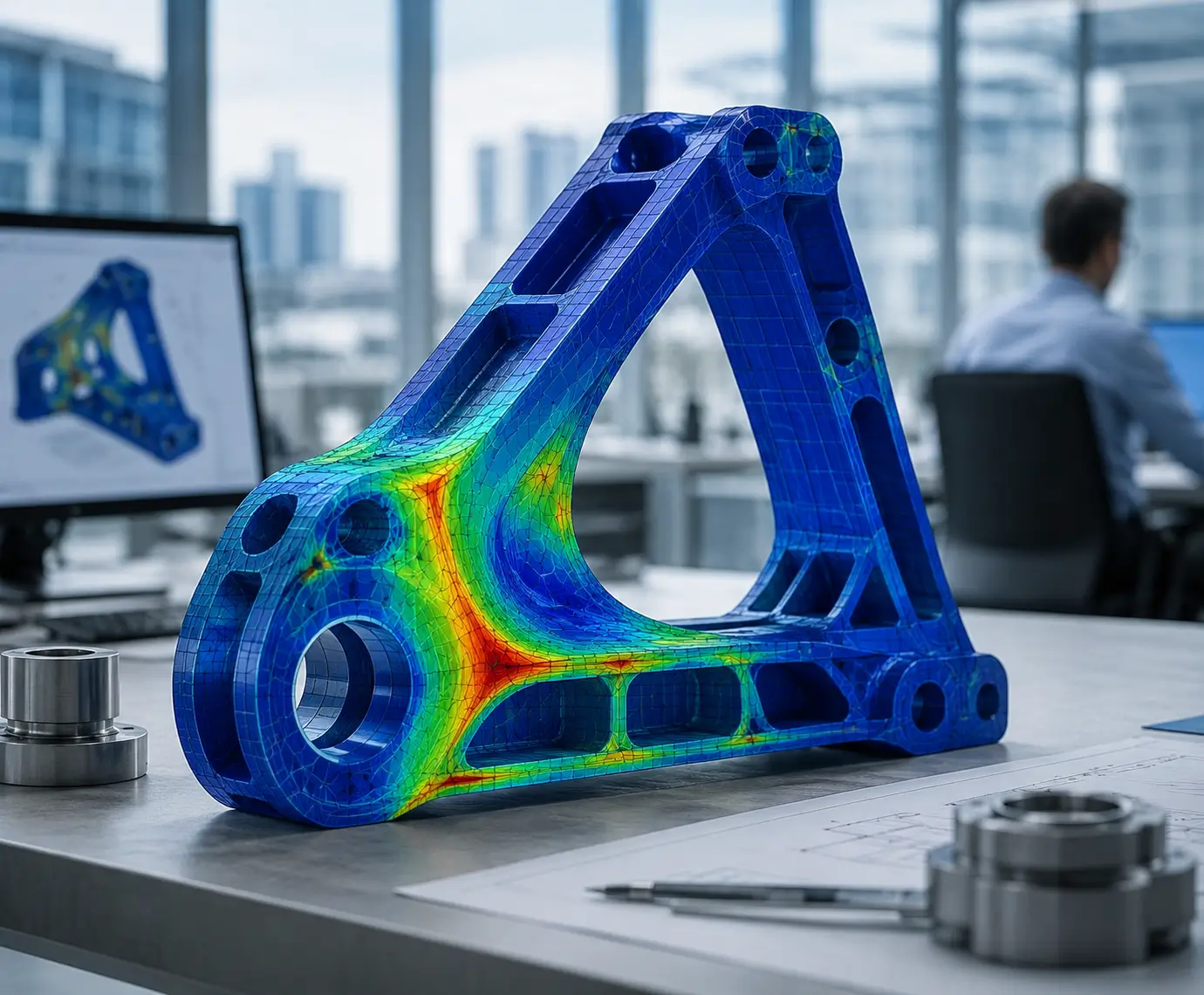
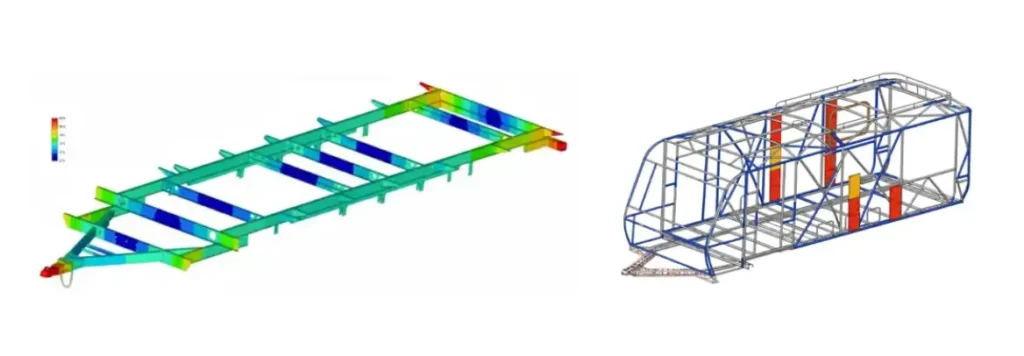
See Where the Structure Is Working Hardest
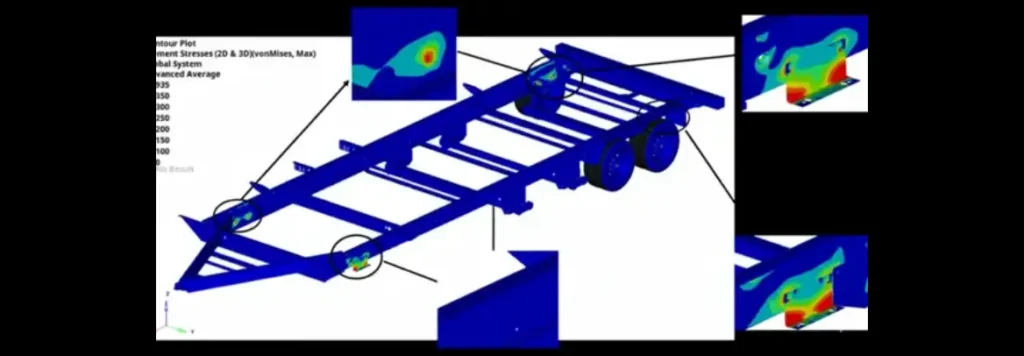
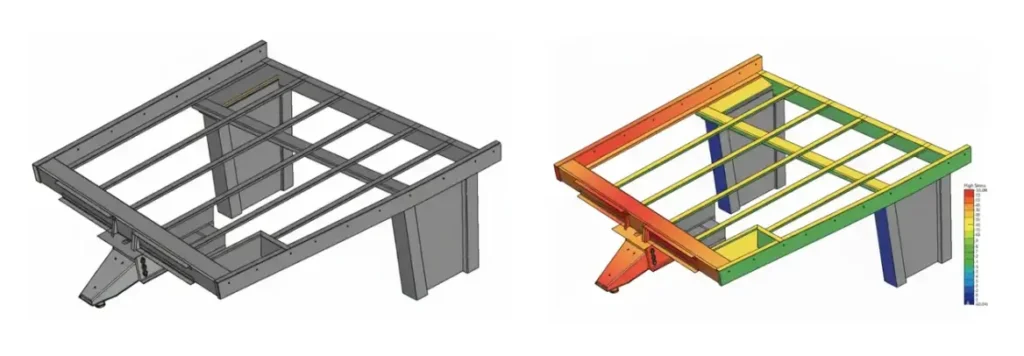
One of the most useful applications of structural simulation is identifying areas where the design experiences significant structural demand.
Stress distribution can reveal regions that deserve additional engineering attention.
Our structural stress analysis services in Ohio can help teams investigate:
- Stress concentrations
- Highly loaded areas
- Load transfer regions
- Geometry-sensitive locations
- Interfaces
- Mounting areas
- Structural discontinuities
Finding a critical area is only the beginning.
The next question is why the stress develops there and whether a design change could improve the structural response.
Simulation can be repeated across design iterations to evaluate potential improvements.
Measure How Much a Product Moves Under Load
Strength and deformation are closely related, but they are not the same engineering question.
A structure may remain below a specified stress limit while still deforming enough to affect product performance.
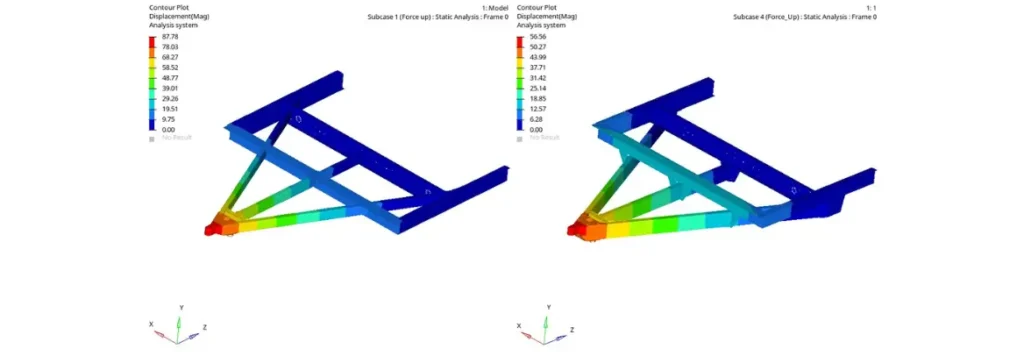
Our structural deformation analysis services help engineers evaluate how much a component or assembly moves when subjected to specified conditions.
This can be important when a product must maintain:
- Alignment
- Dimensional accuracy
- Clearances
- Position
- Fit
- Sealing
- Mechanical interaction
- Operational precision
Simulation can provide displacement information across the structure and help identify where excessive movement may occur.
This information can then be considered alongside design requirements when determining whether changes are necessary.
Determine Whether a Design Is Stiff Enough
Stiffness requirements can be important in both simple components and highly integrated systems.
The objective may be to prevent excessive deflection, maintain geometry, improve stability, or control how loads are transmitted through an assembly.
Our stiffness simulation services can help engineering teams evaluate structural rigidity under defined loading conditions.
Design variables can be compared to understand their influence on stiffness.
For example:
- Increasing or reducing thickness
- Changing geometry
- Adding reinforcement
- Altering support conditions
- Changing material
- Modifying mounting points
This type of analysis can be particularly useful when a team is trying to improve stiffness without simply adding more material.
Use Simulation to Compare Design Options
Engineering teams rarely have only one possible design.
A product may have several possible geometries, materials, reinforcement strategies, or structural configurations.
Building and testing every option physically can increase development time.
Simulation allows alternatives to be evaluated virtually.
Our structural design comparison services can help engineers understand how different concepts affect structural performance.
A comparison may examine:
| Design consideration | Simulation insight |
|---|---|
| Geometry | Effect on stress and deformation |
| Thickness | Effect on stiffness and structural response |
| Material | Effect on strength and weight |
| Reinforcement | Effect on local and global behavior |
| Mounting configuration | Effect on load transfer |
| Structural layout | Effect on overall performance |
The objective is not to identify a universally “best” design. It is to provide engineering data that helps your team select a design appropriate for its requirements.
Reduce Weight Without Losing Structural Performance
Lightweighting can be valuable across many industries.
Lower product weight may contribute to improved efficiency, reduced material consumption, easier handling, transportation benefits, or improved system performance.
However, weight reduction must be balanced against structural requirements.
Our structural lightweighting simulation services can help engineers evaluate where material may be reduced and how those changes influence strength and stiffness.
Simulation can be used to investigate:
- Material thickness
- Structural reinforcement
- Geometry
- Material selection
- Load paths
- Weight distribution
The analysis can help identify areas where material is structurally important and areas where alternative designs may provide opportunities for improvement.
Structural Simulation for New Product Development
When developing a new product, structural questions often appear before the design is finalized.
At this stage, simulation can be used to evaluate concepts and reduce uncertainty.
An engineering team may want to know whether a particular architecture is structurally viable before investing heavily in tooling or prototype development.
Our structural simulation for product development can support this early engineering work.
The analysis can help teams compare concepts and identify structural characteristics that should influence the detailed design.
As the product develops, additional simulations can then be performed on increasingly detailed models.
This creates an opportunity to use simulation throughout the development process rather than waiting until the final design stage.
Structural Simulation for Existing Products
Simulation can also provide value after a product has entered production.
Engineering teams may need to make changes because of:
- Component availability
- Material changes
- Manufacturing changes
- Cost reduction
- Weight reduction
- Customer requirements
- Performance improvements
- Reliability concerns
Before implementing a change, structural simulation can help determine whether the proposed modification is likely to affect product performance.
This can reduce uncertainty when modifying an established design.
Investigate Structural Failures With Simulation
When a component fails, the visible failure may not reveal the complete cause.
There may be a combination of loading, geometry, material behavior, assembly conditions, or operating conditions behind the problem.
Our structural failure investigation support can use simulation to evaluate possible scenarios.
Depending on the available information, engineers can investigate:
- Areas of high stress
- Unexpected deformation
- Load concentrations
- Structural weaknesses
- Component interactions
- Alternative loading conditions
- Potential design changes
Simulation can then be used to evaluate proposed corrective actions.
This creates an engineering framework for moving from observed problem → potential cause → design change → virtual evaluation.
Structural Analysis of Components and Assemblies
Some engineering questions can be answered by analyzing a single component.
Others require consideration of the complete assembly.
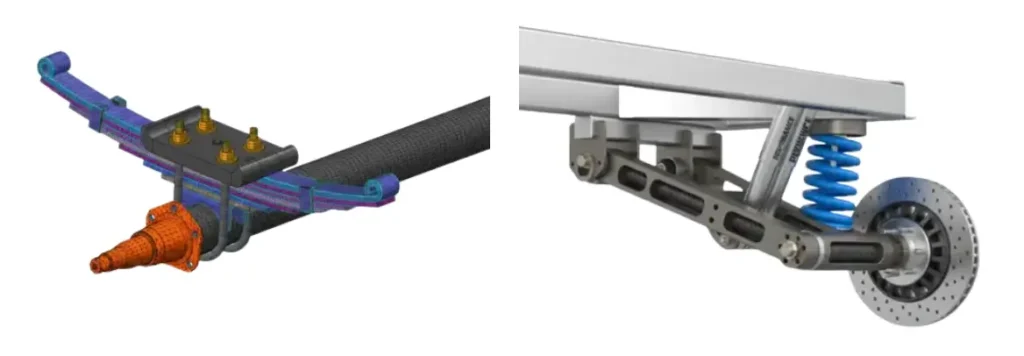
Our structural simulation services can be scaled to the product and the engineering requirement.
Individual Components
Useful for focused investigations of stress, deformation, stiffness, and structural strength.
Subassemblies
Useful when several components interact and transfer loads between one another.
Complete Systems
Useful when system-level structural behavior depends on multiple connected components.
The appropriate modeling level depends on what the simulation needs to determine.
Structural Durability Under Repeated Loads
A product may perform correctly under a single load and still experience problems over an extended operating life.
Repeated loading can gradually contribute to fatigue and other durability concerns.
Our structural simulation capabilities can support engineering studies involving repeated and variable loading conditions.
This can help teams examine:
- Cyclic loading
- Load histories
- Repeated operating conditions
- Critical structural regions
- Structural response
- Potential durability concerns
Where the engineering requirement calls for it, structural simulation can be considered alongside load and durability analysis.
Structural Simulation and Physical Validation
Simulation is most effective when its role in the broader validation process is clearly defined.
Physical testing provides information about the real product. Simulation provides a virtual representation that can be used to investigate design behavior and explore alternatives.
The two approaches can complement one another.
Our team can support simulation correlation with physical test data where appropriate.
Comparing virtual and physical behavior can help identify differences related to:
- Loads
- Constraints
- Material characteristics
- Geometry
- Interfaces
- Modeling assumptions
The resulting understanding can help engineers determine whether a model is appropriate for future design evaluations or needs further refinement.
Engineering Applications Across Ohio
Structural simulation is applicable to far more than one industry.
Ohio has a broad engineering and manufacturing base, making structural analysis relevant to organizations developing products, machinery, components, equipment, and technical systems.
Our services can support engineering applications in areas such as:
Industrial Manufacturing
Evaluate components, assemblies, machinery, and manufactured products.
Aerospace
Investigate structural behavior while balancing strength, stiffness, weight, and operating requirements.
Energy
Analyze components and equipment exposed to mechanical and operational loads.
Transportation
Evaluate structural response of components and systems used in transportation applications.
Heavy Equipment
Investigate structures subjected to demanding operating conditions and significant mechanical loads.
Medical Technology
Support mechanical evaluation of engineered medical products and equipment.
Consumer Products
Assess products subjected to handling, operating, impact, or repeated loading.
Mechanical Engineering
Provide structural analysis support for engineered components and systems across many product categories.
The specific simulation approach is determined by the product, loading environment, available information, and engineering objective.
When Your Internal Team Needs More Simulation Capacity
A company does not need to lack engineering expertise to benefit from an external structural simulation partner.
Internal engineering teams can become overloaded during major product launches, multiple concurrent development programs, or periods of increased validation activity.
A specialized external team can provide additional capacity when required.
Caliber Technologies can support organizations that need:
- Additional structural analysis resources
- FEA project support
- Engineering design evaluation
- Structural problem investigation
- Simulation correlation
- Design optimization support
- Ongoing product-development simulation
This allows your internal engineers to maintain ownership of the product while gaining additional simulation capability when needed.
A Better Way to Use Structural Simulation
The value of structural simulation depends heavily on how it is used.
A model can produce highly detailed results, but those results still need to be interpreted in relation to the actual product.
Our engineering approach focuses on connecting four elements:
Engineering Requirement
What does the product need to achieve?
Physical Reality
What loads and operating conditions will it experience?
Simulation
What does the virtual model predict?
Engineering Decision
What should the team do with that information?
Keeping these elements connected helps prevent simulation from becoming disconnected from the product-development process.
Structural Simulation Support From Concept to Validation
A structural simulation requirement does not necessarily begin with a finished CAD model.
Engineering teams may need support at different stages.
Concept Stage
Evaluate structural feasibility and compare initial concepts.
Development Stage
Investigate detailed geometry, loading, stress, deformation, and stiffness.
Optimization Stage
Compare modifications intended to improve performance or reduce weight.
Problem-Solving Stage
Investigate unexpected structural behavior or product failures.
Validation Stage
Compare simulation predictions with physical test results and support engineering verification.
This flexibility allows structural simulation to remain useful throughout the product lifecycle.
Why Choose Caliber Technologies?
Engineering Understanding
We approach structural simulation from the perspective of the engineering problem that needs to be solved.
Cross-Industry Capability
Our structural simulation services can support different products and industries rather than being limited to one application area.
Practical Results
The objective is to provide information that engineering teams can use to evaluate, improve, or validate their designs.
Flexible Engagement
Support can be structured around a defined project, additional engineering capacity, or ongoing product development requirements.
Simulation and Validation
Where appropriate, simulation can be connected with physical test data to improve understanding and confidence in the engineering model.
Structural Simulation Services Across Ohio
Caliber Technologies provides Structural Simulation Services throughout Ohio, supporting engineering and product-development organizations in Columbus, Cleveland, Cincinnati, Dayton, Toledo, Akron, Youngstown, Dublin, and surrounding areas.
Our services can support manufacturers, engineering companies, technology businesses, product developers, industrial organizations, and other companies that need to understand structural product performance.
Whether you are evaluating a new concept, optimizing an existing design, investigating a failure, or preparing for physical validation, our engineers can help determine how structural simulation can contribute to your development process.
Have a Structural Engineering Problem to Solve?
You may already know exactly what analysis you need. Or you may simply know that a product is not behaving as expected and need engineering support to understand why.
Either way, the first step is to define the engineering problem.
Caliber Technologies can support structural FEA, stress analysis, deformation analysis, stiffness evaluation, load analysis, structural durability studies, design optimization, and simulation correlation based on your requirements.
Contact Caliber Technologies to discuss your Structural Simulation Services in Ohio and find an engineering approach suited to your product and development goals.
How We Provide Services
Project Scope Based Services
Time Based Projects
On-site Resource Assignment
Strategic Consulting Services
We are very glad to get client review.

Have a question? Send us a message, and we’ll respond shortly.
Tackle your toughest technical challenges in automotive engineering and reach your product development goals by leveraging the expertise of our trusted engineers.