
Structural Simulation Services in California
Solve Structural Problems Before They Become Product Problems
A structural issue discovered late in product development can lead to redesigns, additional prototypes, manufacturing changes, and delays.
Simulation provides engineering teams with an opportunity to investigate structural behavior earlier.
Instead of waiting for a physical prototype to reveal a weakness, engineers can evaluate how a proposed design is expected to respond to its intended operating conditions.
Our structural simulation work can help answer practical questions such as:
- Where will the highest stresses occur?
- How much will a component deform?
- Is the structure sufficiently stiff?
- How are loads transferred through the product?
- Which design is likely to perform better?
- Can material be removed without compromising performance?
- What may be contributing to a structural failure?
- How will a proposed design change affect structural behavior?
- Does the virtual model reasonably represent the physical product?
These questions can arise during new product development, redesign, troubleshooting, optimization, or validation.
Our role is to use simulation to provide engineering insight that helps your team move the product forward.
Structural Simulation for California Product Development
California’s engineering landscape spans technology, manufacturing, aerospace, transportation, energy, medical technology, consumer products, and many other sectors.
Products in these industries can have very different requirements, but many share the need to understand structural behavior before production.
A component may need to remain rigid under load. A lightweight structure may need to withstand demanding operating conditions. A mechanical assembly may need to maintain alignment while subjected to repeated forces.
Structural simulation can provide a virtual environment for evaluating these requirements.
Depending on the project, our engineering team can support simulation during:
- Product concept development
- Engineering design
- Prototype development
- Design modification
- Product optimization
- Failure investigation
- Performance improvement
- Virtual validation
- Physical test preparation
- Engineering verification
The earlier structural questions are addressed, the more opportunity an engineering team typically has to incorporate the findings into the design.
Analyze the Structure Before You Build It
One of the major advantages of simulation is the ability to evaluate a design before every engineering change requires a physical prototype.
A virtual model can be used to compare different structural concepts and investigate the effect of design variables.
For example, engineers may want to understand what happens when they:
- Change material thickness
- Modify a structural feature
- Add or remove reinforcement
- Alter a mounting location
- Change a material
- Modify a connection
- Reduce weight
- Change the geometry
Rather than making each decision through physical trial and error, simulation can provide comparative information during the engineering process.
This does not replace physical testing. Instead, simulation and testing can work together to create a more efficient development strategy.
Finite Element Analysis for Real Engineering Questions
Finite Element Analysis (FEA) is one of the primary methods used for structural simulation.
Our FEA services in California can support the analysis of individual components, assemblies, and larger structural systems.
The appropriate model depends on the product and the engineering objective.
Structural FEA can be used to evaluate:
- Stress
- Strain
- Displacement
- Deformation
- Stiffness
- Load distribution
- Structural strength
- Load transfer
- Component interaction
- Critical regions
A technically sophisticated model is not automatically a useful model.
The simulation needs to represent the engineering problem appropriately. Loads, constraints, material properties, geometry, interfaces, and assumptions all influence the resulting behavior.
Our engineers focus on selecting an analysis approach that provides meaningful information for the decision your team needs to make.
Evaluate Structural Strength and Safety Margins
Engineering teams often need to determine whether a component or structure can withstand its expected operating conditions.
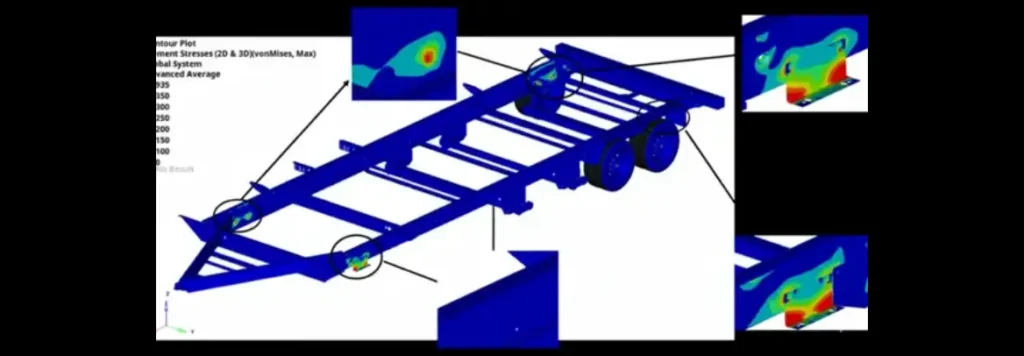
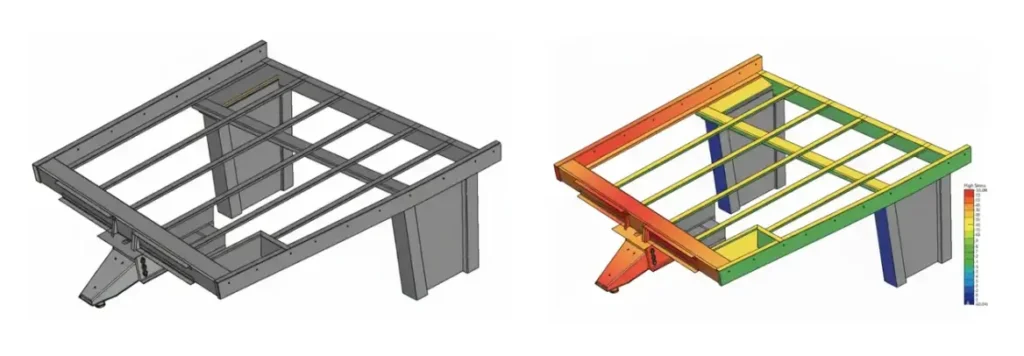
Structural simulation can provide insight into how a design responds to specified loads and where critical areas may occur.
Our structural strength analysis services can support engineering evaluations involving:
- Applied forces
- Mechanical loads
- Pressure
- Weight
- Operational conditions
- Load combinations
- Structural constraints
- Component interfaces
The resulting analysis can help engineers investigate whether a design meets its intended structural requirements and where additional attention may be necessary.
When a potential concern is identified, simulation can also be used to evaluate possible modifications.
This creates a useful feedback loop:
Analyze → Identify → Modify → Reanalyze
Instead of stopping after identifying a problem, engineering teams can use simulation to explore possible solutions.
Find Out Why a Design Deforms
Not every structural issue results in a broken component.
Excessive deformation can cause its own set of problems.
Movement or deflection can affect:
- Alignment
- Fit
- Clearance
- Sealing
- Component interaction
- Precision
- System operation
- Product appearance
- Long-term performance
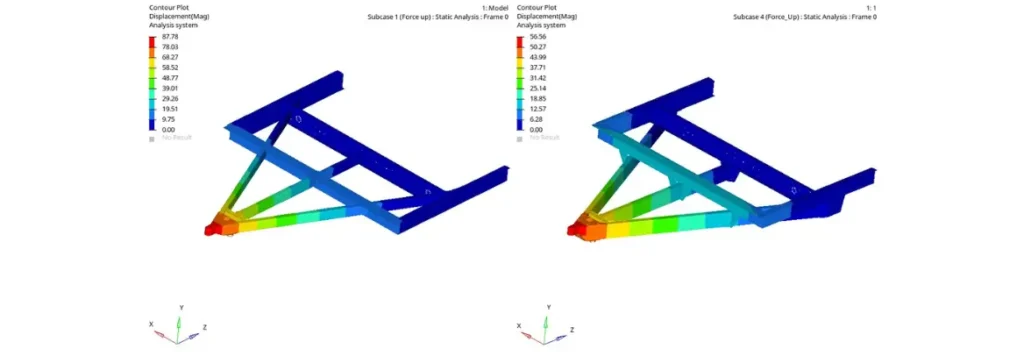
Our deformation analysis services help engineers understand how much a component or assembly moves under specified loading conditions.
Simulation can identify areas experiencing significant displacement and provide information about how geometry, material selection, support conditions, or reinforcement influence the result.
This is particularly useful when a product needs to maintain a specific shape or position while operating under load.
Understand Structural Stiffness
A structure’s ability to resist deformation is often as important as its ability to withstand stress.
Our stiffness simulation services in California help engineering teams evaluate the relationship between applied loads and structural movement.
Stiffness analysis can be useful when developing:
- Mechanical components
- Structural assemblies
- Industrial equipment
- Transportation systems
- Precision products
- Machinery
- Lightweight structures
- Consumer products
Simulation can allow engineers to compare different structural configurations and determine how changes influence rigidity.
This can be particularly useful when trying to improve stiffness without unnecessarily increasing material or weight.
Investigate Loads and Load Paths
A structure does not experience loads in isolation.
For an assembly, forces may enter through one component, pass through connections, and ultimately travel through several other structural elements.
Understanding this load path can be essential when investigating structural performance.
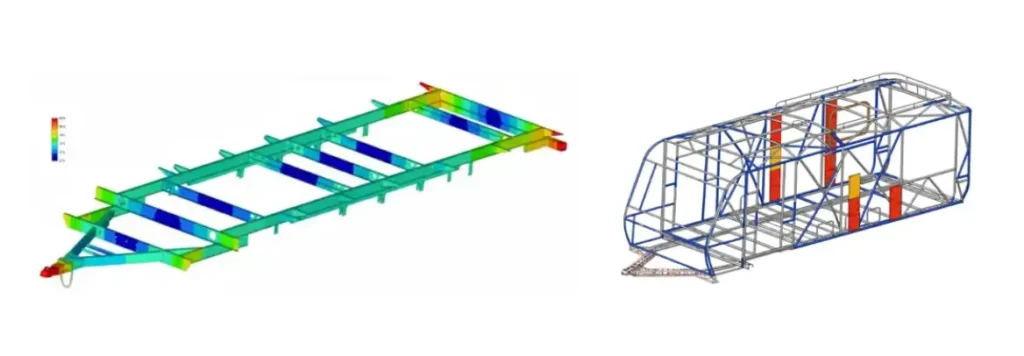
Our structural simulation services can help engineers visualize and evaluate how loads move through a product.
This can help identify:
- Highly loaded components
- Critical interfaces
- Stress concentrations
- Weak structural regions
- Underutilized material
- Areas requiring reinforcement
Load-path understanding can also help designers make more targeted modifications.
Instead of reinforcing an entire structure, engineering teams may be able to focus changes on specific areas that have the greatest influence on performance.
Structural Analysis for Lightweight Products
Reducing product weight can provide significant benefits, but lightweight design requires careful engineering.
Removing material may reduce weight while simultaneously reducing stiffness or structural strength.
Simulation can help engineers evaluate these trade-offs before finalizing a design.
Our lightweight structural simulation services can support development programs where teams are trying to achieve an appropriate balance between:
- Weight
- Strength
- Stiffness
- Durability
- Material consumption
- Performance
- Manufacturing requirements
By comparing different structural configurations virtually, engineering teams can investigate where material is providing meaningful structural value and where opportunities for optimization may exist.
The goal is not simply to remove material. It is to develop an efficient structure that satisfies the intended engineering requirements.
Improve Existing Designs With Simulation
Structural simulation can be valuable even when a product is already in production.
A company may want to reduce manufacturing costs, improve reliability, respond to customer feedback, introduce a new material, or make a design change without negatively affecting performance.
Simulation can provide a way to evaluate proposed modifications before implementing them.
Our engineers can help assess questions such as:
- Will a geometry change affect stiffness?
- Can a component be made lighter?
- Does a material change influence structural response?
- Will a new mounting arrangement alter load distribution?
- Can a reinforcement improve performance?
- What happens if manufacturing constraints change the design?
This makes simulation useful not only for new products, but also for continuous product improvement.
Structural Failure Investigation
When a component fails unexpectedly, identifying the cause is more important than simply replacing the failed part.
A structural simulation can help engineers investigate possible failure mechanisms by recreating relevant loading and operating conditions.
Our structural failure analysis support can be used to examine potential relationships between:
- Product geometry
- Applied loads
- Stress concentrations
- Material behavior
- Boundary conditions
- Component interfaces
- Structural deformation
Simulation does not automatically determine the cause of every failure. Physical evidence, material information, operating history, and testing may also be important.
However, a properly defined simulation can provide another layer of engineering evidence and help teams evaluate potential corrective actions.
Structural Durability Under Repeated Loading
Some products are exposed to repeated loads throughout their operating life.
A component may experience thousands or millions of loading cycles rather than a single static event.
In these situations, engineers need to consider not only whether a structure can withstand a particular load, but how its structural behavior may evolve under repeated use.
Our structural simulation capabilities can support durability-related engineering evaluations involving:
- Cyclic loading
- Variable loads
- Repeated operating conditions
- Load histories
- Critical structural locations
- Potential fatigue concerns
- Design changes
Where appropriate, structural analysis can be combined with load and durability engineering to provide a broader understanding of expected product behavior.
Component-Level and System-Level Simulation
The right simulation scale depends on the engineering question.
Sometimes the behavior of one component is the primary concern.
In other cases, the component cannot be evaluated accurately without considering the surrounding assembly.
Our structural simulation services can therefore be applied at different levels of product definition.
Component Analysis
Useful when engineers need detailed information about an individual part.
Assembly Analysis
Useful when connections, interfaces, and neighboring components influence structural response.
System-Level Evaluation
Useful when the structural behavior of multiple subsystems needs to be considered together.
Selecting the appropriate level of analysis helps avoid both extremes: oversimplifying the engineering problem or creating unnecessary model complexity.
Structural Simulation Across California Industries
Our services are not restricted to one product category.
Structural simulation can support companies across California’s diverse engineering and technology landscape.
Aerospace and Aviation
Evaluate structural performance while balancing strength, stiffness, weight, and operating requirements.
Advanced Manufacturing
Support development and improvement of components, machinery, tooling, and manufactured products.
Medical Technology
Investigate mechanical performance of engineered medical products and equipment where structural behavior is important.
Energy and Clean Technology
Evaluate structural components used in energy systems and related equipment.
Transportation and Mobility
Analyze structural behavior of components and systems exposed to operational loads.
Industrial Products
Support engineering teams developing machinery, equipment, mechanical systems, and assemblies.
Consumer Products
Evaluate products subjected to mechanical loads, handling, impact, or repeated use.
Electronics and Electromechanical Systems
Investigate structural performance where mechanical and electrical components interact within a product.
Construction and Infrastructure
Support engineering evaluations of structural components and engineered systems where simulation is appropriate.
The specific modeling methodology depends on the product, available information, loading environment, and engineering objective.
When Simulation Needs to Connect With Testing
Virtual analysis and physical validation provide different types of engineering information.
Simulation allows engineers to investigate behavior under defined assumptions. Testing provides information about the behavior of the physical product.
Connecting the two can improve engineering confidence.
Our simulation correlation services can help compare simulation predictions with available physical test data.
Correlation may reveal differences associated with:
- Loading
- Constraints
- Material properties
- Geometry
- Connections
- Manufacturing variation
- Model assumptions
Understanding these differences can help engineers determine whether the simulation model is appropriate for future design decisions or requires refinement.
Structural Simulation as an Engineering Resource
Many companies have capable design and engineering teams but do not need to maintain every specialized simulation capability internally.
A project may require additional FEA capacity for several months. Another may involve a structural problem that requires expertise not currently available within the team.
External structural simulation support can provide flexibility without requiring a permanent expansion of internal resources.
Caliber Technologies can support engineering organizations with:
- Defined structural analysis projects
- Additional FEA capacity
- Product development support
- Engineering troubleshooting
- Design evaluation
- Structural optimization studies
- Simulation correlation
- Ongoing simulation requirements
The engagement can be shaped around the actual engineering requirement.
What You Can Expect From a Structural Simulation Engagement
Every project is different, but effective simulation should begin with a clear understanding of what needs to be learned.
Our engineering team can work through the following considerations:
The Product
What is being analyzed and how is it expected to operate?
The Engineering Question
What does your team need the simulation to determine?
The Loading Environment
What forces, pressures, constraints, or operating conditions need to be represented?
The Required Output
Are you evaluating stress, deformation, stiffness, durability, design alternatives, or another structural characteristic?
The Engineering Decision
How will the simulation results be used?
Keeping these questions in focus helps ensure the simulation effort remains practical and relevant.
Engineering Expertise Behind the Simulation
Structural simulation requires more than generating a finite element model.
Engineering judgment plays an important role in deciding how a product should be represented, what assumptions are reasonable, which results deserve attention, and what the results mean for the actual design.
Caliber Technologies approaches structural simulation with an engineering-first mindset.
We focus on understanding the physical product and the problem behind the analysis.
The objective is to provide results that engineers can use when deciding whether to modify a design, proceed with testing, compare alternatives, investigate a problem, or continue development.
Start With Your Structural Engineering Requirement
You do not need to have a perfectly defined simulation plan before contacting us.
If your team knows that a structural problem needs to be investigated, we can discuss the product, operating conditions, available information, and desired outcome.
From there, an appropriate simulation approach can be considered.
Our team can support organizations that need:
- Structural FEA
- Stress and strain analysis
- Deformation analysis
- Stiffness evaluation
- Load-path investigation
- Structural durability assessment
- Design optimization
- Failure investigation
- Simulation correlation
- Additional structural engineering capacity
Structural Simulation Support Across California
Caliber Technologies provides structural simulation services throughout California, supporting engineering and product development teams across the state.
Our services can support organizations in Los Angeles, San Diego, San Jose, San Francisco, Sacramento, Irvine, Anaheim, Oakland, Fremont, Santa Clara, and other California locations.
Whether you are developing an entirely new product or trying to resolve a structural issue in an existing design, our engineers can work with your team to determine where simulation can provide useful engineering insight.
Discuss Your Structural Simulation Requirement
A structural engineering decision made early can have a significant effect on the cost, performance, and reliability of the final product.
Simulation can give your team another way to investigate those decisions before committing to the next stage of development.
If you are looking for Structural Simulation Services in California, talk to Caliber Technologies about your product, your engineering challenge, and what you need to understand.
Contact our engineering team to discuss your structural simulation project.
How We Provide Services
Project Scope Based Services
Time Based Projects
On-site Resource Assignment
Strategic Consulting Services
We are very glad to get client review.

Have a question? Send us a message, and we’ll respond shortly.
Tackle your toughest technical challenges in automotive engineering and reach your product development goals by leveraging the expertise of our trusted engineers.