
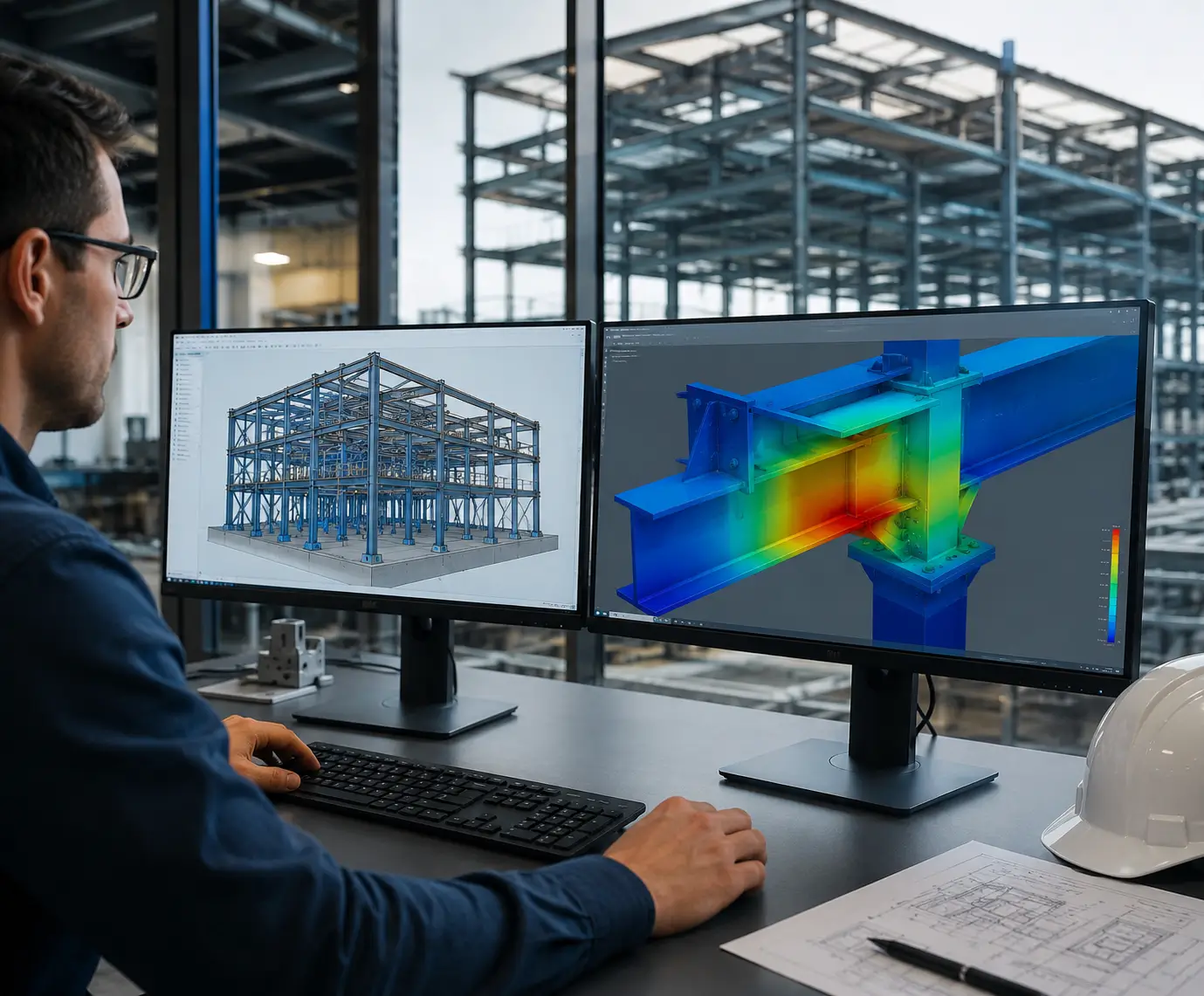
Structural Simulation Services in Indiana
Structural Simulation That Supports Better Engineering Decisions
Designing a product that performs reliably requires an understanding of how it will behave once it is subjected to actual operating conditions.
Loads, stresses, deformation, vibration, material properties, geometry, connections, and operating environments can all influence structural performance. Physical prototypes and testing can provide valuable information, but simulation allows engineering teams to investigate these factors earlier in the development process.
Our structural simulation services help companies evaluate product behavior before committing to extensive physical testing or production.
We can help engineering teams answer questions such as:
- Will the component withstand its expected loads?
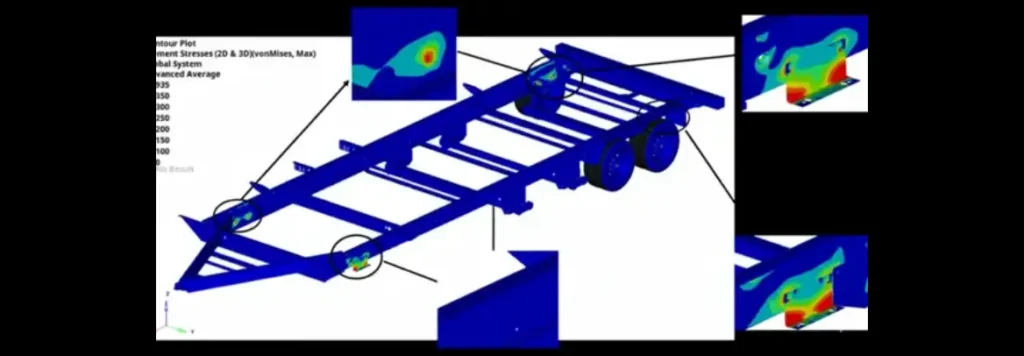
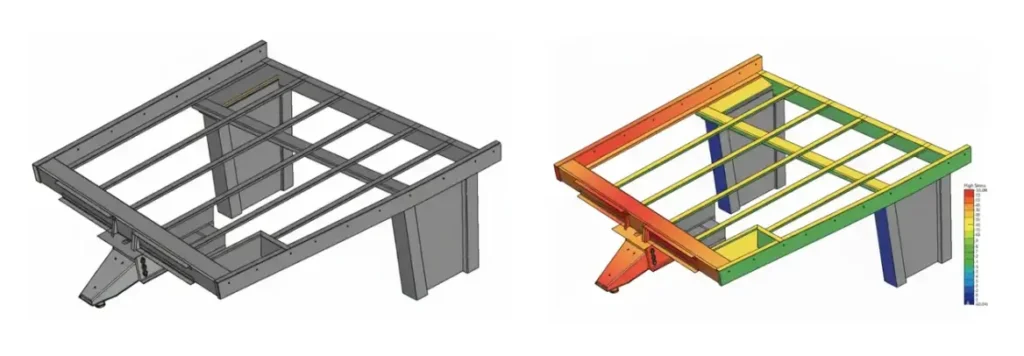
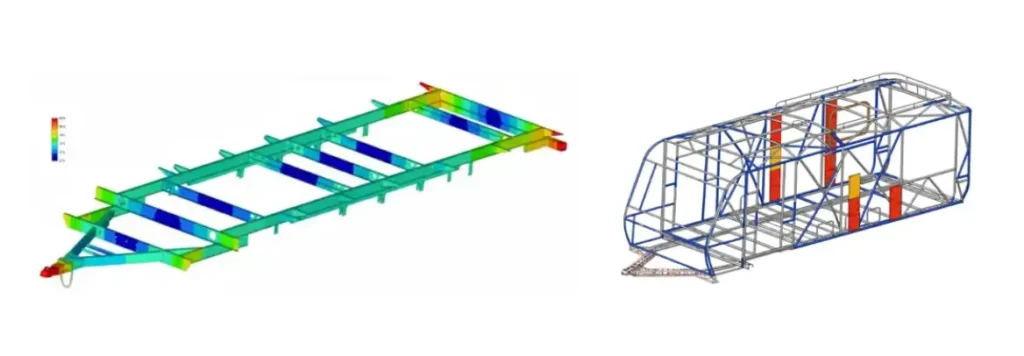
- Where are the highest stress areas?
- Will excessive deformation affect product performance?
- Is the current design sufficiently stiff?
- How will a design change affect structural performance?
- Can material or weight be reduced without compromising requirements?
- Why is a component experiencing a structural problem?
- Which design concept is likely to perform better?
- Does the simulation correlate with available test results?
The goal is not simply to produce simulation data. The goal is to turn engineering analysis into information your team can use.
Structural Simulation for Product Development
Structural simulation can be valuable throughout the product development lifecycle.
During early design, simulation can help engineers compare concepts and identify potential structural concerns before designs become difficult or expensive to change.
As the design matures, simulation can support detailed evaluation of components and assemblies. Later in development, it can complement physical testing and help investigate discrepancies or unexpected product behavior.
Our structural simulation support can be applied during:
- Concept development
- Preliminary design
- Detailed engineering
- Design optimization
- Prototype development
- Virtual validation
- Physical test preparation
- Test correlation
- Product improvement
- Engineering problem-solving
This approach gives engineering teams another way to evaluate design decisions before moving further into the development cycle.
Finite Element Analysis for Structural Engineering
Finite Element Analysis (FEA) is a widely used engineering simulation method for evaluating the behavior of complex structures.
Our structural FEA services in Indiana can help engineers analyze components and assemblies under defined operating conditions and understand how their designs respond.
Depending on the requirements of the project, structural FEA can be used to investigate:
- Stress
- Strain
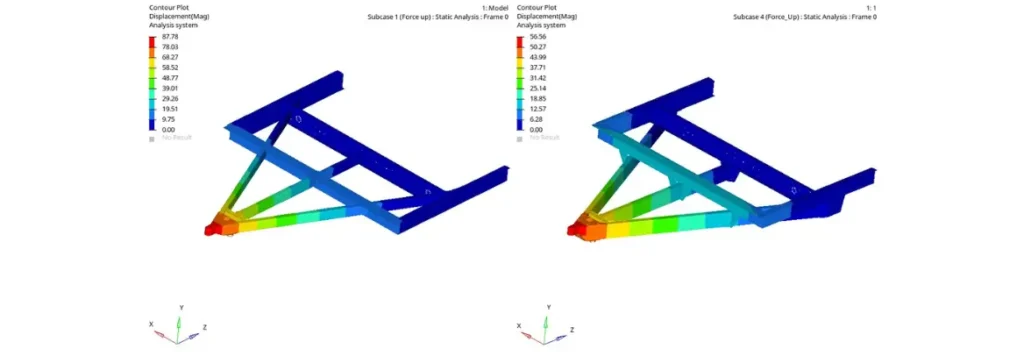
- Displacement
- Deformation
- Stiffness
- Structural strength
- Load distribution
- Load paths
- Contact behavior
- Component interaction
- Design sensitivity
- Structural performance
A useful FEA study begins with the engineering problem, not the software.
The geometry, material properties, loads, constraints, interfaces, and operating conditions need to represent the problem appropriately for the intended engineering decision.
Our engineers focus on developing simulation approaches that are aligned with the purpose of the analysis and the information your team needs.
Stress and Strain Analysis
Stress and strain analysis can reveal areas of a design that may require additional engineering attention.
A component may experience relatively low overall loading while still developing localized high-stress regions because of geometry, connections, changes in section thickness, openings, mounting locations, or other design features.
Our stress analysis services can help engineering teams identify and investigate these areas.
Simulation can be used to evaluate:
- Stress distribution
- Strain levels
- Stress concentrations
- Critical structural regions
- Load transfer
- Localized structural response
- Design changes
- Material utilization
Understanding where and why stresses develop can help engineers determine whether a design needs modification, reinforcement, material changes, or additional validation.
The analysis can also be used to compare alternative designs and determine how specific geometry changes influence structural behavior.
Deformation and Displacement Analysis
Structural strength is only one aspect of product performance.
In many applications, excessive deformation can be just as important as excessive stress.
A component may technically withstand its applied load but still fail to perform its intended function if it bends, deflects, twists, or moves beyond acceptable limits.
Our deformation and displacement simulation services help engineering teams understand how products respond to applied loads.
Analysis can provide insight into:
- Total deformation
- Directional displacement
- Local deflection
- Structural flexibility
- Component movement
- Load-induced distortion
- Interface movement
This information can be particularly useful when dimensional accuracy, alignment, fit, sealing, motion, or interaction with other components is important.
Structural Stiffness Analysis
Stiffness is a critical engineering characteristic for many products and structures.
The right level of stiffness can influence product performance, handling, vibration behavior, dimensional stability, operating precision, and durability.
Our structural stiffness analysis services help companies evaluate how much a component or assembly deforms under an applied load.
Simulation can be used to compare:
- Different geometries
- Material options
- Thicknesses
- Reinforcement strategies
- Mounting configurations
- Structural concepts
This allows engineering teams to understand how design modifications affect stiffness before physical prototypes are produced.
For complex products, stiffness can also be evaluated at different levels, from individual components to larger assemblies, depending on the engineering requirement.
Structural Load Analysis
A structural simulation is only as meaningful as the loading conditions used in the analysis.
Products may experience static loads, dynamic loads, operational loads, environmental loads, pressure, impact, or combinations of different loading conditions.
Our engineers can help define and evaluate the structural loading requirements relevant to a simulation study.
This can include consideration of:
- Applied forces
- Moments
- Pressure loads
- Gravity
- Operating loads
- Boundary conditions
- Constraints
- Component interfaces
- Load paths
- Load combinations
Understanding how loads enter and travel through a structure can provide valuable insight into potential design weaknesses and areas where structural performance can be improved.
Structural Simulation for Components and Assemblies
Structural behavior does not always depend on a single component.
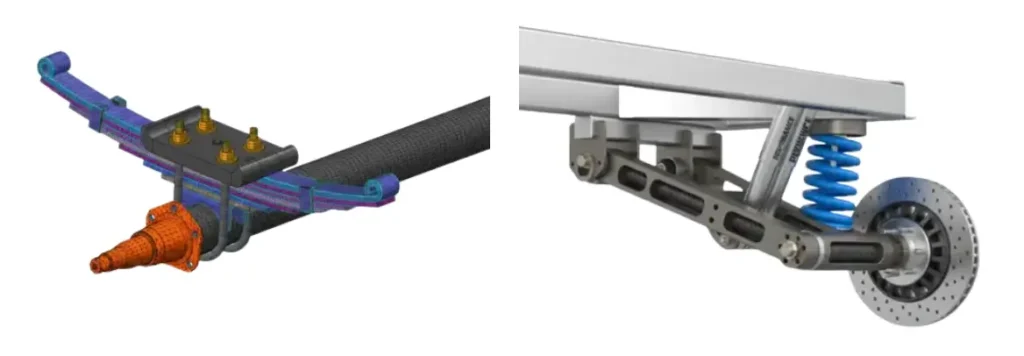
Connections, interfaces, fasteners, mounts, joints, and neighboring components can significantly influence how a product responds to loading.
Our structural simulation capabilities can therefore be applied to both individual components and larger assemblies, depending on the objectives of the project.
Component-level analysis can help answer focused questions about a specific part.
Assembly-level simulation can provide a broader understanding of:
- Load transfer
- Component interaction
- Interface behavior
- Structural stiffness
- System deformation
- Load distribution
- Relative movement
Choosing the appropriate level of simulation helps ensure that the analysis remains aligned with the engineering problem rather than unnecessarily increasing model complexity.
Structural Durability and Performance
A product may need to withstand more than a single loading event.
Repeated loading over an extended operating life can gradually affect structural performance. For products exposed to cyclic or variable operating conditions, durability can therefore be an important part of structural engineering.
Our structural simulation services can support durability-related engineering evaluations by examining how expected loading conditions influence structural behavior.
This can help engineering teams investigate:
- Repeated loading
- Cyclic loads
- Critical structural locations
- Load histories
- Potential fatigue concerns
- Design improvements
- Component durability
Where appropriate, structural simulation can be considered alongside load and durability analysis to provide a broader understanding of expected product performance.
Structural Simulation for Design Optimization
Simulation is not only useful for finding problems.
It can also help engineers improve a design that already meets its basic requirements.
Engineering teams may need to reduce weight, lower material usage, improve stiffness, increase strength, simplify manufacturing, or achieve a better balance between competing requirements.
Our structural design optimization support can help evaluate different design concepts and understand how changes to geometry and materials affect structural performance.
Simulation can help compare options before committing to tooling or physical prototypes.
This can make the design process more informed and help engineering teams focus their development effort on solutions that demonstrate promising performance in the virtual environment.
Lightweight Design and Material Efficiency
Reducing unnecessary material can provide benefits in terms of weight, cost, manufacturing, transportation, and overall product efficiency.
However, reducing material without understanding its structural impact can introduce unwanted performance issues.
Structural simulation provides a way to investigate how changes in geometry, thickness, reinforcement, and material affect structural behavior.
Our engineering team can help evaluate design alternatives where the objective is to achieve an appropriate balance between:
- Weight
- Strength
- Stiffness
- Durability
- Material usage
- Product performance
- Manufacturing considerations
The result can be a more informed design-development process rather than relying solely on physical trial and error.
Structural Simulation Across Industries
Structural simulation is relevant wherever products or systems need to withstand physical loads and maintain their intended performance.
Caliber Technologies provides structural simulation support across a broad range of engineering applications.
Manufacturing
Manufacturers can use structural simulation to evaluate components, machinery, assemblies, tooling, and engineered products before production.
Industrial Equipment
Simulation can help evaluate structural strength, stiffness, deformation, and durability of industrial equipment and mechanical systems.
Aerospace
Structural simulation can support the evaluation of lightweight structures and components where performance and weight are important engineering considerations.
Automotive and Transportation
Simulation can be used to investigate structural behavior across vehicle components, transportation systems, and related products.
Energy
Engineers developing energy-related equipment and systems can use structural simulation to evaluate components exposed to mechanical and operational loads.
Medical and Healthcare Products
Structural analysis can help evaluate engineered medical products and equipment where mechanical performance and reliability are important.
Consumer and Commercial Products
Simulation can support the development of products that need to withstand handling, operating, impact, or other physical loading conditions.
Heavy Equipment
Structural analysis can help engineers investigate components and assemblies subjected to demanding operating environments and high loads.
These are only examples. If your product has a structural engineering challenge, our team can review the application and determine whether simulation can provide useful insight.
Structural Simulation for Engineering Problem-Solving
Sometimes simulation is required not because a new product is being developed, but because an existing product is not performing as expected.
An unexpected deformation, structural failure, excessive vibration, premature wear, or component damage can require engineers to understand what is happening before a corrective action is selected.
Our structural simulation capabilities can support engineering investigations by helping teams examine potential causes and evaluate possible design changes.
Simulation can be used to compare different scenarios and investigate questions such as:
- Where is the structural load concentrated?
- Why is a particular area experiencing high stress?
- How does a design change affect the response?
- Could a different geometry improve performance?
- Would reinforcement address the issue?
- Is the problem related to loading or structural configuration?
This can provide engineering teams with additional information when physical observations alone do not explain the underlying problem.
Simulation Correlation and Validation
Physical testing remains an important part of engineering development.
Simulation and testing can work together to provide greater confidence in product performance.
Where test data is available, structural simulation correlation can help compare predicted and measured behavior.
This may involve evaluating differences between simulation and physical results and investigating whether changes to model assumptions, loading, material properties, boundary conditions, or other factors are necessary.
Correlation can help engineering teams understand how well a simulation represents the physical product and whether the model is appropriate for the engineering decisions it is being used to support.
Our approach is focused on engineering understanding rather than simply matching numbers.
Engineering-Led Structural Simulation
A simulation tool can produce thousands of data points.
The real value comes from understanding what those results mean.
Our engineers approach structural simulation with attention to the physical product, its intended application, and the engineering question being investigated.
This means considering:
- What the product is expected to do
- How it will be used
- What loads it will experience
- Which performance characteristics matter
- What assumptions are appropriate
- What the simulation results indicate
- What design decisions need to follow
This engineering-led approach helps keep simulation focused on practical outcomes.
Flexible Structural Simulation Support
Different organizations need different levels of engineering support.
You may have an established engineering team that needs additional simulation capacity for a particular project. Alternatively, you may need specialized expertise to investigate a structural problem or support a new product-development program.
Caliber Technologies can provide structural simulation support based on your requirements.
Our engagement can be structured around:
A Specific Engineering Project
Ideal when you have a defined structural analysis requirement and specific deliverables.
Additional Engineering Capacity
Useful when your internal team has more simulation work than available resources.
Ongoing Product Development
Suitable for organizations requiring continued structural simulation support throughout a development program.
Engineering Problem-Solving
Appropriate when simulation is needed to investigate an existing structural performance issue.
The scope can be discussed based on your product, engineering requirements, available information, and development stage.
Our Structural Simulation Approach
We keep the process focused on the engineering objective.
1. Understand the Product
We begin by understanding the product, component, application, operating environment, and structural concern.
2. Define the Engineering Requirements
We establish the relevant loads, constraints, materials, performance requirements, and expected outputs.
3. Develop the Simulation
An appropriate structural simulation model is developed based on the requirements and available information.
4. Analyze the Results
The simulation results are evaluated to identify structural behavior, critical areas, and potential design concerns.
5. Correlate Where Required
Available physical test data can be used to evaluate and improve simulation confidence where appropriate.
6. Support the Design Decision
The final objective is to provide useful engineering information that helps your team determine the next step.
Why Work With Caliber Technologies?
Engineering Experience
Structural simulation requires more than familiarity with analysis software. It requires an understanding of engineering principles, product behavior, loads, materials, and design requirements.
Broad Industry Application
Our structural simulation capabilities are not restricted to a single industry. We can apply engineering simulation methods to different products, systems, and development environments.
Practical Engineering Focus
We focus on what the analysis means for your product and your engineering decisions.
Flexible Support
Our services can be adapted to individual analysis projects, additional engineering capacity, or longer-term development requirements.
Simulation and Engineering Knowledge
Our broader engineering simulation experience allows structural problems to be considered within the wider context of product performance when necessary.
Structural Simulation Services Across Indiana
Caliber Technologies provides structural simulation services across Indiana, supporting engineering teams in Indianapolis, Fort Wayne, Evansville, South Bend, Carmel, Fishers, Lafayette, Bloomington, Terre Haute, Gary, and surrounding areas.
Our services can support companies involved in manufacturing, industrial engineering, product development, transportation, energy, technology, and other engineering-intensive industries.
Whether your organization is developing a new product, optimizing an existing design, validating a component, or investigating a structural problem, simulation can provide valuable engineering insight before the next development decision is made.
Talk to a Structural Simulation Engineer
Have a component that needs to be evaluated? Are you investigating excessive stress or deformation? Do you need to improve stiffness, reduce weight, validate a design, or understand why a product is experiencing a structural problem?
Caliber Technologies can help you apply structural simulation to your engineering challenge.
Tell us about your product, the operating conditions, and what you need to understand.
Our engineering team can review your requirements and discuss an appropriate simulation approach.
Contact Caliber Technologies today for Structural Simulation Services in Indiana.
How We Provide Services
Project Scope Based Services
Time Based Projects
On-site Resource Assignment
Strategic Consulting Services
We are very glad to get client review.

Have a question? Send us a message, and we’ll respond shortly.
Tackle your toughest technical challenges in automotive engineering and reach your product development goals by leveraging the expertise of our trusted engineers.