1. Introduction
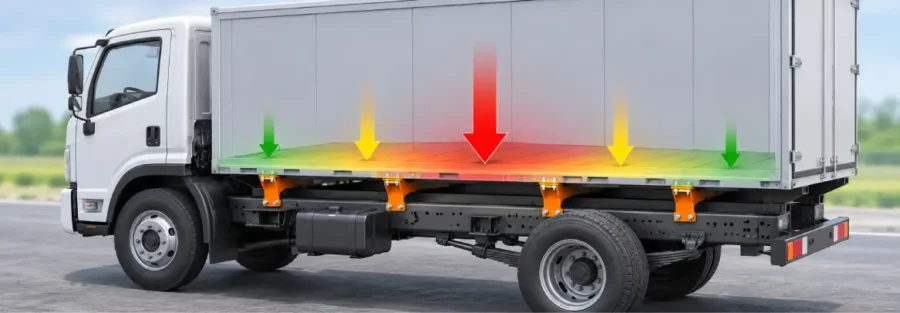
Truck body mounting systems transfer loads from the body structure to the vehicle chassis. Whether the vehicle carries a cargo body, tipper body, tanker, or specialised equipment, the mounting arrangement directly influences how forces are distributed across the chassis frame.
An incorrectly designed mounting system can create uneven load transfer, localised stress concentrations, excessive chassis deformation, and premature fatigue around mounting brackets and fastener connections.
Evaluating the mounting design is therefore important to maintain structural integrity while accommodating payload weight, road inputs, and vehicle operating conditions.
2. Key Engineering Considerations
Load distribution across chassis rails: Mounting locations determine how body weight and payload forces transfer into the chassis. Uneven mounting stiffness or poorly positioned supports can concentrate loads in specific frame sections.
Mounting bracket geometry: Bracket thickness, shape, spacing, and attachment position influence local stress and bending behaviour. Abrupt changes in stiffness can create stress concentrations around connection points.
Chassis flexibility and torsion: Truck frames experience bending and twisting during uneven-road operation. The body mounting arrangement must accommodate the required chassis movement without introducing excessive local stresses.
Fastener and joint behaviour: Bolt preload, bearing stress, slip, and joint stiffness influence load transfer between the body and chassis. Welded connections also require evaluation for local stress and fatigue.
Payload and dynamic loading: Static body weight is only one part of the loading condition. Braking, cornering, vertical road inputs, and payload distribution can generate additional forces and moments.
Fatigue durability: Repeated loading can initiate fatigue damage around mounting holes, brackets, welds, and chassis attachment regions.
3. Engineering Analysis & Simulation Approach
FEA helps evaluate how different mounting configurations affect structural load distribution.
- CAD preparation: Develop the truck chassis and body mounting assembly, including brackets, support rails, and connection interfaces.
- Material and connection definition: Assign material properties and represent bolted, welded, and contact interfaces according to the actual design.
- Load case development: Apply body weight, payload conditions, vertical road loads, braking forces, and lateral loading.
- Structural simulation: Evaluate chassis stress, mounting bracket deformation, connection loads, and load distribution across frame rails.
- Torsional assessment: Examine how chassis twisting influences mounting interfaces and local structural response.
- Fatigue evaluation: Assess critical mounting locations under representative repeated loading conditions.
- Design optimisation: Compare bracket positions, support spacing, reinforcement, and mounting stiffness to improve load transfer and structural durability.
The analysis should consider the intended chassis flexibility. Simply increasing mounting stiffness may shift loads into local chassis regions rather than improve overall structural performance.
4. Caliber Technologies Expertise
Caliber Technologies provides engineering simulation support for commercial vehicle structures, truck chassis, and mounted assemblies.
Relevant capabilities include:
- Structural FEA: Evaluating chassis stress, body mounting brackets, and structural deformation under defined operating loads.
- Load case development: Establishing representative payload, road, braking, and lateral loading conditions.
- Load path assessment: Understanding how forces transfer through mounting brackets, chassis rails, and structural connections.
- Fatigue analysis: Identifying potential durability concerns around repeatedly loaded mounting interfaces.
- Design optimisation: Evaluating alternative bracket geometries, support locations, and reinforcement configurations.
These capabilities help engineering teams assess mounting designs, identify critical load paths, and improve structural performance before physical prototyping.
5. Conclusion
Truck body mounting design plays an important role in distributing payload and operating loads across the chassis. Bracket geometry, mounting positions, connection stiffness, and chassis flexibility all influence structural performance.
FEA provides a practical way to evaluate these interactions, identify local stress concentrations, and compare mounting configurations before manufacturing.
For truck body mounting analysis, chassis load distribution, or structural FEA support, contact Caliber Technologies at operations@thecalibertech.com.