1. Introduction
A robotic gripper must hold and manipulate objects of different weights without slipping, excessive deformation, or structural failure. As payload increases, gripping forces and stresses develop across the fingers, joints, mounting interfaces, and actuator connections.
Validating gripper strength is important when designing robotic systems for manufacturing, material handling, assembly, and automated production. Physical testing alone may not reveal stress concentrations or structural weaknesses under every loading condition.
Finite Element Analysis (FEA) helps engineers evaluate gripper performance across different payloads before manufacturing and physical validation.
2. Key Engineering Considerations
Payload and gripping force: The gripper must generate sufficient normal force to hold the object against gravity and operational acceleration. Required gripping force depends on payload mass, contact friction, finger geometry, and the number of contact points.
Finger bending and deformation: Gripper fingers experience bending loads during gripping. Excessive deflection can affect positioning accuracy, contact distribution, and object stability.
Material strength: Material selection must account for yield strength, stiffness, fatigue resistance, and operating conditions. Lightweight designs must maintain adequate structural strength.
Contact pressure and friction: Contact pressure should remain within acceptable limits to avoid damaging the object or causing unstable gripping. Friction assumptions must reflect the actual contact materials and surface conditions.
Mounting and actuator loads: Loads transfer through finger pivots, linkages, fasteners, actuator connections, and the robot wrist interface. These areas require particular attention during structural validation.
3. Engineering Analysis & Simulation Approach
FEA can be used to evaluate gripper performance across multiple payload conditions.
- CAD preparation: Import the gripper assembly and simplify non-critical geometric details while retaining important structural features.
- Material definition: Assign material properties to fingers, joints, brackets, and mounting components.
- Load case development: Define different payload weights, gripping forces, gravity, and relevant acceleration conditions.
- Contact modelling: Define contact interactions between gripper fingers and the object, including friction where required.
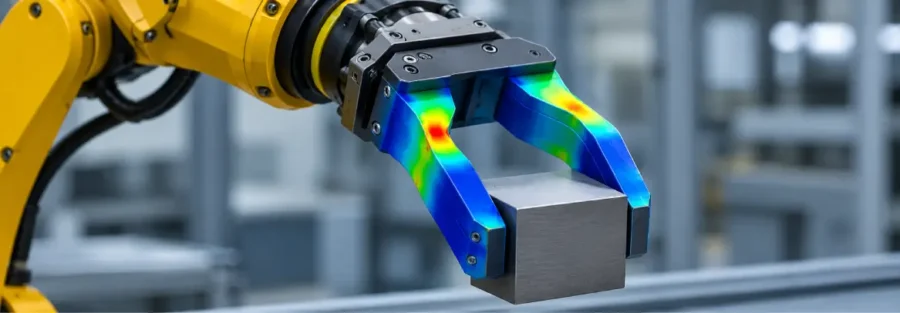
- Structural simulation: Evaluate von Mises stress, deformation, strain, and load transfer through the assembly.
- Design evaluation: Identify high-stress regions around finger roots, pivot holes, joints, and mounting interfaces.
- Design optimisation: Assess changes to finger thickness, geometry, material selection, and reinforcement to improve strength without unnecessary weight.
Multiple payload cases should be analysed separately to identify the gripper’s structural limits and determine whether the design meets its required safety margin.
4. Caliber Technologies Expertise
Caliber Technologies provides engineering simulation support for robotic hardware design and structural validation.
Our capabilities relevant to robotic gripper development include:
- FEA-based structural analysis: Evaluating stress, deformation, and structural strength under different payload conditions.
- Contact and load analysis: Assessing load transfer and interaction between gripper components and gripping surfaces.
- Design optimisation: Identifying opportunities to reduce weight while maintaining structural performance.
- Modal and vibration analysis: Evaluating natural frequencies and potential vibration-related issues in robotic assemblies.
- CAD-to-FEA workflow: Preparing engineering geometry for simulation and evaluating design changes before prototyping.
These simulation capabilities help engineering teams identify structural weaknesses, compare design configurations, and make informed decisions during robotic hardware development.
5. Conclusion
Robotic gripper strength validation requires more than checking whether fingers can hold a specified payload. Engineers must evaluate gripping forces, contact behaviour, deformation, stress concentrations, and mounting loads across the intended operating range.
FEA provides a practical way to assess these conditions before physical testing and improve gripper reliability during development.
To discuss robotic gripper analysis or structural validation requirements, contact Caliber Technologies at operations@thecalibertech.com.