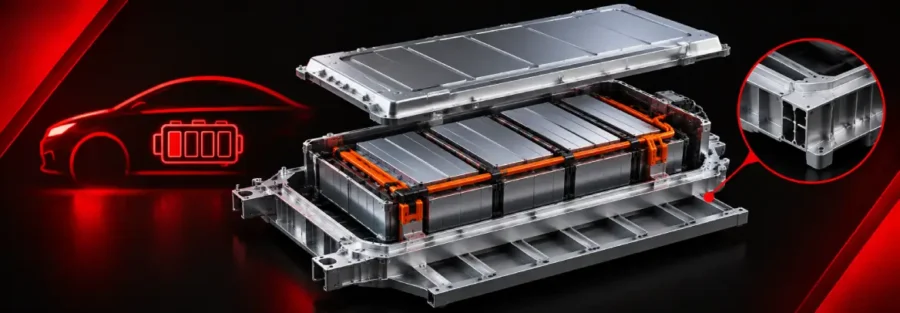
Battery pack structural design focuses on developing an enclosure and supporting structure that can safely house and protect an EV battery system under different operating conditions. The structure must withstand vehicle loads, vibration, road impacts and environmental exposure while maintaining the required stiffness, strength and durability.
For electric vehicle manufacturers, structural design is important because battery pack damage can affect vehicle safety, reliability and overall performance.
What Does Battery Pack Structural Design Include?
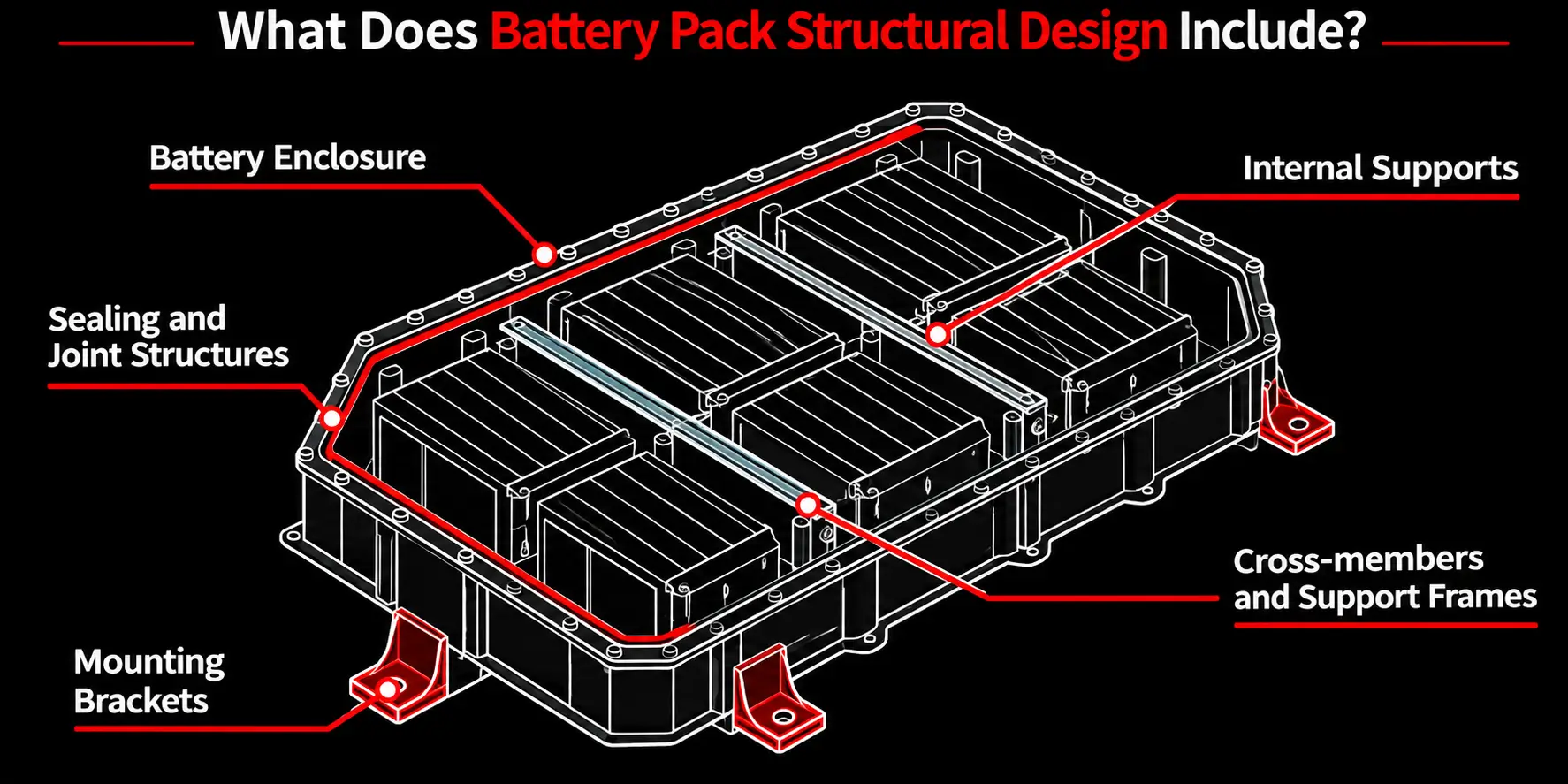
An EV battery pack is more than a collection of battery cells. Its structural design includes several components that work together to support and protect the battery system.
Key structural components include:
- Battery enclosure: Houses the battery modules and protects internal components from external loads and environmental conditions.
- Mounting brackets: Connect the battery pack to the vehicle chassis or underbody structure.
- Cross-members and support frames: Distribute loads and improve structural stiffness.
- Sealing and joint structures: Help maintain enclosure integrity and protect against water and dust ingress.
- Internal supports: Secure battery modules and limit unwanted movement during vehicle operation.
Each component must be designed according to the vehicle’s packaging, load requirements and operating conditions.
Key Requirements in EV Battery Pack Structural Design
1. Structural Strength and Stiffness
The battery pack must withstand loads generated during vehicle operation without excessive deformation. The enclosure should maintain its structural integrity under static and dynamic loading conditions.
Engineers evaluate stress distribution, deformation and load paths to identify weak areas and improve the design.
2. Crash and Impact Resistance
The battery pack may experience significant loads during vehicle collisions or underbody impacts. Its structure must help protect the battery modules from intrusion and damaging deformation.
Crash-related design requirements depend on vehicle category, applicable regulations and the intended protection strategy.
3. Vibration and Fatigue Durability
Road irregularities, vehicle acceleration and drivetrain operation expose battery packs to continuous vibration and cyclic loading.
Structural components, welds, joints and mounting brackets must withstand these repeated loads over the vehicle’s expected service life.
4. Thermal and Environmental Considerations
Battery pack structures operate alongside thermal management systems and electrical components. The design must account for operating temperatures, thermal expansion, corrosion protection and environmental exposure.
Material selection and joint design also influence long-term structural performance.
5. Weight and Packaging Optimisation
Battery packs need sufficient structural strength without adding unnecessary weight. Engineers must balance stiffness, durability, available installation space and manufacturing requirements.
Material selection, component geometry and structural optimisation help achieve this balance.
Common Challenges in Battery Pack Structural Design
EV battery pack development involves several engineering challenges:
- Weight versus strength: Reducing enclosure weight without compromising structural performance.
- Limited packaging space: Integrating battery modules, cooling systems and electrical components within the available space.
- Load distribution: Managing forces transferred through mounting points and enclosure structures.
- Joint durability: Preventing fatigue-related issues around welds, bolts and bonded connections.
- Manufacturing constraints: Designing components that can be produced and assembled consistently.
- Multiple load conditions: Evaluating structural behaviour under static, dynamic, vibration and impact loading.
These challenges make structural evaluation an important part of battery pack development.
Role of FEA in Battery Pack Structural Design
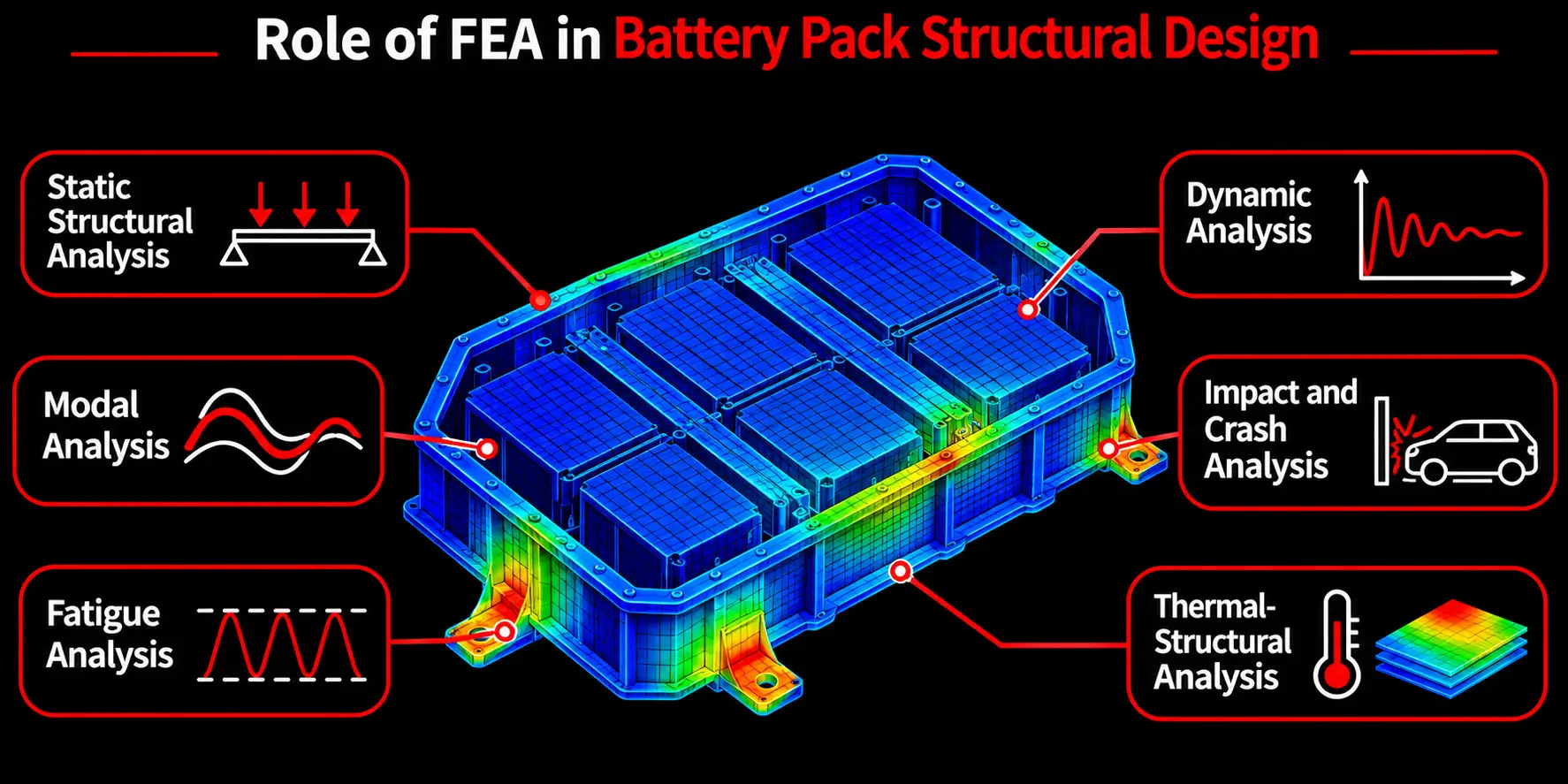
Finite Element Analysis (FEA) helps engineers evaluate battery pack structural performance before physical prototypes are manufactured.
Depending on project requirements, simulation can be used for:
- Static structural analysis: Evaluating stress and deformation under defined operating loads.
- Modal analysis: Identifying natural frequencies and vibration modes.
- Fatigue analysis: Assessing durability under repeated loading.
- Dynamic analysis: Evaluating structural response to time-dependent loads.
- Impact and crash analysis: Studying structural behaviour under defined impact conditions.
- Thermal-structural analysis: Evaluating the effects of temperature changes and thermal expansion.
FEA results help identify high-stress regions, weak mounting points and areas that may require design modifications.
How Caliber Technologies Supports EV Battery Pack Structural Engineering
Caliber Technologies provides engineering simulation and structural analysis support for EV battery systems. Our work can include evaluating battery enclosures, mounting structures and supporting components against defined structural and durability requirements.
We support engineering teams with:
- Battery enclosure structural analysis
- Battery pack mounting bracket analysis
- Stress and deformation evaluation
- Vibration and modal analysis
- Fatigue and durability assessment
- Design improvement based on simulation results
Our analysis approach is aligned with the component geometry, material properties, loading conditions and project requirements.
Planning an EV battery pack structural analysis project?
Contact Caliber Technologies at operations@thecalibertech.com to discuss your engineering requirements.