1. Introduction
RV water tanks are exposed to repeated forces during acceleration, braking, cornering, and travel over uneven roads. These loads transfer through the tank supports, mounting brackets, fasteners, and surrounding chassis structure.
A mounting system designed only for the static weight of a full water tank may experience excessive stress or deformation under dynamic road conditions. Tank movement, bracket fatigue, fastener loosening, and local chassis damage can develop if these effects are not properly evaluated.
Finite Element Analysis (FEA) helps engineers assess the structural performance of RV water tank mounting systems under representative road-load conditions before physical testing.
2. Key Engineering Considerations
Full and partial tank weight: A full tank creates the maximum static gravitational load, while partially filled tanks can introduce additional fluid movement during vehicle manoeuvres.
Road-induced acceleration: Longitudinal, lateral, and vertical accelerations generate additional forces during braking, cornering, bumps, and uneven-road operation. These load cases should reflect the intended vehicle operating conditions.
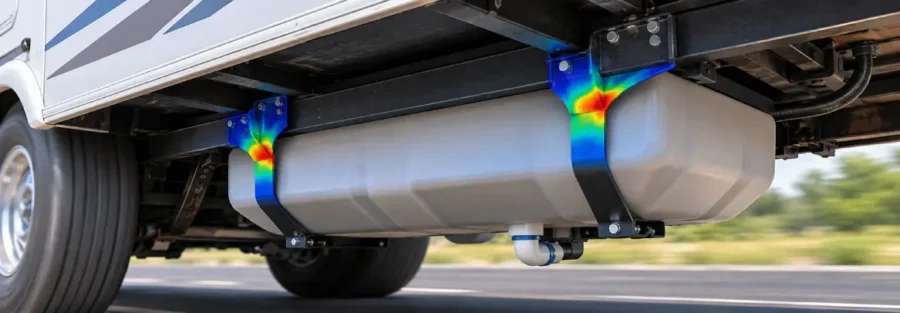
Mounting bracket strength: Brackets and support rails experience bending, shear, and local stress concentrations, particularly around bends, welds, and fastener holes.
Fastener and chassis connections: Bolt loads, joint stiffness, bearing stress, and local chassis deformation influence how loads transfer from the tank to the vehicle frame.
Fatigue performance: Repeated road vibration and load cycles can cause fatigue damage in brackets, welds, and mounting interfaces, even when individual load cases remain below material yield strength.
Tank movement and support stiffness: Excessive support deformation can allow unwanted tank displacement, increase connection loads, or create contact with nearby vehicle components.
3. Engineering Analysis & Simulation Approach
FEA can evaluate the mounting assembly under different tank fill levels and road-load conditions.
- CAD preparation: Model the tank supports, brackets, fasteners, chassis interfaces, and relevant surrounding structure.
- Material and connection definition: Assign material properties and represent welded, bolted, and contact interfaces appropriately.
- Load case development: Establish static tank weight and longitudinal, lateral, and vertical acceleration cases based on vehicle operating requirements.
- Structural simulation: Evaluate stress distribution, bracket deformation, fastener loads, and load transfer into the chassis.
- Fatigue assessment: Use representative road-load histories or duty cycles to assess fatigue risk in repeatedly loaded components.
- Design evaluation: Identify critical regions around bracket bends, welds, mounting holes, and chassis attachment points.
- Design improvement: Compare bracket thickness, support spacing, reinforcement, and connection configurations to improve structural performance.
Where partial tank fill and fluid movement are significant, fluid slosh loads may need to be evaluated separately or incorporated through an appropriate fluid-structure analysis approach. A static structural model alone does not capture the full dynamic behaviour of moving water.
4. Caliber Technologies Expertise
Caliber Technologies provides engineering simulation support for RV structural components and vehicle systems. Relevant capabilities include:
- Structural FEA: Evaluating water tank brackets, support structures, and chassis attachment points under defined loading conditions.
- Load case development: Establishing representative loading scenarios for vehicle structures and mounted components.
- Fatigue analysis: Assessing durability risks under repeated loading conditions.
- Connection assessment: Evaluating stress and load transfer around mounting interfaces, fasteners, and structural joints.
- Design optimisation: Comparing support configurations, reinforcement strategies, and material options to improve strength while managing weight.
These capabilities help RV engineering teams identify mounting weaknesses and evaluate design changes before physical prototyping.
5. Conclusion
RV water tank mounting requires structural evaluation beyond the tank’s static weight. Road-induced acceleration, bracket deformation, fastener loads, and repeated vibration all influence mounting reliability.
FEA helps engineers understand load transfer, identify critical stress locations, and assess design performance under representative operating conditions.
For RV water tank mounting analysis, structural FEA, or durability assessment, contact Caliber Technologies at operations@thecalibertech.com.