1. Introduction
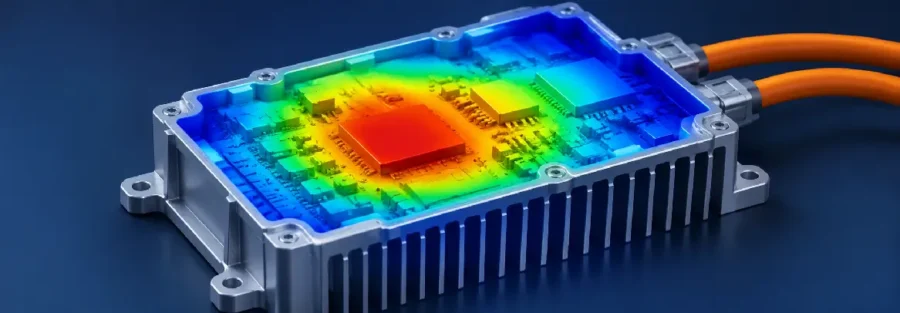
Thermal simulation helps engineering teams predict temperature distribution, heat transfer, and cooling performance before physical prototyping. It is widely used in automotive systems, EV components, electric motors, HVAC equipment, industrial machinery, and electronic enclosures.
The cost depends on the type of analysis, geometry complexity, operating conditions, and engineering deliverables. A basic steady-state thermal study may require considerably less effort than a transient simulation involving multiple heat sources, airflow, and coupled thermal-fluid behaviour.
style=”font-size: 24px; color: #df4244;”2. Key Engineering Considerations
How Much Does Thermal Simulation Cost?
Published engineering service prices provide the following indicative benchmarks:
| Thermal simulation type | Estimated cost (USD) |
|---|---|
| Basic thermal analysis | $1,000–$3,000 |
| Thermal analysis with multiple conditions | $3,000–$10,000 |
| Focused heat transfer study | From $3,000 |
| Transient thermal analysis | $3,000–$6,000 |
| Complex thermal-fluid or coupled simulation | Project-specific quotation |
They are estimated cost, not fixed industry rates or Caliber Technologies quotations.
What Affects Thermal Simulation Cost?
- Geometry complexity: Detailed assemblies and complex internal passages require more CAD preparation and mesh development.
- Heat transfer mechanisms: Conduction-only studies are generally simpler than simulations involving convection, radiation, and fluid flow.
- Material properties: Temperature-dependent thermal conductivity, specific heat, and contact resistance can require additional modelling.
- Simulation type: Transient analysis requires evaluating temperature changes over time, increasing computational and engineering effort.
- Operating conditions: Multiple heat loads, ambient temperatures, airflow conditions, and operating cycles increase the number of simulation cases.
- Reporting and validation: Mesh sensitivity checks, test-data correlation, engineering recommendations, and detailed reports add to the scope.
3. Engineering Analysis & Simulation Approach
A typical thermal simulation project involves:
- Geometry preparation: Review CAD models and simplify details that do not significantly affect heat transfer.
- Material definition: Assign thermal conductivity, specific heat, density, and relevant temperature-dependent properties.
- Boundary conditions: Define heat generation, ambient temperature, convection, radiation, and thermal contact conditions.
- Mesh development: Refine the mesh around heat sources, interfaces, and regions with high temperature gradients.
- Simulation: Run steady-state or transient thermal analysis. Use CFD when airflow and fluid-driven heat transfer need to be evaluated.
- Result evaluation: Examine temperature distribution, heat flux, thermal gradients, and potential overheating locations.
The required accuracy, number of operating cases, and validation level determine the overall engineering effort.
4. Caliber Technologies Expertise
Caliber Technologies provides engineering simulation support to evaluate thermal performance and identify potential design issues before physical testing.
Our relevant simulation capabilities include:
- Thermal analysis: Evaluating temperature distribution, heat transfer, and thermal gradients across components.
- CFD simulation: Studying airflow, convection, and heat dissipation in enclosed systems and equipment.
- Automotive thermal management: Assessing underhood heat distribution, HVAC airflow, and component cooling.
- EV component evaluation: Supporting thermal assessment of electric vehicle components and associated systems.
- Design evaluation: Comparing design configurations to identify opportunities to improve heat transfer and cooling performance.
The project scope, CAD geometry, material properties, operating conditions, and expected deliverables are reviewed before preparing a project-specific quotation.
5. Conclusion
Thermal simulation projects can cost anywhere from around $1,000 to $10,000 or more, depending on the analysis requirements and complexity. Basic thermal studies generally require less engineering effort, while transient and coupled thermal-fluid simulations need more extensive modelling and validation.
Defining the engineering objectives and operating conditions clearly helps control costs and avoid unnecessary simulation work.
If your team needs thermal or CFD simulation support, contact Caliber Technologies at operations@thecalibertech.com to discuss your project requirements.