Introduction
Finite Element Analysis (FEA) helps engineering teams evaluate structural strength, stiffness, deformation, fatigue, and product performance before physical testing.
But there is another decision companies need to make: should they build an in-house FEA team or outsource simulation work to an engineering service provider?
Both options have costs beyond the analysis itself. In-house FEA requires software licences, skilled engineers, hardware, training, and ongoing maintenance. Outsourcing involves project fees, communication, data preparation, and coordination.
The more economical option depends on how frequently your company needs simulation, the complexity of its projects, and the level of engineering expertise available internally.
1. Cost of Building an In-House FEA Team
Setting up an internal FEA capability involves several initial and recurring expenses.
FEA software licences
Commercial FEA software can involve significant licensing costs. The final amount depends on the software package, solver capabilities, number of users, and licence type.
Companies may also need additional modules for nonlinear analysis, fatigue, dynamics, contact, or advanced material modelling.
Engineering salaries
An experienced FEA engineer is a major recurring expense. Depending on project requirements, a company may need more than one specialist for model preparation, solver setup, result interpretation, and design recommendations.
Recruitment, employee benefits, and ongoing professional development also add to the cost.
Hardware and infrastructure
FEA simulations can require high-performance workstations or computing resources, particularly for large assemblies, nonlinear models, and detailed mesh requirements.
Companies must account for hardware upgrades, storage, IT support, and maintenance.
Training and software maintenance
Software updates, technical training, and employee development are ongoing requirements. Without regular training, an internal team may struggle to use advanced analysis methods effectively.
2. Cost of Outsourcing FEA Services
Outsourcing allows companies to access engineering simulation expertise without establishing a complete internal department.
Instead of maintaining permanent resources, the company pays for the analysis required for a particular project.
Typical cost components include:
- Project-based fees: Payment depends on geometry, analysis complexity, load cases, and deliverables.
- Model preparation: CAD cleanup, simplification, and mesh preparation may be included or charged separately.
- Engineering analysis: Includes solver setup, simulation execution, and interpretation of results.
- Reporting: Results, stress plots, deformation data, assumptions, and engineering recommendations.
- Additional iterations: Design changes or extra load cases may increase the project fee.
The main advantage is that companies can access specialist support when required, without carrying the fixed costs of a full-time FEA department.
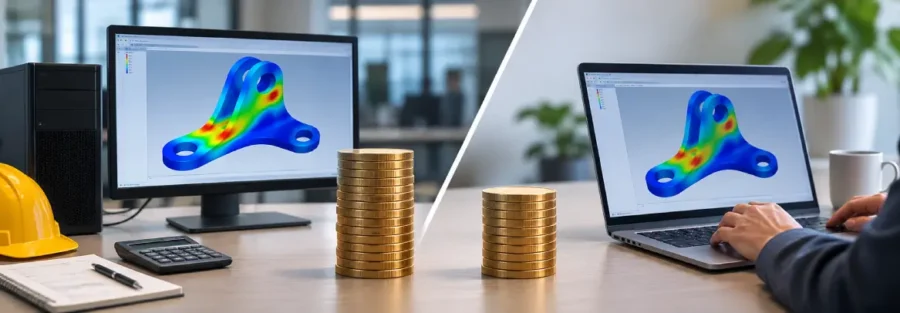
3. In-House vs. Outsourced FEA: Cost Comparison
| Cost factor | In-house FEA | Outsourced FEA |
|---|---|---|
| Software | Recurring licence expense | Usually included in project fee |
| Engineers | Permanent salaries | Project-based engineering fees |
| Hardware | Company investment | Provider’s infrastructure |
| Training | Ongoing internal expense | Managed by service provider |
| Maintenance | Internal responsibility | Provider’s responsibility |
| Workload flexibility | Limited by team capacity | Can scale with project needs |
| Project control | Direct internal control | Requires coordination |
| Initial investment | Generally high | Generally lower |
The comparison is not simply about the price of one simulation. It is about the total cost of maintaining the capability over time.
4. When Does In-House FEA Make Financial Sense?
Building an internal FEA team can be a practical decision when simulation is part of everyday product development.
It may be suitable when:
- Your engineering team runs simulations regularly throughout the year.
- Product development requires frequent design iterations.
- Engineers need immediate access to simulation results.
- You have enough qualified engineers to maintain the workload.
- Simulation knowledge is a core part of your product development process.
- Your company can justify the software and infrastructure investment.
For companies with a consistent and predictable simulation workload, the cost per analysis may become more competitive over time.
However, an internal team still requires management, software updates, training, and capacity planning.
5. When Is Outsourcing FEA More Cost-Effective?
Outsourcing can be more practical when simulation requirements are occasional, specialised, or dependent on project demand.
Consider outsourcing when:
- You do not have a dedicated FEA engineer.
- Hiring a full-time specialist is difficult to justify.
- Your projects require advanced structural or fatigue analysis.
- You need additional engineering capacity during peak workloads.
- You want to avoid investing in expensive software and hardware.
- You need independent engineering support for a specific design or validation requirement.
For small and mid-sized engineering companies, outsourcing can provide access to experienced simulation resources without adding permanent operational expenses.
6. Hidden Costs Companies Should Consider
The initial price is not always the complete cost of either option.
Hidden costs of in-house FEA
- Recruiting and retaining experienced engineers.
- Software licences and additional solver modules.
- Idle engineering capacity during periods with fewer projects.
- Hardware upgrades and IT support.
- Time spent training new employees.
- Delays when specialist expertise is unavailable.
Hidden costs of outsourced FEA
- Preparing and sharing accurate CAD models.
- Explaining design requirements and operating conditions.
- Additional fees for revised designs or new load cases.
- Coordination between internal designers and external engineers.
- Time required for technical reviews and approval.
A clear scope, agreed deliverables, and defined revision requirements can help control costs in both models.
7. Can a Hybrid FEA Model Reduce Costs?
Companies do not always need to choose one approach exclusively.
A hybrid model combines internal engineering knowledge with outsourced simulation support.
For example, an internal design team can handle routine design checks and CAD preparation while an external FEA provider manages complex nonlinear analysis, fatigue assessment, vibration studies, or large assembly simulations.
This approach can help companies:
- Retain control over product design.
- Access specialist expertise when required.
- Avoid investing in every software module.
- Manage workload during peak development periods.
- Reduce the need for permanent specialist resources.
The right balance depends on the company’s engineering workload and internal capabilities.
8. How to Decide Between In-House and Outsourced FEA
Before making a decision, evaluate these five factors:
- Annual simulation workload: Estimate how many projects require FEA each year.
- Analysis complexity: Identify whether your projects need basic linear analysis or advanced nonlinear, dynamic, and fatigue simulations.
- Available expertise: Assess whether your existing engineers can prepare, run, and interpret simulations reliably.
- Total operating cost: Include salaries, software, hardware, training, and maintenance, not just licence prices.
- Project deadlines: Consider whether your internal team can handle workload fluctuations without delaying product development.
Compare the total annual cost of maintaining an internal team with the expected annual outsourcing fees. This gives a more realistic basis for the decision.
Conclusion
In-house FEA offers direct control and can make financial sense when simulation is a regular part of engineering operations. Outsourcing is often more practical when projects are occasional, specialist expertise is required, or maintaining a dedicated team is not financially justified.
The best decision comes from understanding your actual workload, technical requirements, and long-term operating costs.
Need FEA support for your next engineering project?
Caliber Technologies provides engineering simulation support for structural analysis, stress evaluation, deformation, fatigue, and design validation. We work with engineering teams that need additional simulation capacity without building a complete in-house department.
Contact us at operations@thecalibertech.com to discuss your FEA requirements.