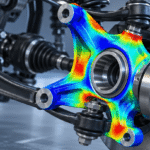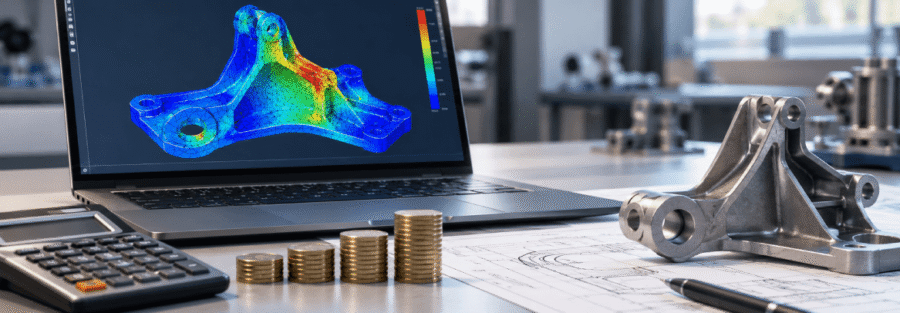
Finite Element Analysis (FEA) helps engineering teams evaluate stress, deformation, stiffness, vibration, and other performance factors before committing to physical prototypes or production changes. But the cost of an FEA project can vary considerably depending on the component, simulation requirements, and level of engineering support needed.
A simple static structural analysis of a single component is generally less involved than a nonlinear contact analysis, fatigue assessment, or full assembly simulation.
There is no single price for FEA analysis. The most useful estimate comes from defining the engineering problem, the required outputs, and the level of validation expected.
For manufacturers considering outsourced simulation, understanding the main cost factors helps them compare proposals and avoid paying for analysis that does not address their actual design requirements.
Typical FEA Analysis Cost
Published service prices provide a starting point, but they are not directly comparable because each provider may include different modelling, engineering review, and reporting work.
For preliminary budgeting, one published engineering service price guide lists standard FEA projects at US$800–$2,000 and advanced analyses at US$2,000–$5,500. These are reference prices from one provider, not a universal industry rate.
| Type of analysis | Indicative cost reference |
|---|---|
| Standard structural or thermal FEA | US$800–$2,000 |
| Advanced nonlinear or complex-contact FEA | US$2,000–$5,500 |
| Fatigue, impact, or complex assembly analysis | Requires project-specific quotation |
The final category can vary substantially with model size, load cases, material behaviour, and validation requirements. The ranges above should be used for initial planning, not as a quote for a specific component.
What Affects the Cost of FEA Analysis?
1. Component and Assembly Complexity
A single bracket or machined component usually requires less modelling effort than a large assembly with multiple parts, fasteners, welds, and contact interfaces.
If CAD geometry needs substantial cleanup or rebuilding, that work can also increase the project cost.
2. Type of Simulation
The analysis method is one of the main cost drivers.
- Linear static analysis: Evaluates stress and deformation under specified loads.
- Modal analysis: Identifies natural frequencies and mode shapes.
- Thermal analysis: Evaluates temperature distribution and thermal effects.
- Nonlinear analysis: May account for large deformation, nonlinear materials, or complex contact.
- Fatigue analysis: Evaluates damage from repeated loading.
- Impact or crash analysis: Models short-duration events that may involve complex material and contact behaviour.
More advanced analyses often require additional model setup, solver work, and result interpretation.
3. Number of Load Cases
A component evaluated under one clearly defined load case generally requires less work than an assembly that must be assessed under multiple combinations of braking, vibration, pressure, temperature, or operating loads.
Each additional case may require separate setup and review.
4. Quality of Inputs
Having accurate CAD files, material properties, boundary conditions, and load data ready can reduce preparation time. Missing or uncertain information may require engineering assumptions, additional investigation, or sensitivity studies.
5. Reporting and Validation
A project delivering basic stress plots is different from one requiring a detailed engineering report, mesh-convergence checks, design comparisons, correlation with test results, or formal documentation.
Agreeing on deliverables before work starts helps keep the scope and cost clear.
How to Reduce FEA Project Costs Without Compromising Quality
Engineering teams can control costs by preparing the project properly before requesting a quote.
- Define the engineering question: Be clear about whether you need stress, stiffness, fatigue, vibration, or another specific result.
- Provide usable CAD files: Include the relevant assembly and connection details.
- Share load cases and material data: Avoid unnecessary delays caused by missing inputs.
- Prioritise critical scenarios: Analyse the load cases that matter to the design requirements first.
- Agree on deliverables: Confirm the required plots, report depth, design iterations, and validation scope before work begins.
Reducing the scope does not mean skipping essential checks. The objective is to spend engineering effort where it helps answer the design question reliably.
Is Outsourcing FEA More Cost-Effective?
Outsourcing can be useful when an engineering team needs specialist simulation support without maintaining all the required software, computing resources, and expertise internally.
The comparison should consider more than the quoted analysis fee. Internal engineering time, software costs, project deadlines, rework, and the level of specialist knowledge required can all affect the overall cost.
FEA can help identify design issues before manufacturing, but it does not guarantee that prototypes or physical tests will be unnecessary. The value comes from making better-informed design decisions earlier.
Get an FEA Analysis Cost Estimate from Caliber Technologies
Caliber Technologies provides engineering simulation support for manufacturers and product development teams. The scope of an FEA project can be tailored to the component, required analysis, available inputs, and expected deliverables.
To request an estimate, share:
- The component or assembly CAD files.
- The material specification.
- The loads and operating conditions.
- The type of analysis required.
- Your reporting and delivery requirements.
Contact operations@thecalibertech.com to discuss your project and obtain a scope-specific quotation.