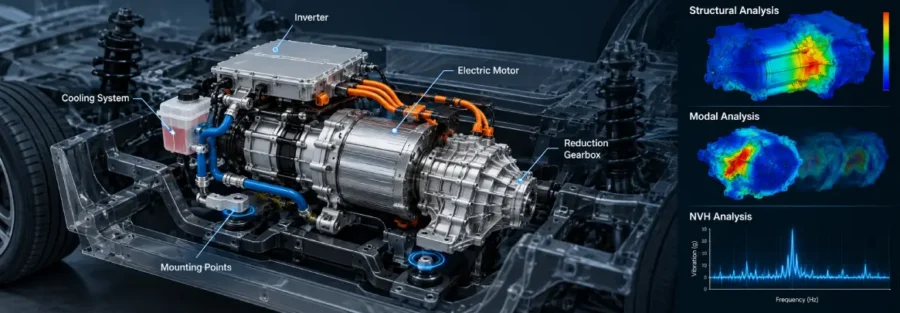
Packaging an electric powertrain is often treated as a dimensional exercise. The motor, inverter, reduction gearbox, cooling system and supporting components need to fit within a defined vehicle envelope.
But a package that fits on CAD can still create engineering problems once the powertrain is operating.
Changing component positions or mounting locations can alter load paths, housing stiffness, shaft alignment and vibration behaviour. In high-speed electric powertrains, these changes can turn a packaging decision into a structural or NVH problem.
A Typical Packaging-Related NVH Problem
Consider an e-powertrain where the motor and reduction gearbox initially meet the required packaging envelope. During vehicle integration, a mounting point is moved to create additional space for another component.
The revised layout still meets the dimensional requirements. However, the change reduces local housing stiffness and alters the load path between the powertrain and vehicle structure.
During testing, a noticeable vibration appears within a specific motor-speed range. Modal analysis shows that a structural mode of the housing has shifted closer to an excitation frequency generated by the rotating system.
The result is not a packaging failure in the conventional sense. The components physically fit, but the new mounting arrangement creates an undesirable structural response.
This type of problem can be expensive to correct once tooling and prototype hardware are already complete.
Why Dimensional Packaging Is Not Enough
A powertrain package has several interfaces that influence its mechanical behaviour.
These include:
- Motor-to-gearbox interfaces
- Powertrain mounts
- Shaft and bearing locations
- Inverter mounting points
- Cooling connections
- Vehicle attachment points
Moving one component can change the stiffness or loading of another.
For example, changing a mount position may alter the way torque reactions enter the housing. Changing the gearbox position can affect shaft alignment. Reducing housing wall thickness to create space can lower structural stiffness.
This means EV powertrain packaging design needs to consider mechanical behaviour alongside available space.
Mounting Locations Can Change NVH Behaviour
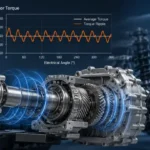
Electric motors produce electromagnetic excitation, while gears introduce mesh-related excitation. These forces are transmitted through the powertrain structure and its mounting system.
The response depends partly on the stiffness and natural frequencies of the surrounding components.
A packaging change can therefore move a structural mode closer to an excitation frequency.
The engineering sequence can look like:
Packaging change → stiffness change → modal shift → stronger structural response → increased vibration
The problem may only appear at a particular motor speed, which can make it difficult to identify through basic static analysis.
Housing Stiffness Is a Packaging Constraint
Reducing component size or changing housing geometry can create additional packaging space, but it may also affect structural stiffness.
Local flexibility can lead to:
- Increased deformation
- Shaft misalignment
- Changes in gear contact
- Higher vibration
- Altered bearing loading
- New resonant behaviour
This is particularly relevant for integrated motor and gearbox assemblies, where the housing performs both structural and functional roles.
A lightweight housing therefore needs to be evaluated for stiffness and dynamic behaviour rather than judged only by weight or available packaging volume.
Shaft Alignment Can Be Affected
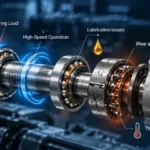
Packaging changes can also influence the relative position of shafts, bearings and housings.
Even small changes in alignment can affect bearing loading and gear contact.
In a reduction gearbox, for example, housing deformation under torque can change the relative position of the gear shafts. This can influence contact distribution and potentially contribute to gear noise or durability issues.
This creates a direct relationship between packaging, structural analysis and drivetrain performance.
Thermal Packaging Creates Another Constraint
Electric powertrains have several heat-generating components operating within a compact space.
The motor, inverter, gearbox and cooling system may all have competing packaging requirements.
A packaging change can influence:
- Cooling-line routing
- Heat transfer paths
- Component temperatures
- Thermal expansion
- Available cooling area
- Service access
Thermal expansion can also affect component interfaces and alignment.
For this reason, packaging decisions should be checked against thermal conditions rather than evaluated only at nominal dimensions.
What Engineers Should Analyse Before Freezing the Package
Before finalizing an e-powertrain package, engineers should understand how the proposed architecture behaves under representative operating conditions.
Depending on the system, analysis may include:
Structural FEA
To evaluate housing stiffness, deformation and load paths.
Modal analysis
To identify natural frequencies and mode shapes.
NVH analysis
To determine how motor and gear excitations are transmitted through the structure.
Multi-body dynamics
To understand shaft, bearing and gear behaviour under operating loads.
Thermal analysis
To evaluate component temperatures and thermal expansion.
The objective is to identify conflicts while the package can still be changed.
Finding the Problem Before Prototype Build
A packaging-related NVH problem discovered during vehicle testing can require changes to mounts, housings or surrounding structures. At that stage, the cost and schedule impact can be significant.
Virtual analysis allows different mounting arrangements, housing geometries and component positions to be compared earlier.
For example, engineers can assess whether moving a mount improves packaging but creates a structural mode in an undesirable operating range.
That comparison is much easier to make before the design is released for production tooling.
Packaging Should Be Treated as an Engineering Problem
Good e-powertrain packaging is not simply about fitting more components into less space.
The package needs to maintain:
- Structural stiffness
- Shaft and bearing alignment
- NVH performance
- Thermal performance
- Component durability
- Mounting integrity
- Serviceability
A design that works dimensionally but fails one of these requirements can still result in expensive redesign.
The earlier these interactions are evaluated, the more options engineers have to correct the design.
How Caliber Supports E-Powertrain Development
Caliber Technologies provides engineering analysis and simulation support for electric powertrain development.
Our capabilities can support:
- Structural and FEA analysis
- Modal analysis
- NVH assessment
- Multi-body dynamics
- Thermal analysis
- Component and housing optimization
- Virtual validation
If your team is facing EV powertrain packaging, structural stiffness, mounting or NVH challenges, Caliber Technologies can support the engineering analysis required to identify and address the problem.