An electric motor can meet its rated torque, efficiency and power targets and still create a vehicle-level NVH problem.
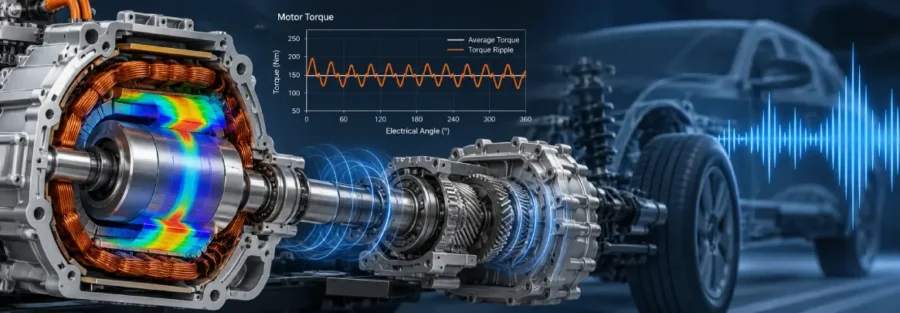
One common cause is torque ripple, the periodic variation in motor torque produced during rotation. At certain operating speeds, these torque fluctuations can excite the rotor, shafts, gears, bearings or motor housing and produce vibration or an audible tonal noise.
For EV engineering teams, the challenge is not simply reducing torque ripple. Changes made to reduce it can also affect motor torque density, efficiency, electromagnetic performance and manufacturability.
A Typical Torque Ripple Scenario
Consider a traction motor that meets its required peak torque and efficiency targets during bench testing. Once integrated into the vehicle, however, a distinct tonal noise appears within a specific motor-speed range.
The vibration is not caused by a conventional mechanical failure. Order analysis shows a periodic excitation associated with the motor’s electromagnetic operating characteristics. The excitation is transmitted through the shaft and housing and can interact with the reduction gearbox and vehicle mounts.
The result is a narrow operating range where electromagnetic excitation aligns with a structural response, making the noise clearly noticeable to occupants.
The motor therefore passes its basic performance requirements but fails to meet the expected NVH target.
Where Torque Ripple Comes From
Torque ripple can result from several electromagnetic and control-related factors.
These can include:
- Slot and pole combinations
- Magnetic field harmonics
- Back-EMF harmonics
- Current waveform distortion
- Rotor and stator geometry
- Manufacturing variation
- Control strategy
The magnitude and frequency of the resulting torque fluctuations depend on the motor architecture and operating condition.
This means torque ripple should be assessed across the motor’s operating range rather than at only one rated condition.
How Torque Ripple Becomes Vibration
A torque fluctuation becomes an NVH problem when it excites a mechanical structure strongly enough to produce a measurable response.
The excitation can travel through:
Electromagnetic forces → Rotor → Shaft → Bearings → Housing → Mounts → Vehicle structure
The reduction gearbox can add another transmission path. Gear mesh and motor excitation can interact, making the resulting vibration more complex than the original motor torque waveform.
This is why EV motor torque ripple analysis needs to consider the complete excitation and response path.
A Key Engineering Trade-Off
Reducing torque ripple is not always as simple as changing the rotor or stator geometry.
For example, a geometry change may reduce a specific harmonic but also reduce average torque or affect efficiency. Increasing certain design features may improve electromagnetic behaviour while making manufacturing more difficult.
Engineers therefore need to balance:
Torque ripple ↔ Torque density ↔ Efficiency ↔ NVH ↔ Manufacturability
The best design is not necessarily the one with the lowest torque ripple. It is the one that meets the required electromagnetic, mechanical and acoustic targets together.
Why Operating Speed Matters
A torque ripple component may exist across a wide speed range, but the resulting vibration may become significant only at certain speeds.
The reason is structural response.
If an excitation order approaches a natural frequency of the rotor, housing, shaft or mounting structure, the response can increase sharply.
This can produce a characteristic complaint such as:
“The motor is quiet at most speeds but produces a noticeable whine between two specific RPM points.”
Finding that operating window is often the first step toward identifying the underlying excitation mechanism.
How Engineers Investigate the Problem
A useful investigation needs to connect the electromagnetic source with the mechanical response.
Depending on the development stage, engineers may use:
Electromagnetic analysis
To identify torque harmonics and electromagnetic excitation sources.
Order analysis
To determine how vibration or noise changes with motor speed.
Modal analysis
To identify structural frequencies that may be interacting with the excitation.
Structural FEA
To understand housing, shaft and component response.
NVH analysis
To determine how the excitation is transmitted and where the resulting noise is generated.
Test correlation
To compare simulation results with measured vibration and acoustic data.
The objective is to identify the excitation order and the structural response responsible for the observed NVH issue.
Design Changes Need to Be Evaluated as a System
Once the source has been identified, engineers may consider changes to the electromagnetic design, control strategy or mechanical structure.
Potential approaches include:
- Optimizing rotor or stator geometry
- Reducing specific electromagnetic harmonics
- Adjusting current control
- Changing structural stiffness
- Modifying mounts
- Improving shaft or housing behaviour
- Altering the drivetrain response
A change that solves the vibration at one speed can create another issue elsewhere. This is why the solution needs to be evaluated across the complete operating range.
Why Early Analysis Matters
Torque ripple-related NVH problems can become expensive when discovered late in vehicle development.
By that stage, changes to the motor, gearbox, housing or mounts may require new prototypes and additional validation.
Early electromagnetic and structural analysis provides an opportunity to identify problematic excitation orders before the hardware is frozen.
The aim is not simply to minimize one calculated torque-ripple value. It is to understand which excitation can create a vehicle-level NVH problem and address it before physical testing exposes it.
How Caliber Supports E-Powertrain NVH Development
Caliber Technologies supports electric powertrain engineering through simulation, analysis and virtual validation.
Our capabilities can support:
- Electric motor NVH analysis
- Torque ripple and excitation assessment
- Structural FEA
- Modal analysis
- Multi-body dynamics
- Powertrain vibration analysis
- Design optimization
- Simulation-to-test correlation
If your EV motor is experiencing torque ripple, vibration or tonal noise at specific operating speeds, Caliber Technologies can help identify the excitation source and evaluate the engineering changes required to address it.