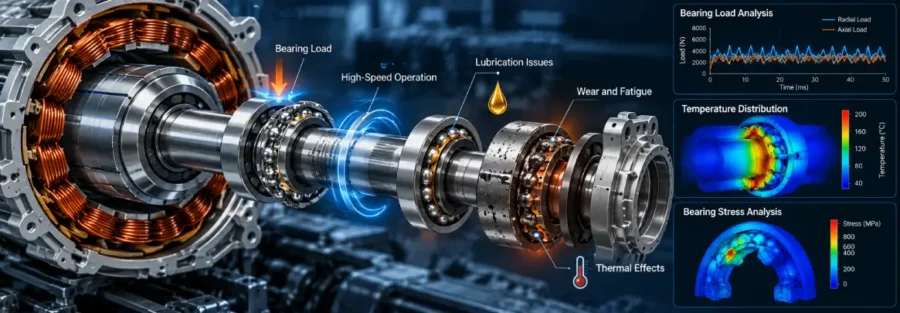
Higher motor speeds help electric powertrains achieve greater power density, but they also place greater demands on the bearings supporting the rotor. Speed, load, temperature and lubrication conditions can interact in ways that are easy to underestimate during early design.
A bearing that meets its calculated static or basic fatigue life may still experience premature damage if the actual operating conditions include high-speed operation, rapid acceleration, thermal gradients or inadequate lubrication.
For engineers developing high-speed e-motors, bearing selection therefore needs to go beyond catalogue life calculations.
A Typical EV Motor Bearing Failure Scenario
Consider a traction motor operating at high rotational speed for extended periods. The bearing is correctly sized for the expected radial and axial loads, and the initial life calculation appears acceptable.
During testing, however, bearing temperature rises significantly during sustained high-speed operation. The higher temperature reduces lubricant viscosity and changes the lubrication condition at the rolling contacts.
Over time, the bearing may develop surface distress, raceway damage or increased vibration. If the condition continues, fatigue damage can progress and eventually lead to bearing spalling or seizure, potentially causing rotor misalignment or motor shutdown.
The important point is that the failure may not originate from excessive static load. It can result from the interaction between speed, temperature, lubrication and cyclic loading.
Why High Motor Speed Changes Bearing Behaviour
Bearing speed affects more than rotational frequency. As speed increases, frictional losses and heat generation can also increase.
The resulting temperature rise can affect:
- Lubricant viscosity
- Lubrication film thickness
- Bearing clearances
- Cage behaviour
- Contact stress
- Fatigue life
This creates a feedback loop that needs to be considered during design:
Higher speed → increased losses → higher temperature → changed lubrication conditions → increased wear or fatigue risk
For this reason, high-speed electric motor bearing analysis should consider the complete operating envelope rather than a single nominal RPM.
Load Distribution Is Not Always Straightforward
The bearing load in an e-motor depends on more than the rotor’s weight.
Gear forces, electromagnetic forces, shaft geometry, thermal expansion and housing deformation can all influence bearing loading.
In an integrated e-powertrain, for example, gear mesh forces can introduce additional radial and axial loads into the motor shaft and bearing arrangement.
Misalignment can also change the distribution of load across the rolling elements. A bearing may therefore experience localized contact conditions that are not obvious from a simplified load calculation.
Understanding the actual shaft and housing behaviour is important when assessing EV motor bearing durability.
Lubrication Can Become the Limiting Factor
At high speed, lubricant selection and delivery become critical.
Insufficient lubricant can increase friction and surface damage. Excessive lubricant can also create additional churning losses and heat.
Engineers may need to evaluate:
- Lubricant viscosity
- Operating temperature
- Lubricant quantity
- Oil or grease delivery
- Churning losses
- Contact conditions
- Expected speed range
The correct lubrication strategy depends on the bearing type, motor architecture and operating conditions. It should therefore be evaluated as part of the motor design rather than treated as an isolated component choice.
Thermal Expansion Can Change Bearing Conditions
Temperature differences across the motor can affect shaft and housing dimensions.
As components expand, internal bearing clearance and preload conditions can change. If these changes are not properly accounted for, the bearing may experience excessive contact stress or insufficient operating clearance.
This becomes more important in compact, high-power-density motors where heat generation and available cooling capacity are tightly constrained.
Thermo-mechanical analysis can help engineers understand how shaft, housing and bearing conditions change across the operating temperature range.
Electrical Currents Can Create Another Failure Path
In some electric motor architectures, electrical currents can pass through the bearing.
These currents can produce localized electrical discharge damage on the bearing raceways, commonly associated with fluting or pitting.
The resulting surface damage can increase vibration and accelerate bearing degradation.
Depending on the motor and inverter architecture, engineers may therefore need to consider electrical bearing protection alongside conventional mechanical and thermal analysis.
What Engineers Should Validate
A reliable EV motor bearing durability analysis should consider the conditions the bearing will actually experience.
Important inputs can include:
- Radial and axial loads
- Maximum and continuous speed
- Shaft and housing stiffness
- Operating temperature
- Lubrication conditions
- Bearing clearance or preload
- Misalignment
- Duty-cycle loading
- Electrical bearing-current risk
The objective is to determine not only the theoretical bearing life, but also the conditions that could cause premature degradation.
Using Simulation Before Physical Testing
Simulation can help identify bearing-related risks before prototype testing.
Depending on the development stage, engineering analysis can be used to assess shaft deformation, bearing loads, housing behaviour, thermal conditions and dynamic response.
This can help answer practical questions such as:
Is the bearing overloaded at a particular operating condition?
Does shaft deformation create uneven load distribution?
Does temperature change the bearing clearance or preload?
Is the lubrication strategy suitable for the target speed?
These questions are more useful than relying on a single bearing life number.
Designing for Bearing Durability
High-speed EV motor bearing performance depends on the interaction between mechanical loads, speed, temperature, lubrication and the surrounding structure.
A bearing failure can become a system-level problem. Increased vibration can affect rotor dynamics, loss of bearing integrity can affect air-gap stability, and excessive friction can increase motor losses and temperature.
Addressing these interactions during design gives engineering teams a better opportunity to prevent premature failures before physical validation.
How Caliber Supports E-Motor Engineering
Caliber Technologies supports electric powertrain development through engineering analysis, simulation and design support.
Our capabilities can be applied to:
- Bearing load analysis
- Structural and FEA studies
- Thermal and thermo-mechanical analysis
- Fatigue and durability assessment
- Shaft and rotor dynamics
- NVH analysis
- Design optimization
- Virtual validation
If your team is developing a high-speed electric motor and needs support with bearing loads, lubrication-related risks, thermal behaviour or durability, contact Caliber Technologies.