Electric vehicle drivetrains are placing new demands on reduction gearboxes. Higher motor speeds, rapid torque changes, tighter packaging and strict NVH requirements are pushing gearbox design beyond the conditions traditionally seen in many conventional powertrains.
The reduction gearbox may look mechanically simple compared with a complete transmission, but it has a direct effect on efficiency, durability, noise and vehicle refinement. A weakness in gear geometry, bearing selection, lubrication or housing stiffness can become a noticeable vehicle-level problem.
For engineering teams developing electric powertrains, the challenge is no longer just selecting a suitable gear ratio. The complete gearbox system needs to be designed and validated for its actual operating loads.
Higher Motor Speeds Change Gearbox Loading
Electric motors can operate at substantially higher rotational speeds than many conventional powertrain components. This changes the operating conditions experienced by the reduction gears, shafts and bearings.
Higher speed affects:
- Gear mesh forces and dynamic behaviour
- Bearing loads and operating temperature
- Lubricant behaviour
- Shaft deflection
- Gear whine
- Housing vibration
- Fatigue life
The gearbox therefore needs to maintain acceptable contact and bending stresses across a wide operating range.
A gearset that performs adequately at a limited design point may behave differently during high-speed operation, rapid acceleration or regenerative braking. These transient conditions need to be considered during the design and validation process.
Torque Changes Create Additional Durability Concerns
One of the differences between conventional and electric powertrains is the way torque is delivered.
Electric motors can produce high torque from very low speeds, while the drivetrain can also experience rapid torque changes during acceleration, traction events and regenerative braking.
These conditions can increase the loading cycles experienced by:
- Gear teeth
- Shafts
- Bearings
- Splines
- Differential components
- Gearbox housing
Peak torque alone does not provide enough information to assess durability. Engineers need to understand how loads vary throughout the operating cycle and how those loads are transferred through the complete reduction gear system.
This makes EV gearbox durability analysis an important part of the development process.
Gear Whine Is a Major NVH Challenge
With the absence of an internal combustion engine, electric vehicles expose mechanical noise that could previously be masked by engine and exhaust noise.
Gear mesh can therefore become one of the dominant sources of high-frequency noise.
Small changes in gear geometry, manufacturing tolerances, shaft alignment or housing stiffness can influence the resulting vibration and acoustic response.
Common areas of investigation include:
- Gear mesh excitation
- Transmission error
- Shaft and bearing dynamics
- Housing modes
- Gear microgeometry
- Manufacturing tolerances
- Structural vibration
For this reason, EV reduction gearbox NVH analysis needs to be considered alongside mechanical strength and durability rather than treated as a final-stage refinement exercise.
Lightweighting Makes Housing Design More Difficult
Weight reduction remains an important objective in electric vehicle development. However, removing material from the gearbox housing can affect stiffness and vibration behaviour.
A lighter housing may have:
- Lower structural stiffness
- Different natural frequencies
- Greater local deformation
- Higher sensitivity to gear mesh excitation
The housing therefore needs to provide sufficient stiffness without becoming unnecessarily heavy.
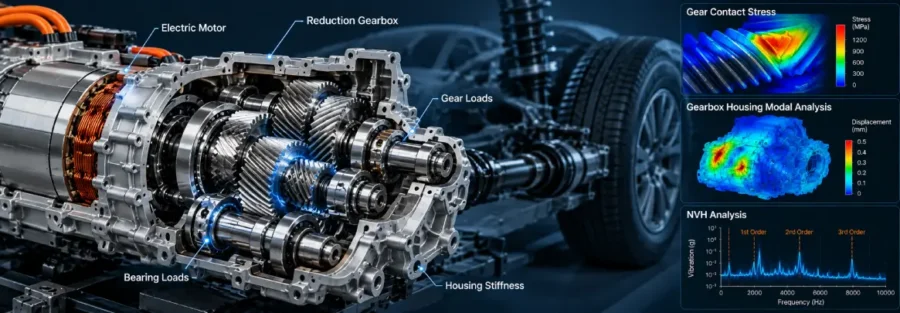
FEA can be used to assess structural behaviour, identify critical areas and compare design alternatives before physical prototypes are built.
Thermal Behaviour Cannot Be Ignored
Gearbox losses generate heat through gear meshing, bearings and lubricant friction. At high operating speeds, these losses can become significant.
Poor thermal management can affect lubricant performance, component temperatures and long-term durability.
The engineering task is to understand the relationship between:
Speed → Losses → Heat generation → Lubrication → Component temperature → Durability
This is particularly relevant when the gearbox needs to operate across a wide speed and load range.
Simulation Helps Identify Problems Earlier
Physical testing remains necessary for gearbox validation, but finding fundamental design problems after hardware is available can be expensive.
Engineering simulation can be used earlier to investigate:
- Gear tooth stresses
- Contact pressure
- Shaft deformation
- Bearing loads
- Housing stiffness
- Modal behaviour
- Fatigue performance
- Thermal behaviour
- Gear mesh and NVH characteristics
Different analysis methods can also be combined to understand how changes at component level affect the complete e-powertrain.
For example, shaft deformation can change gear alignment. Gear alignment can influence contact distribution. Contact changes can affect transmission error and ultimately contribute to NVH.
Looking at these relationships early gives engineers more opportunity to correct the design before prototype validation.
The Design Challenge Is System-Level
The biggest mistake in EV reduction gearbox development is treating each component independently.
A gear can meet its stress requirement while the gearbox still has an NVH problem. A housing can meet its strength target while its stiffness creates an undesirable vibration response. A bearing can meet its calculated life while the actual operating temperature creates a lubrication problem.
The gearbox therefore needs to be assessed as an integrated mechanical system.
That means considering gear geometry, shafts, bearings, housing, lubrication, loads, thermal behaviour and NVH together.
How Caliber Supports E-Powertrain Development
Caliber Technologies supports engineering teams with simulation and product engineering expertise for electric powertrain development.
Our engineering work can support areas such as:
- Gear and component analysis
- Structural and fatigue assessment
- NVH analysis
- Multi-body dynamics
- Thermal analysis
- Design optimization
- Virtual validation
The objective is to identify engineering risks early, understand their causes and provide practical design direction before they become expensive prototype or vehicle-level issues.
Need Support With Your EV Gearbox Development?
If your engineering team is working on EV reduction gearbox design, durability, NVH, structural analysis or validation, discuss your requirements with Caliber Technologies.