
Wheelbase is the distance between the centres of the front and rear wheels of a vehicle. It is an important vehicle dimension that influences stability, handling, ride comfort and interior packaging.
Different vehicles have different wheelbase measurements depending on their design and intended use. Passenger cars, SUVs, trucks and buses are designed with specific wheelbase dimensions to meet their performance and load-carrying requirements.
A vehicle’s wheelbase also affects how it responds to steering inputs, road irregularities and weight distribution.
How Is Wheelbase Measured?
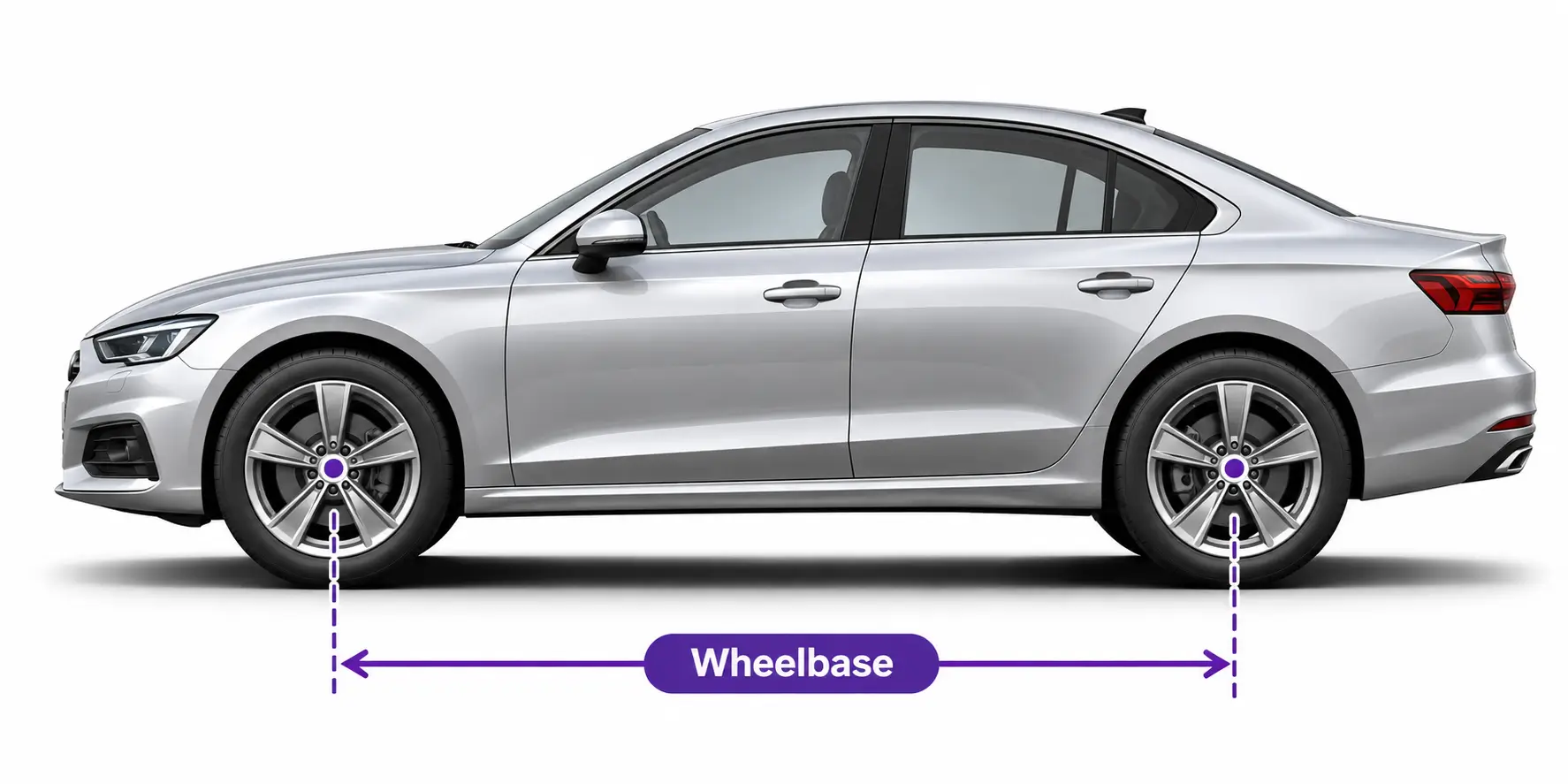
Wheelbase is measured horizontally between the centre of the front axle and the centre of the rear axle.
For example, if the distance between these two axle centres is 2,700 mm, the vehicle has a wheelbase of 2.7 metres.
Wheelbase should not be confused with overall vehicle length. A vehicle can have a long body but a relatively short wheelbase, depending on the front and rear overhangs.
What Are the Different Types of Wheelbase?
Vehicles are generally classified by their wheelbase dimensions and axle arrangements.
Short Wheelbase: Vehicles with shorter distances between their front and rear axles. This arrangement generally allows tighter turning and easier manoeuvrability. It is common in compact cars and some off-road vehicles.
Long Wheelbase: Vehicles with greater distances between their axles. This can improve straight-line stability and provide more space for passengers or cargo. It is common in luxury cars, buses and commercial vehicles.
Extended Wheelbase: Some vehicle platforms offer extended-wheelbase versions with additional space between the axles. These are commonly used in passenger vehicles, vans and commercial applications where additional cabin or cargo space is required.
How Does Wheelbase Affect Vehicle Stability and Handling?
Wheelbase influences several aspects of vehicle behaviour. Its effect depends on suspension geometry, steering characteristics, vehicle weight distribution and tyre properties.
Straight-Line Stability: A longer wheelbase generally helps a vehicle maintain directional stability at higher speeds. It can reduce sensitivity to certain steering inputs and road disturbances.
Cornering Behaviour: Wheelbase influences the vehicle’s yaw response during cornering. Shorter-wheelbase vehicles generally respond more quickly to steering inputs, while longer-wheelbase vehicles may have a slower response.
Turning Radius: A shorter wheelbase can help reduce the turning radius for a given steering angle. However, actual turning radius also depends on steering geometry and maximum wheel angle.
Ride Comfort: A longer wheelbase can help reduce the effect of some road undulations on vehicle motion. Actual ride comfort also depends on suspension design, damping and seating position.
Load Distribution: Wheelbase affects how vehicle weight and payload are distributed between the front and rear axles. This is particularly important in trucks and commercial vehicles.
What Is the Difference Between Wheelbase and Track Width?
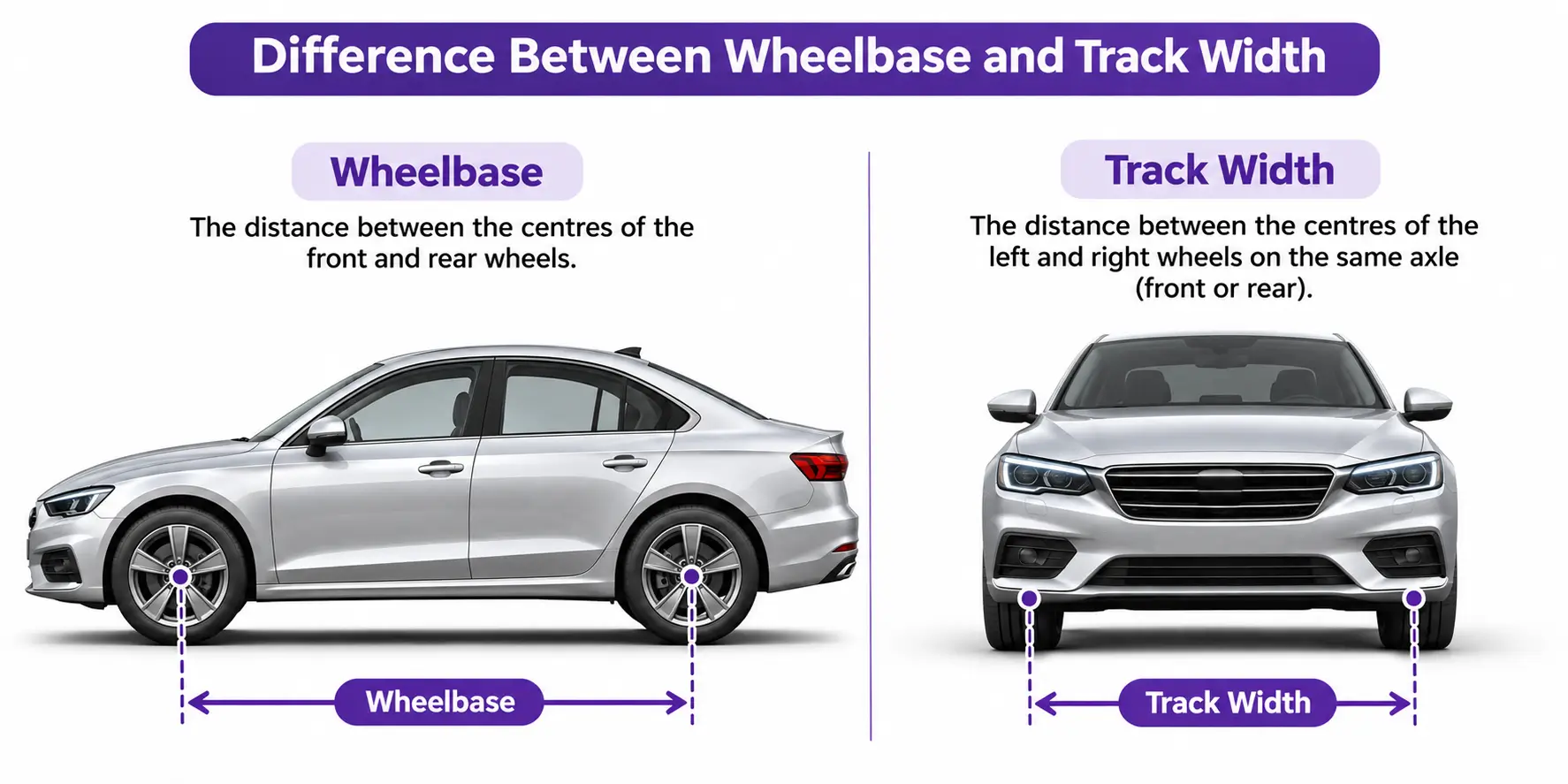
Wheelbase and track width are two different vehicle dimensions that influence handling and stability.
- Wheelbase: Distance between the front and rear axle centres, measured along the vehicle’s length.
- Track Width: Distance between the centres of the left and right wheels on the same axle.
Wheelbase influences longitudinal vehicle dimensions and yaw response, while track width influences lateral stability and load transfer characteristics.
Engineers consider both measurements when developing vehicle platforms and suspension systems.
What Should Engineers Consider When Selecting Wheelbase?
Wheelbase selection depends on vehicle type, intended application and performance requirements.
Important considerations include:
- Vehicle Dimensions: Available space for passengers, cargo, engine and other components.
- Weight Distribution: Front and rear axle loads under different loading conditions.
- Suspension Layout: Suspension mounting positions and available wheel travel.
- Steering Requirements: Turning radius, steering response and manoeuvrability.
- Vehicle Stability: Directional stability and handling during different driving conditions.
- Payload Requirements: Axle spacing and load distribution in trucks and commercial vehicles.
For commercial vehicles, wheelbase selection also affects body mounting arrangements, cargo space and chassis loading.
How Is Wheelbase Evaluated in Vehicle Dynamics Analysis?
Wheelbase is an important input in vehicle dynamics and handling analysis. Engineers study how axle spacing interacts with steering geometry, suspension characteristics, tyre forces and vehicle mass.
Vehicle dynamics simulation can help evaluate:
- Steering response during cornering manoeuvres.
- Yaw rate and lateral acceleration.
- Vehicle stability during lane changes.
- Understeer and oversteer characteristics.
- Load distribution between front and rear axles.
- Handling behaviour under different operating conditions.
These evaluations help engineers understand how wheelbase changes may affect overall vehicle behaviour before finalising a design.
Vehicle Dynamics Engineering Support from Caliber Technologies
Caliber Technologies provides vehicle dynamics simulation and engineering support for automotive and commercial vehicle development.
Our capabilities include vehicle dynamics analysis, suspension kinematics, steering response evaluation and handling performance assessment. We help engineering teams study vehicle behaviour under different driving conditions and evaluate design changes.
If you are developing a vehicle platform or evaluating its handling characteristics, contact our engineering team.
Email: operations@thecalibertech.com