
A connecting rod is an important component of an internal combustion engine. It connects the piston to the crankshaft and transfers the force generated during combustion to the crankshaft.
As the piston moves up and down inside the cylinder, the connecting rod transfers this motion to the crankshaft, helping convert reciprocating motion into rotational motion.
Connecting rods operate under repeated tensile and compressive loads. Their design, material strength and dimensions directly affect engine reliability, performance and durability.
What Are the Main Parts of a Connecting Rod?
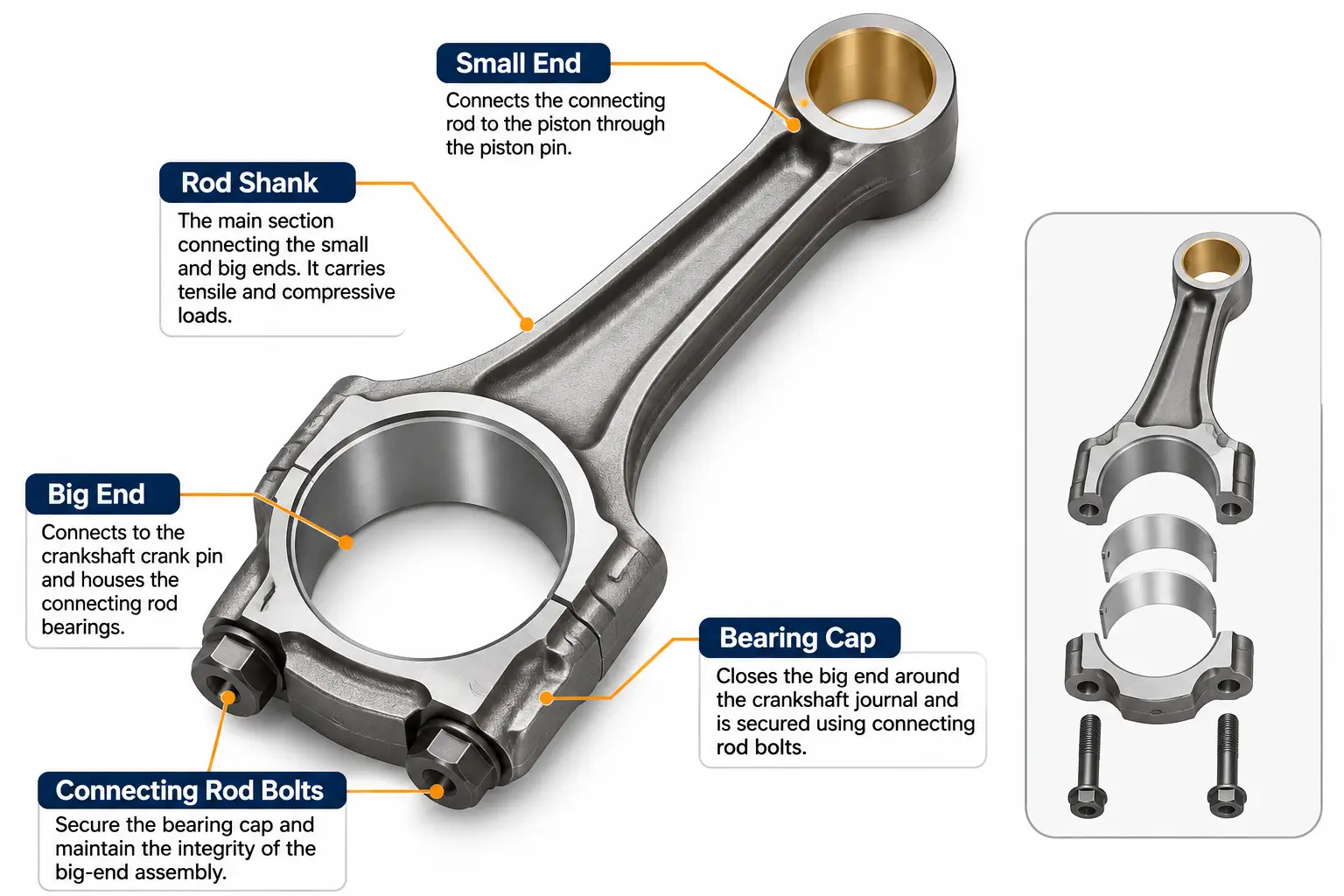
A typical engine connecting rod consists of several important sections:
- Small End: Connects the connecting rod to the piston through the piston pin or gudgeon pin.
- Big End: Connects to the crankshaft crank pin and houses the connecting rod bearings.
- Rod Shank: The main section connecting the small and big ends. It carries tensile and compressive loads.
- Bearing Cap: Closes the big end around the crankshaft journal and is secured using connecting rod bolts.
- Connecting Rod Bolts: Secure the bearing cap and maintain the integrity of the big-end assembly.
How Does a Connecting Rod Work?
The connecting rod transfers force between the piston and crankshaft during the engine cycle.
During combustion, expanding gases push the piston downward. The connecting rod transfers this force to the crankshaft through the crank pin, producing rotational motion.
During the remaining strokes, the crankshaft drives the piston through the connecting rod. This movement allows the engine to complete its intake, compression, power and exhaust cycles.
The connecting rod continuously experiences changes in loading and direction as engine speed increases and decreases.
What Are the Different Types of Connecting Rods?
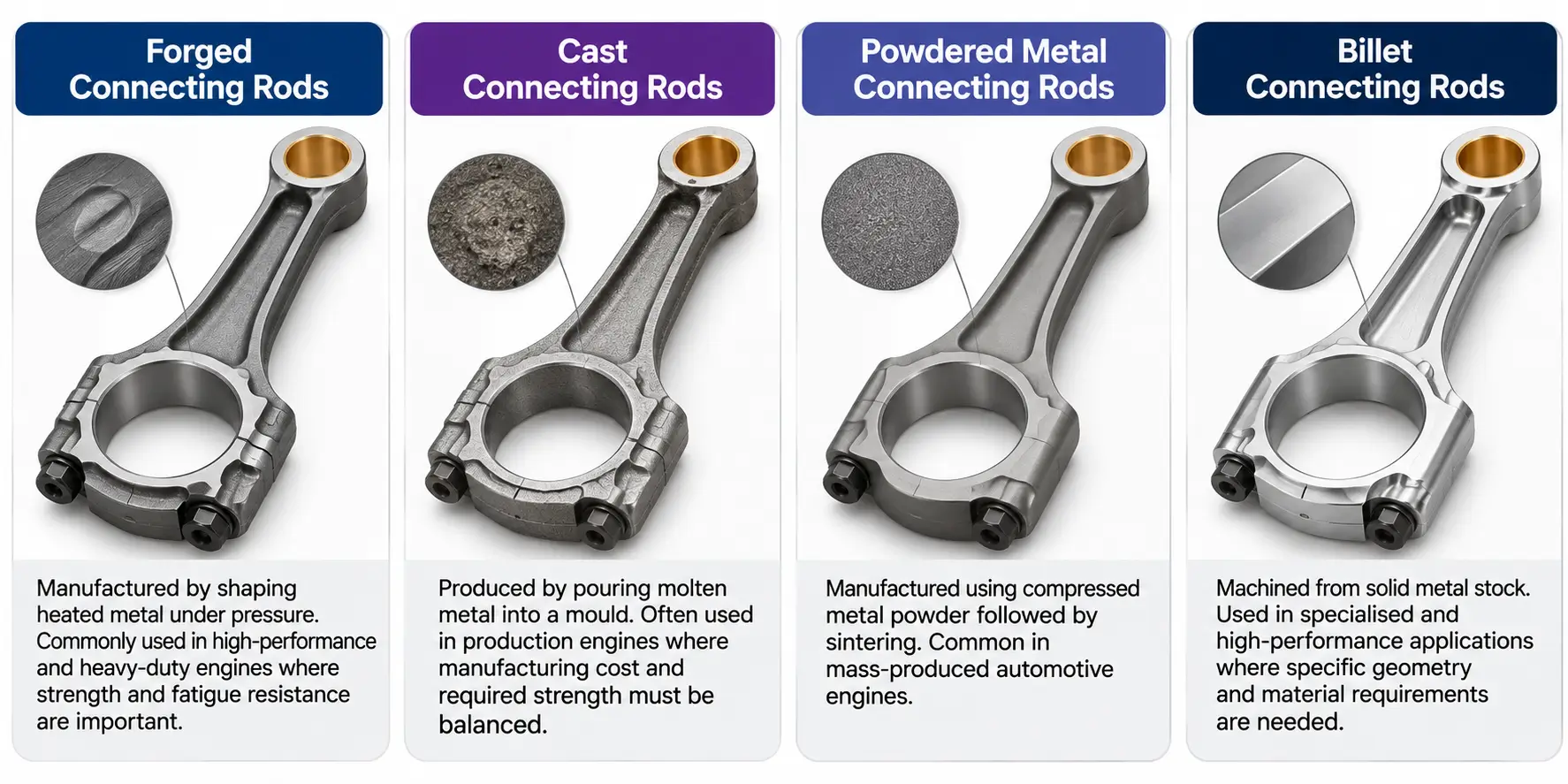
Connecting rods are manufactured in different designs depending on engine configuration, operating loads and manufacturing requirements.
- Forged Connecting Rods: Manufactured by shaping heated metal under pressure. Commonly used in high-performance and heavy-duty engines where strength and fatigue resistance are important.
- Cast Connecting Rods: Produced by pouring molten metal into a mould. Often used in production engines where manufacturing cost and required strength must be balanced.
- Powdered Metal Connecting Rods: Manufactured using compressed metal powder followed by sintering. Common in mass-produced automotive engines.
- Billet Connecting Rods: Machined from solid metal stock. Used in specialised and high-performance applications where specific geometry and material requirements are needed.
What Materials Are Used in Connecting Rods?
Material selection depends on engine loads, operating speed, temperature, weight and manufacturing requirements.
Common materials include:
- Carbon Steel: Used in many conventional engine applications because of its strength and availability.
- Alloy Steel: Offers improved mechanical properties and is commonly used in demanding engine applications.
- Aluminium Alloys: Used in selected performance and specialised applications where reducing reciprocating mass is important.
- Titanium Alloys: Used in high-performance applications where high strength-to-weight ratio is required, although material and manufacturing costs are higher.
What Causes Connecting Rod Failure?
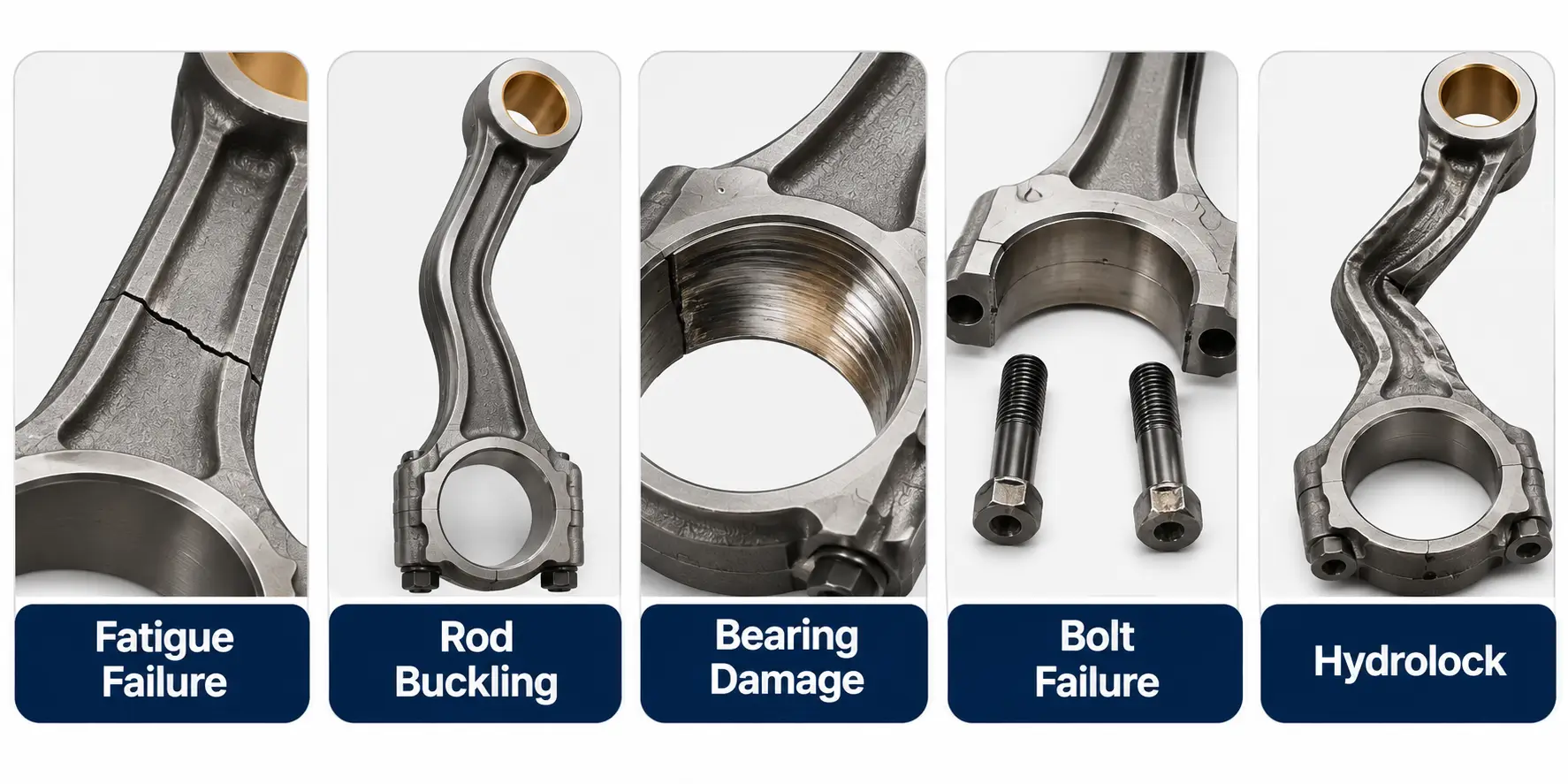
Connecting rods operate under repeated loading throughout engine operation. Excessive stress, lubrication problems and abnormal combustion conditions can contribute to failure.
Common causes include:
- Fatigue Failure: Repeated tensile and compressive loads can initiate cracks in the rod shank or around the big-end region.\
- Rod Buckling: Excessive compressive loading can cause the connecting rod to bend or become unstable.
- Bearing Damage: Insufficient lubrication can cause overheating and damage at the big end.
- Bolt Failure: Excessive loading or improper bolt installation can affect bearing cap retention.
- Hydrolock: Liquid entering the combustion chamber can prevent normal piston movement and cause severe connecting rod deformation.
What Should Engineers Consider in Connecting Rod Design?
Connecting rod design involves balancing strength, weight, stiffness and durability. Engineers must evaluate how the component performs under different engine operating conditions.
Important design considerations include:
- Load Capacity: The rod must withstand combustion forces and inertia loads generated by piston movement.
- Buckling Resistance: The shank must resist instability under compressive loading.
- Fatigue Strength: The component must withstand repeated loading throughout its expected service life.
- Weight Optimisation: Reducing reciprocating mass can help reduce inertia forces.
- Bearing Design: Big-end and small-end geometry must support proper load transfer and lubrication.
- Material Selection: Material properties must match the required strength, durability and operating conditions.
How FEA Helps in Connecting Rod Design
Finite Element Analysis (FEA) helps engineers evaluate connecting rod strength and identify potential structural weaknesses before manufacturing.
Engineers can use structural simulation to assess:
- Stress distribution around the big end, small end and rod shank.
- Deformation under tensile and compressive loads.
- Buckling behaviour under compression.
- Fatigue performance under repeated engine loading.
- Connecting rod bolt and bearing cap loading.
- Weight reduction opportunities while maintaining structural requirements.
The accuracy of these results depends on appropriate load cases, material properties, boundary conditions and model assumptions.
Connecting Rod Design and Analysis Support from Caliber Technologies
Caliber Technologies provides engineering design and simulation support for internal combustion engine components.
Our capabilities include CAD modelling, structural FEA, fatigue assessment and engineering analysis to evaluate component strength and performance under defined operating conditions.
For connecting rod development, we can support design evaluation, structural validation and optimisation based on project requirements.