Electric motor performance is influenced by more than electromagnetic geometry and conductor selection. Winding and insulation design can affect the amount of copper that fits inside a slot, winding resistance, electrical losses, heat transfer, and ultimately the motor’s thermal operating margin.
Insulation is essential for electrical isolation and winding reliability, but its thickness and thermal properties also occupy physical space and influence the thermal path from the conductors to the stator and cooling system. This creates a direct relationship between a material-level design decision and overall motor performance.
How Insulation Thickness Changes Copper Utilization
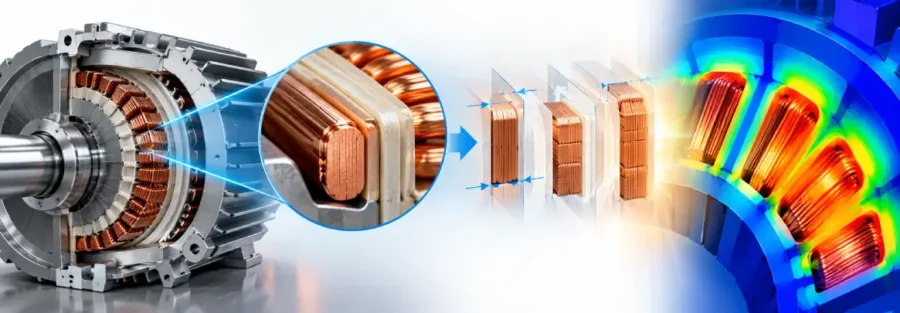
The available slot volume is shared by conductors, electrical insulation, impregnation material, and other required features. Increasing insulation thickness reduces the volume available for the conductor.
A reduction in available conductor area can affect the copper fill factor, conductor cross-section, winding resistance, and current density. For a given current, increased resistance results in higher copper losses and greater heat generation.
The design relationship can therefore be expressed as:
Insulation thickness → available slot volume → conductor area → copper fill → resistance → electrical losses → heat generation → winding temperature
This relationship makes insulation thickness an important design variable rather than simply an electrical-isolation parameter.
Insulation Thermal Conductivity and Motor Heat Transfer
Insulation also influences how effectively heat moves away from the winding. The thermal conductivity of an insulation or impregnation material affects the thermal resistance between the copper conductors and surrounding motor structure.
Higher thermal conductivity can provide a more effective heat-transfer path, while lower conductivity can increase thermal resistance and contribute to higher winding temperatures under the same loss conditions.
The resulting relationship is:
Insulation thermal conductivity → thermal resistance → heat transfer → winding temperature → thermal margin
The actual thermal performance depends on the complete winding construction, including material thickness, interfaces, impregnation, conductor arrangement, stator geometry, and cooling conditions.
Winding Resistance, Copper Loss and Temperature
Winding resistance directly affects copper losses. As conductor area decreases, resistance generally increases for a given conductor length and material. Copper losses then increase according to the winding current and resistance.
Temperature introduces another interaction because copper resistance increases with temperature. Higher winding temperature can therefore increase electrical losses, creating additional heat generation.
This interaction is important when evaluating motors operating continuously at high load or under demanding duty cycles. A winding design that appears acceptable from a geometric perspective may have limited thermal margin once resistance and heat transfer are evaluated together.
Evaluating Winding and Insulation Design Through Simulation
Electromagnetic and thermal simulation can quantify the effect of insulation and winding design changes before physical prototypes are built.
The electromagnetic model can evaluate available conductor area, copper fill, resistance, current density, and copper losses. These losses can then be transferred into the thermal model to determine winding temperature, temperature gradients, hot spots, and thermal margin.
Changing insulation thickness can therefore be evaluated as a complete design variation rather than as an isolated material parameter. The same approach can be used to investigate insulation thermal conductivity and its effect on heat transfer.
The analysis becomes particularly useful when several competing requirements must be satisfied simultaneously. Electrical insulation must remain adequate, sufficient copper must fit within the slot, losses must remain controlled, and heat must be transferred effectively to the cooling system.
Thermal Hot Spots and Winding Reliability
Average winding temperature does not always represent the most critical condition. Localized regions with higher loss density or greater thermal resistance can produce winding hot spots.
Thermal simulation can identify these locations and determine how insulation properties, conductor arrangement, slot geometry, and cooling conditions influence the temperature field.
This information can support decisions involving insulation selection, winding layout, conductor dimensions, impregnation, and cooling strategy. It can also help establish whether the design has sufficient thermal margin for its intended operating conditions.
Product Design Beyond the Motor
The relationship between winding and insulation design applies across many electrically driven products. Electric motors used in pumps, compressors, fans, industrial machinery, robotics, actuators, e-mobility systems, powertrain systems, and other electrified equipment can face different combinations of current, speed, duty cycle, cooling conditions, and packaging constraints.
The required insulation system and winding architecture therefore need to be evaluated against the complete product operating environment. A design suitable for one application may not provide the same electrical or thermal margin in another.
Engineering Outputs and Design Decisions
The purpose of the analysis is to connect material and geometric changes with measurable product performance.
Key electromagnetic outputs include copper fill factor, conductor area, resistance, current density, and copper losses. Thermal outputs include winding temperature, hot-spot temperature, thermal resistance, heat-transfer behaviour, and available thermal margin.
These results can guide decisions on insulation thickness, insulation material, conductor dimensions, slot geometry, winding configuration, cooling conditions, and allowable operating current.
For example, reducing insulation thickness may create additional conductor volume, but the change must still satisfy electrical insulation requirements. Increasing insulation thermal conductivity may improve heat transfer, but its benefit depends on the complete thermal path and the surrounding motor structure.
Simulation therefore helps determine the balance between electrical isolation, copper utilization, resistance, heat generation, thermal performance, and product reliability.
Caliber Technologies for Winding and Insulation Design
Caliber Technologies applies multiphysics engineering analysis to evaluate how winding and insulation parameters influence electric motor performance. Electromagnetic and thermal models can be used together to assess insulation thickness, available slot volume, copper utilization, resistance, current density, copper losses, heat transfer, and winding temperature.
This approach connects material and component-level decisions with product-level performance. Engineers can evaluate design alternatives, identify thermal constraints, and understand how changes in insulation or winding configuration affect the complete motor system.
The same simulation methodology can support electrically driven products across industrial, mobility, automation, and other applications where electrical losses and thermal management directly influence product performance.
Need support with electric motor design or simulation? Email operations@thecalibertech.com to discuss your engineering requirements.
Conclusion
Winding and insulation design can influence the entire electric motor performance chain. Insulation thickness affects available slot volume and copper utilization, which influence resistance and electrical losses. Insulation thermal conductivity affects thermal resistance and heat transfer, which influence winding temperature and thermal margin.
Evaluating these relationships through coupled electromagnetic and thermal simulation allows engineers to make informed decisions about conductor geometry, insulation systems, winding configuration, cooling, and operating limits.
Caliber Technologies supports this product-engineering approach by connecting material and winding design parameters with measurable electromagnetic and thermal performance.