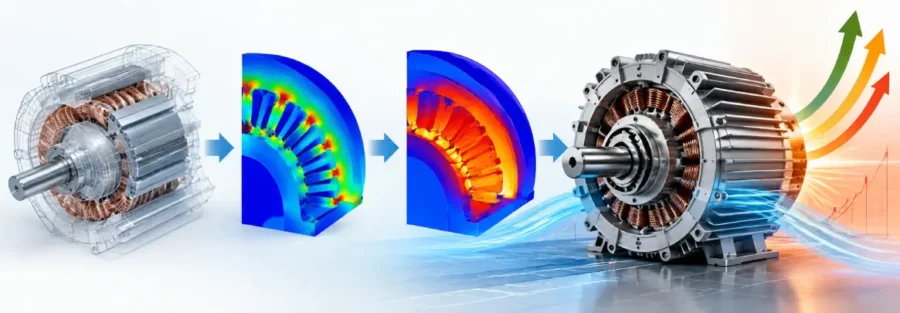
Electric motor designers are continuously balancing power, efficiency, size, weight, temperature, and reliability. Increasing power output within a smaller package can improve system-level performance, but higher power density often increases electromagnetic losses and thermal loading.
This creates a fundamental product-development problem. A motor cannot be optimized for electromagnetic performance alone if the resulting losses push winding, magnet, core, or other component temperatures beyond acceptable limits. Electromagnetic-thermal simulation provides a way to evaluate these interactions before physical prototypes are finalized.
From Motor Geometry to Continuous Power Capability
Motor power density is influenced by a chain of interconnected design variables:
Motor geometry → electromagnetic performance → electrical losses → heat generation → temperature → thermal limits → continuous power capability
Changing the motor geometry affects its magnetic circuit and electrical loading. These changes influence torque, efficiency, current density, and losses. The resulting heat must then be transferred through the motor structure and cooling system.
If temperature limits are reached before the electromagnetic capability is exhausted, thermal performance becomes the constraint on continuous power.
This is why increasing current or reducing motor size does not automatically increase useful power density. The electromagnetic and thermal limits must be evaluated together.
Optimizing Conductor Geometry and Slot Fill
Conductor geometry directly affects winding resistance, current density, copper utilization, and heat generation. Increasing copper fill can reduce unused slot volume and potentially improve electrical utilization, but the available space must also accommodate insulation and manufacturing requirements.
Electromagnetic analysis can evaluate current density and copper losses, while thermal analysis determines how those losses affect winding temperature.
The design objective is therefore not simply maximum copper fill. It is achieving an appropriate balance between conductor area, resistance, thermal behaviour, insulation requirements, and manufacturability.
Winding Configuration and Insulation Design
Winding configuration influences conductor length, resistance, current distribution, and thermal paths. Insulation thickness also affects the volume available for copper and the thermal resistance between the winding and surrounding motor structure.
A change in insulation design can therefore influence both electrical and thermal performance. Reducing available conductor area may increase resistance and copper losses, while changes in insulation thermal conductivity can affect heat transfer.
Coupled simulation allows these effects to be evaluated as part of the complete motor design rather than as isolated parameters.
Magnetic Design, Air Gap and Electromagnetic Performance
Magnetic geometry affects torque production, flux density, saturation, losses, and efficiency. Air-gap dimensions are particularly important because they influence the magnetic field and electromagnetic loading.
Simulation can evaluate how changes in air gap, magnetic materials, rotor and stator geometry, and other design parameters affect motor performance.
The goal is to achieve the required torque and efficiency without creating excessive saturation or losses that reduce thermal margin.
Cooling and Thermal Limits
As power density increases, cooling becomes a critical design variable. The thermal model evaluates how effectively generated heat moves through the winding, stator, rotor, housing, and cooling system.
Depending on the motor architecture, thermal analysis may be combined with CFD to evaluate coolant flow, heat-transfer conditions, pressure drop, and cooling distribution.
The resulting outputs include winding temperature, component temperatures, hot-spot locations, temperature gradients, heat-flow paths, and thermal margin. These results establish whether the motor can sustain the required operating point continuously.
Optimizing Across Multiple Operating Points
A motor may have sufficient thermal margin at one operating point but reach a temperature limit at another. High torque, high speed, continuous operation, acceleration, and overload conditions can produce different combinations of current and electromagnetic losses.
Evaluating multiple operating points helps establish the actual operating envelope. This is particularly important when optimizing for both peak and continuous power.
A design that achieves high peak power but requires significant thermal derating may not provide the required continuous power capability.
Engineering Outputs and Design Decisions
Electromagnetic-thermal simulation should produce measurable outputs that directly support product decisions.
Electromagnetic results can include torque, torque density, power, efficiency, flux density, current density, saturation, and loss distribution. Thermal results can include winding temperature, hot-spot temperature, thermal gradients, heat-flow paths, and thermal margin.
These results allow engineers to determine which design variable is limiting performance. High copper losses may lead to changes in conductor geometry or winding configuration. Excessive magnetic losses may require changes to magnetic materials or geometry. High temperatures may require improved cooling, revised thermal paths, or changes to the operating envelope.
Packaging can also be evaluated alongside electromagnetic and thermal performance. Reducing motor volume may increase power density, but the smaller package can reduce available cooling area and thermal margin.
The engineering objective is therefore to maximize useful power within the required size, weight, efficiency, temperature, reliability, and manufacturing constraints.
A Simulation-Led Motor Optimization Workflow
An efficient development workflow can combine electromagnetic and thermal analysis throughout the design process:
Motor architecture → electromagnetic analysis → loss calculation → thermal analysis → design modification → multipoint evaluation → validation
Early simulations can identify promising motor geometries and operating conditions. Detailed analysis can then evaluate spatial loss distribution, thermal hot spots, cooling performance, and component limits.
Design variables such as conductor geometry, slot fill, winding configuration, insulation, magnetic materials, air gap, cooling, current density, and package dimensions can be varied and assessed against the same performance requirements.
This approach reduces reliance on trial-and-error physical prototypes and provides quantitative evidence for design refinement.
Caliber Technologies for Motor Power Density Optimization
Caliber Technologies applies electromagnetic and thermal simulation as a multiphysics product-engineering workflow for electric motor development. The analysis can connect motor geometry and electromagnetic performance with loss generation, temperature rise, cooling behaviour, and operating limits.
This allows engineering teams to evaluate torque density, power density, efficiency, thermal margins, and packaging as interconnected design measures rather than isolated targets.
By linking electromagnetic losses with thermal response, Caliber Technologies can help identify the constraints limiting power density and evaluate design changes involving conductors, windings, insulation, magnetic materials, air gaps, cooling systems, and operating conditions.
Need support with electric motor design or simulation? Email operations@thecalibertech.com to discuss your engineering requirements.
Conclusion
Optimizing electric motor power density requires more than increasing electromagnetic loading or reducing package size. The resulting losses generate heat, temperature affects operating capability, and thermal limits can ultimately determine the motor’s continuous power output.
Electromagnetic-thermal simulation connects motor geometry, electromagnetic performance, losses, temperature, cooling, and operating limits within a single engineering workflow.
Caliber Technologies uses this multiphysics approach to help engineering teams evaluate power density, torque density, efficiency, thermal margin, and packaging together, providing a technical basis for motor design optimization and product development.