Choosing between 2D and 3D electromagnetic analysis of electric motors is primarily an engineering modelling decision. A 3D model is not automatically better than a 2D model. The appropriate approach depends on the motor geometry, required outputs, operating conditions, and level of physical detail needed.
For many motor development programs, 2D electromagnetic FEA provides the fastest route from concept to a refined design. 3D analysis is then introduced when axial, end-region, conductor, or other three-dimensional effects can materially influence performance or losses.
2D Electromagnetic Analysis for Motor Design
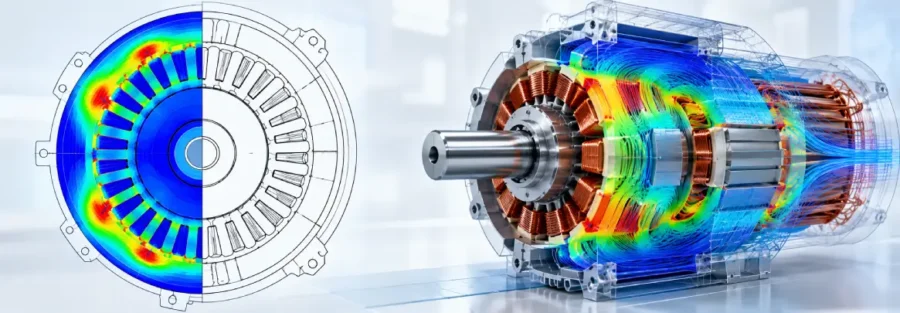
A 2D electromagnetic model represents the motor’s active cross-section and is particularly effective when the electromagnetic behaviour is predominantly radial and periodic. It requires fewer computational resources than a full 3D model, allowing engineers to evaluate multiple design configurations efficiently.
During early motor concept development, 2D FEA can be used to study magnetic flux distribution, saturation, back EMF, torque, torque ripple, and cogging torque. It can also provide initial electromagnetic loss estimates and support rapid optimization of parameters such as air-gap dimensions, magnet geometry, slot configuration, and winding arrangement.
The computational efficiency of 2D analysis makes it valuable when many design iterations are required. Engineers can evaluate alternatives, identify promising configurations, and refine the motor architecture before committing resources to detailed three-dimensional simulation.
What 2D Motor FEA Can Reveal
A well-defined 2D electromagnetic model can provide key outputs including magnetic flux density, current density, back EMF, average torque, torque ripple, cogging torque, saturation, and initial loss distribution.
These results are useful for determining whether the basic electromagnetic architecture is performing as intended. They can also reveal areas where geometry or material selection should be modified before more detailed modelling is performed.
However, a 2D model inherently simplifies phenomena that vary along the motor’s axial direction. This limitation becomes important when end effects, complex conductors, or three-dimensional cooling and loss mechanisms influence the design.
When 3D Electromagnetic Analysis Becomes Necessary
3D electromagnetic analysis becomes valuable when three-dimensional geometry has a significant influence on the required engineering output.
End windings are one example. Their geometry extends outside the active 2D cross-section and can influence leakage fields, copper losses, and thermal behaviour. Hairpin windings present another challenge because conductor geometry, current distribution, and AC losses can require detailed three-dimensional representation.
Other cases include axial flux variations, end-region leakage, rotor features that vary along the shaft, complex conductor arrangements, and localized loss mechanisms that cannot be represented accurately in a 2D model.
3D analysis can also provide more detailed loss distribution for subsequent thermal modelling when localized electromagnetic heating is important.
2D vs. 3D Electromagnetic FEA: Selecting the Right Model
The decision should be based on the physics that need to be resolved rather than simply choosing the most detailed model available.
| Engineering requirement | Typical approach |
|---|---|
| Motor architecture studies | 2D |
| Magnetic flux distribution | 2D |
| Back EMF and torque | 2D |
| Torque ripple and cogging torque | 2D |
| Rapid design optimization | 2D |
| Initial loss estimation | 2D |
| End-winding effects | 3D |
| Hairpin conductor geometry | 3D |
| Axial flux variations | 3D |
| End-region leakage | 3D |
| Complex conductor losses | 3D |
| Detailed spatial loss distribution | 3D |
| Three-dimensional thermal interactions | 3D |
The table is not a strict rule. A 2D model can remain useful for some problems that eventually require 3D validation, while a 3D model may be unnecessary when the required output can be obtained reliably from a 2D representation.
From Electromagnetic Analysis to Thermal Design
The choice between 2D and 3D electromagnetic analysis also affects thermal simulation. Initial 2D losses can provide an efficient basis for early thermal assessment and design comparison. As the motor design becomes more defined, detailed 3D electromagnetic losses can be transferred into a thermal model where localized heating is important.
This is particularly relevant for winding regions, end windings, hairpin conductors, rotor components, and other areas where a uniform loss assumption may not represent the actual heat source distribution.
The objective is to preserve the level of modelling detail that matters to the engineering decision. Unnecessary geometric complexity increases computational cost without necessarily improving the result.
An Efficient Electromagnetic Motor Simulation Workflow
A practical development process can therefore follow:
2D concept analysis → design refinement → 3D detailed analysis → thermal analysis → design optimization
The 2D stage establishes the electromagnetic architecture and allows rapid design iteration. Once the key geometry and operating conditions are established, 3D analysis can investigate effects that require additional spatial detail. The resulting loss distribution can then support thermal analysis and cooling evaluation.
The final design can be iterated using the combined electromagnetic and thermal results. This approach avoids performing expensive 3D simulations for every early-stage design variation while still providing detailed analysis where the physics requires it.
Engineering Outputs and Design Decisions
The purpose of selecting 2D or 3D analysis is to obtain the information required for a specific engineering decision.
2D analysis can establish whether the motor architecture achieves the required torque, back EMF, flux distribution, torque ripple, cogging torque, and initial efficiency targets. These results can guide changes to the air gap, slots, magnets, winding arrangement, or magnetic materials.
3D analysis can establish whether end effects, conductor geometry, axial leakage, localized losses, or three-dimensional field behaviour introduce performance or thermal constraints that are not captured adequately in 2D.
The resulting loss distribution can then be used to identify thermal hot spots and determine whether changes to winding design, cooling architecture, materials, or operating conditions are required.
The engineering decision is therefore not simply 2D versus 3D. It is determining the minimum modelling complexity required to capture the physics that influence the product decision.
Caliber Technologies for Efficient Electromagnetic Motor Simulation
Caliber Technologies applies electromagnetic simulation according to the engineering requirements of the motor rather than treating model complexity as an objective by itself. 2D FEA can support rapid concept evaluation and design optimization, while 3D electromagnetic analysis can be introduced when end effects, complex conductors, axial variations, or localized losses require greater spatial resolution.
The resulting electromagnetic data can then support thermal analysis, cooling assessment, and further design optimization. This workflow allows simulation resources to be focused where additional modelling detail provides engineering value.
By combining 2D electromagnetic analysis, 3D FEA, thermal simulation, and design optimization, Caliber Technologies supports a practical multiphysics workflow for electric motor product development.
Conclusion
The choice between 2D and 3D electromagnetic analysis of electric motors should be driven by geometry, physics, required outputs, and the engineering decision being made.
2D FEA is highly effective for concept development, motor architecture studies, electromagnetic performance evaluation, and rapid design iterations. 3D analysis becomes important when end windings, hairpin conductors, axial variations, leakage fields, complex geometries, or localized losses require three-dimensional resolution.
A staged approach of 2D concept analysis → design refinement → 3D detailed analysis → thermal analysis → design optimization provides a practical way to balance simulation accuracy with computational efficiency while maintaining a clear connection between analysis results and motor design decisions.