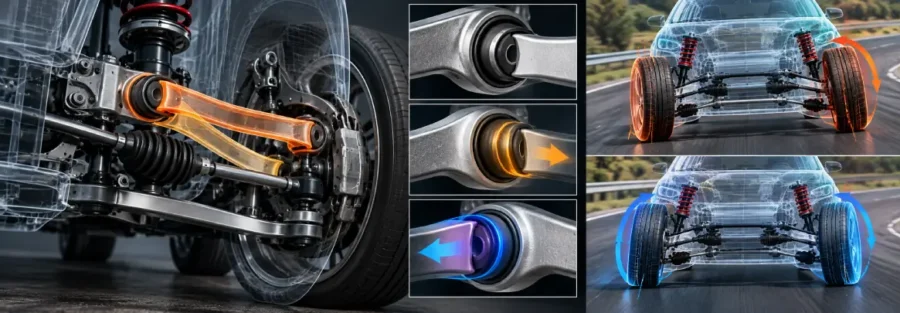
Vehicle handling is influenced by much more than suspension geometry, spring rates, dampers, and tire characteristics. Under real driving conditions, suspension components and their mounting points also deform when they are subjected to braking, cornering, acceleration, and road inputs. One important consequence of this deformation is compliance steer, where suspension deflection produces an unintended change in wheel alignment and alters the vehicle’s steering response.
Suspension bushings are particularly important because they are designed to provide controlled flexibility between suspension components and the vehicle body. Their stiffness and directional compliance directly influence how much a suspension member moves under load. Even relatively small bushing deflections can produce measurable changes in toe, camber, and wheel steer angle.
For engineers developing or refining a vehicle suspension, understanding this relationship is essential. Compliance steer analysis helps identify how bushing characteristics affect vehicle behavior and provides a way to optimize suspension compliance before extensive physical testing.
What Is Compliance Steer?
Compliance steer is the change in wheel steer angle caused by deformation of suspension components, bushings, mounts, and other flexible elements when external forces are applied.
Unlike kinematic steering, which results from the intended movement of suspension geometry, compliance steer is produced by elastic deformation under load.
For example, during cornering, lateral forces act through the tire contact patch and are transferred through the wheel hub, suspension links, bushings, and vehicle body. If a bushing deflects under this load, the position of the suspension link can change slightly. This changes the effective wheel alignment and may introduce an additional toe angle.
The resulting wheel steer can either support or oppose the driver’s steering input, depending on the suspension architecture, bushing characteristics, and direction of deformation.
This is why two vehicles with similar suspension geometry can exhibit different handling characteristics when their bushing stiffness and compliance properties are different.
Why Suspension Bushings Matter to Vehicle Handling
Bushings are not simply isolation components. Their mechanical characteristics form part of the suspension system’s overall compliance.
A typical suspension bushing can experience different levels of stiffness in radial, axial, and torsional directions. The relationship between force and displacement can also be nonlinear, particularly when the bushing experiences large deformation.
During braking, for example, longitudinal forces can cause a control arm or other suspension member to move relative to the body. During cornering, lateral forces can produce a different deformation pattern. Combined braking and cornering can create an even more complex response.
These movements can change:
- Wheel toe angle
- Camber angle
- Caster characteristics
- Wheel center position
- Steering response
- Understeer or oversteer behavior
The magnitude and direction of these changes depend on the suspension geometry, bushing locations, bushing stiffness, applied loads, and structural flexibility of the surrounding components.
How Bushing Deflection Changes Wheel Alignment
Consider a suspension link connected to the vehicle body through a compliant bushing. When an external force acts on the wheel, the link does not necessarily remain in its nominal position.
Instead, the bushing may deform and allow the link to move.
That movement changes the position and orientation of the suspension member. Because the suspension links control the wheel’s position, even a small link displacement can produce a measurable toe or camber change.
Toe change is particularly important for compliance steer.
A toe change toward toe-in or toe-out can introduce a steering effect that changes the vehicle’s response to lateral or longitudinal loading. The effect can be desirable if intentionally designed into the suspension, or undesirable if it produces inconsistent or excessive steering behavior.
This makes bushing stiffness an important suspension design variable rather than simply a component-level specification.
Compliance Steer and Steering Response
The effect of compliance steer becomes most noticeable when the vehicle is subjected to significant lateral or longitudinal loads.
During cornering, lateral tire forces are transmitted into the suspension. If the suspension develops a compliance-induced steer angle, the wheel can effectively steer further into or away from the corner.
This can influence the vehicle’s transient response and steady-state handling characteristics.
During braking, longitudinal forces can also create compliance steer. Depending on the suspension layout, the resulting toe change can influence directional stability and steering feel.
The important point is that the driver’s steering input is not the only factor determining the actual wheel steer angle. Suspension deformation under load can contribute to the final wheel orientation.
How Engineers Analyze Compliance Steer
Compliance steer analysis typically combines suspension kinematics, component stiffness, bushing characteristics, and applied wheel loads.
A common engineering workflow starts by defining the suspension geometry and identifying the forces and moments that act at the wheel center. The model then represents the relevant suspension components and their compliance characteristics.
Kinematics and Compliance, or K&C analysis, is commonly used to evaluate suspension behavior under controlled loading conditions. Multi-body dynamics models can then be used to investigate how those characteristics influence vehicle-level handling.
The analysis may include:
- Lateral wheel loads
- Longitudinal braking and acceleration loads
- Vertical wheel loads
- Combined force cases
- Steering inputs
- Suspension travel
- Bushing force-deflection characteristics
The objective is not simply to calculate bushing displacement. Engineers need to understand how that displacement propagates through the suspension and ultimately changes wheel alignment.
Using MBD to Evaluate Bushing Effects
Multi-body dynamics provides a useful framework for studying the interaction between suspension geometry and compliance.
An MBD model can represent suspension links, joints, bushings, springs, dampers, tires, and other relevant components. Bushing properties can be introduced as directional force-deflection relationships rather than treating the bushing as a perfectly rigid connection.
Engineers can then apply representative loading conditions and evaluate the resulting wheel center motion and alignment changes.
This makes it possible to compare different bushing designs without immediately producing physical prototypes.
For example, an engineer may evaluate whether increasing longitudinal bushing stiffness reduces an unwanted toe change during braking. The same study can investigate whether that stiffness increase creates an undesirable change in ride isolation or another suspension response.
This is where compliance analysis becomes an optimization problem rather than a simple stiffness calculation.
Worked Example: Effect of Bushing Deflection on Toe Change
Consider a simplified suspension example in which a lateral suspension load produces movement at a control-arm bushing.
Assume a hypothetical bushing experiences a lateral load of 4,000 N and has an effective lateral stiffness of 80 N/mm.
The approximate bushing deflection can be estimated as:
Deflection = Force / Stiffness
Deflection = 4,000 / 80 = 50 mm
This value is intentionally illustrative and represents a simplified linear calculation. A production bushing would normally have a measured or modeled nonlinear force-deflection characteristic, and the actual suspension link movement would not necessarily equal the bushing displacement directly.
Now assume the suspension geometry converts a portion of this movement into a small wheel toe change. For illustration, suppose the resulting toe change is 0.15 degrees.
The important engineering relationship is therefore:
Wheel load → bushing force → bushing deflection → suspension link movement → toe change → compliance steer
The 0.15-degree value should not be treated as a design target or acceptable limit. It is only an example of how an MBD or K&C study can connect bushing behavior to wheel alignment.
In an actual engineering program, the bushing force-deflection data, suspension geometry, component stiffness, load cases, and wheel-center response would be derived from the specific vehicle architecture and validated against physical measurements.
How Compliance Steer Can Influence Understeer
Compliance steer can also contribute to the vehicle’s overall understeer or oversteer characteristics.
If the front and rear suspensions develop different compliance-induced steer responses under lateral loading, the effective handling balance of the vehicle can change.
For example, a suspension configuration that produces additional steer at one axle may alter the relationship between lateral acceleration and steering demand. The resulting effect depends on the direction of the compliance steer and the contribution from the other suspension, tires, steering system, and vehicle dynamics.
This is why bushing optimization should not be performed in isolation.
Increasing bushing stiffness may reduce one unwanted compliance movement, but it can also affect ride isolation, noise and vibration characteristics, durability loads, and other suspension responses.
A vehicle-level simulation approach allows these interactions to be evaluated together.
Combining FEA, K&C, and MBD Analysis
Compliance steer analysis becomes more effective when component-level and vehicle-level engineering methods are connected.
FEA can be used to evaluate structural stiffness and deformation in control arms, brackets, knuckles, mounts, and other suspension components. Bushing models can provide force-deflection characteristics that are then incorporated into K&C or MBD simulations.
The resulting vehicle-level model can evaluate how these component properties affect suspension behavior under realistic loading.
A typical workflow can therefore be structured as:
Component FEA → bushing characterization → K&C analysis → MBD vehicle simulation → handling assessment → design optimization
This approach helps engineers determine whether an observed compliance issue originates from bushing properties, suspension geometry, structural flexibility, or an interaction between multiple components.
Common Challenges in Compliance Steer Analysis
One of the biggest challenges is using simplified bushing properties that do not represent actual operating behavior. Real bushings can exhibit nonlinear stiffness, preload effects, hysteresis, temperature sensitivity, and directional behavior.
Another challenge is evaluating only isolated loading conditions. Real vehicles frequently experience combined braking, cornering, vertical, and steering loads. A bushing that performs well under one load direction may behave differently under combined loading.
Model correlation is equally important. Simulation results should be compared with K&C measurements, component tests, or vehicle-level testing where appropriate.
Without correlation, a detailed model can still produce misleading conclusions if the underlying stiffness and force-deflection characteristics are inaccurate.
Optimizing Suspension Compliance for Better Vehicle Behavior
The objective of compliance steer analysis is not necessarily to make every suspension component as stiff as possible. Instead, engineers need to determine where compliance is beneficial and where it creates unwanted wheel movement.
An effective design balances handling response, steering feel, ride characteristics, durability, NVH, packaging, and manufacturing requirements.
Caliber Technologies can apply simulation-driven engineering methods to investigate suspension compliance, bushing behavior, wheel alignment changes, and vehicle dynamics. By combining MBD, K&C analysis, FEA, and optimization techniques, engineering teams can evaluate suspension concepts earlier in the development process and identify the component-level changes that have the greatest effect on vehicle behavior.
Conclusion
Compliance steer is a suspension behavior that can have a meaningful influence on steering response and vehicle handling. Although bushing deflections may appear small at the component level, their effect can propagate through the suspension geometry and produce measurable changes in wheel alignment.
For this reason, suspension development should consider compliance alongside conventional kinematic analysis. Combining bushing characterization, FEA, K&C analysis, and MBD simulation gives engineers a clearer understanding of how suspension components behave under realistic loading conditions.
The result is a more controlled approach to suspension optimization, where bushing stiffness and compliance are evaluated based on their actual influence on wheel movement, steering response, and vehicle-level handling.
Frequently Asked Questions
What is compliance steer in a vehicle?
Compliance steer is the change in wheel steering angle caused by deformation of suspension components, bushings, mounts, or related structures when the suspension is subjected to external loads.
How does bushing deflection affect steering response?
Bushing deflection can move suspension links and change wheel alignment, particularly toe angle. This creates an additional steering effect that can influence vehicle response during braking, cornering, and acceleration.
What is K&C analysis?
K&C, or Kinematics and Compliance analysis, evaluates how suspension geometry and compliance respond to controlled wheel forces and moments. It can be used to study toe, camber, wheel-center movement, and compliance steer.
How is compliance steer analyzed using MBD?
MBD models can represent suspension geometry, joints, bushings, springs, dampers, and loads. Engineers can apply representative wheel forces and evaluate the resulting suspension movement and wheel alignment changes.
Does increasing bushing stiffness always improve handling?
No. Increasing stiffness can reduce certain compliance movements, but it can also affect ride isolation, NVH, durability, and other vehicle characteristics. Bushing stiffness should therefore be optimized as part of the complete suspension system.
How can engineers validate a compliance steer simulation?
Simulation results can be correlated with K&C testing, component-level measurements, suspension rig tests, and vehicle-level testing. Correlation helps verify whether the modeled stiffness and suspension response represent actual vehicle behavior.