Introduction and Background
The modern recreational vehicle (RV) and motorhome industry relies extensively on commercial off-the-shelf (COTS) truck and van chassis platforms supplied by major OEMs such as Ford, General Motors, and Stellantis (Ram). Popular base platforms include the
- Ford Transit, E-Series 350/450/550/600,
- Ram ProMaster and Ram 3500–5500 cab chassis, and
- GM Chevrolet Express, Silverado 3500HD through 6500HD lineups.
These platforms provide certified powertrain, braking, steering, and baseline chassis performance, enabling RV manufacturers to accelerate product development while leveraging proven OEM architectures.

However, RV upfitting fundamentally alters the structural load environment of the base chassis. Unlike the original commercial duty cycles—parcel delivery, utility service, or flatbed hauling—motorhomes introduce large cantilevered bodies, high roof structures, slide-outs, rear overhang extensions, and highly variable mass distributions. In many cases, the original ladder frame rails are cut, spliced, extended, or reinforced to accommodate longer wheelbases, increased rear overhangs, auxiliary axles, or body mounting interfaces.
These modifications significantly change the bending, torsional, and fatigue loading of the frame system. Without rigorous structural re-validation, the modified chassis may experience excessive deflection, long-term fatigue cracking, joint failures, or progressive sag, directly impacting durability, handling, ride quality, and ultimately safety. As RV platforms continue to grow in size, complexity, and GVWR, the need for simulation-driven structural integrity assessment has become critical.
Engineering Challenges and Current State of the Industry
a) Weight Distribution and Overload Risk
RV applications are characterized by high static payloads, asymmetric mass distributions, and large longitudinal CG shifts due to water tanks, slide-outs, rear garages, generators, and rooftop equipment. Variants across floorplans can produce axle loads that deviate significantly from OEM design intent.
Overloaded rear axles and locally overstressed frame sections lead to:
- Increased rail bending stress and web crippling
- Excessive rear overhang deflection
- Elevated fatigue damage at suspension hangers, crossmember joints, and splice regions
- Warranty exposure and regulatory non-compliance
From a safety standpoint, chronic overload degrades braking performance, handling stability, tire life, and structural margin, exposing both the RV manufacturer and end user to substantial risk.
b) Frame Modification Without Structural Re-Qualification
A widespread industry practice involves – Cutting OEM rails and inserting frame extensions, adding drop-downs or kick-ups for body packaging, welding or bolting aftermarket reinforcements, relocating or adding crossmembers and outriggers. These operations are often performed using rule-of-thumb section sizing, without re-establishing: Global bending stiffness, Torsional rigidity, Fatigue life of splice joints and heat-affected zones
Such modifications introduce:
- Stress concentrations at weld toes and bolt holes
- Reduced buckling capacity due to section thinning or cutouts
- Local flexibility leading to body-to-frame relative motion
Field issues commonly observed include:
- Longitudinal cracking at rail flanges
- Progressive mid-span sag
- Crossmember joint separation
- Fifth-wheel and rear hitch mount failures
- Rear hitch assessment due to medication to the base frame and addition of subframe.
c) Limited Use of Advanced Structural Simulation
While automotive OEMs routinely apply full-vehicle FE durability frameworks, the RV industry still relies heavily on:
- Empirical reinforcements
- Late-stage physical testing
- Field feedback after launch
This reactive approach results in:
- Expensive tooling and redesign loops
- Delayed programs
- Brand damage from visible structural failures
Objective of the Project
The primary objective of the Caliber Technologies program is to establish a simulation-driven structural validation framework specifically tailored for modified RV and motorhome chassis architectures, enabling:
- Verification of global bending and torsional stiffness after frame modifications
- Accurate prediction of fatigue life under RV-specific duty cycles
- Assessment of overload robustness and abuse scenarios
- Optimization of reinforcement strategies for minimum weight and maximum durability
- Front-loaded risk elimination prior to first prototype build
The program aims to ensure that:
- All modified chassis meet long-term durability targets
- Structural margins remain compliant under worst-case loading
- Quality risks such as cracking, permanent set, and sag are eliminated
- Brand perception is protected through structurally robust platforms
Key Steps by Caliber Technologies
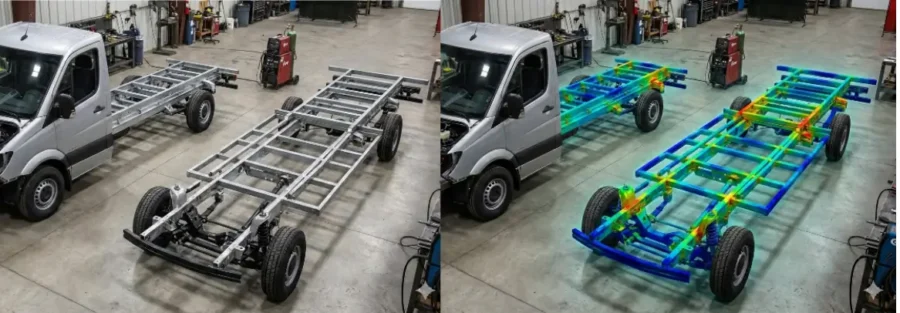
Caliber Technologies applies a multi-fidelity, simulation-first methodology integrating global frame behavior, local joint durability, and RV-specific load environments.
a) Platform Digitization and Baseline Characterization
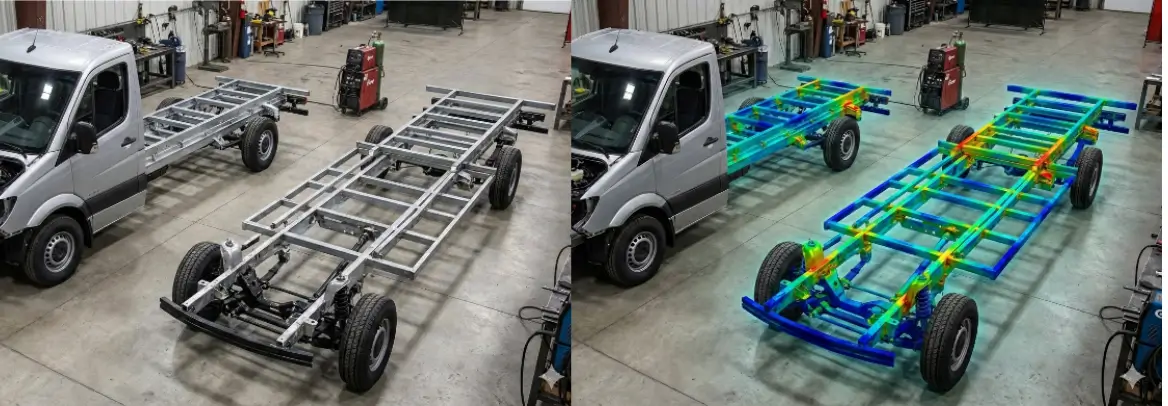
- Creation of high-fidelity ladder frame FE models from OEM CAD or reverse-engineered geometry
- Validation of baseline stiffness, modal behavior, and load paths
- Characterization of OEM joint architectures (rivets, bolts, welds)
b) RV-Specific Load Case Development
Caliber has developed proprietary in-house load cases reflecting real motorhome usage, including:
- Static bending at maximum GVWR and rear axle overload
- Torsion from diagonal wheel articulation and campsite leveling
- Longitudinal bending from rear overhang cantilever effects
- Abuse cases: curb strikes, jack loading, uneven support
These load cases capture variant-to-variant mass distribution effects, ensuring robustness across floorplans and option packages.
c) Global Strength, Stiffness, and Stability Assessment
- Evaluation of:
- Maximum Von Mises stress vs yield
- Rail deflection and permanent set risk
- Torsional rigidity degradation
- Buckling margins in extended sections
This phase ensures global structural adequacy and compliance with stiffness targets for ride, handling, and body integrity.
d) Local Joint and Fatigue Durability Analysis
Critical regions such as:
- Frame splices
- Suspension hanger attachments
- Crossmember joints
- Body mount brackets
are submodeled using refined meshes to evaluate:
- Stress concentration factors
- Weld toe stresses and fatigue class
- Bolt preload and slip margins
- Miner’s damage accumulation using RV duty cycles
Fatigue life predictions are correlated to multi-million-mile equivalent durability targets.
e) Design Optimization and Virtual Validation
- Optimization of reinforcement thickness, length, and placement
- Trade studies between weight, stiffness, and fatigue life
- Virtual validation prior to prototype tooling
- Reduction of physical test iterations and late design changes
Conclusion
The widespread use of prebuilt Ford, GM, and Ram commercial chassis has enabled rapid growth in the RV and motorhome industry. However, the structural consequences of extensive frame modification, high rear overhangs, and variable weight distributions present significant durability, quality, and safety risks when not rigorously re-engineered.
Frame cracking, bending, and long-term sag not only generate warranty exposure but also severely damage brand perception in a highly reputation-driven market. Traditional reactive testing approaches are no longer sufficient for increasingly large and complex RV platforms.
Caliber Technologies provides a state-of-the-art structural simulation framework purpose-built for RV and motorhome chassis integration. By implementing RV-specific load cases, advanced fatigue modeling, and virtual validation upfront, Caliber enables manufacturers to:
- Eliminate structural risks before first prototype
- Achieve durable, lightweight, and robust frame systems
- Protect safety, quality, and long-term brand equity
In an industry where structural integrity directly defines customer confidence, simulation-driven engineering is no longer optional—it is foundational. Let’s build something great together operations@thecalibertech.com.